The complete classic fairytale in verse (with a few prose interludes including at the beginning). It’s thematically like The Ugly Duckling, but with a grand adventure.
আয় রে আমার নাতি-পুতি, আমি তোদের সেই আদিকালের ঠাকুরমা। aj re amar nat̪i-put̪i, ami t̪od̪er ʃei ad̪:i-kaler ʈʰakurma Gather around, grandkids, I am your ancient grandma.
আমার এই ঝুলি ভরা কত গল্প, কত ছড়া, শুনবি তোরা? amar ei dʒʱuli bʱɔra kɔto gɔlpo, kɔto tʃʰɔɽa, ʃunbi t̪ora? My bag is full of many stories, many rhymes, want to hear?
তবে ঝুলি খুলি— এই ঝুলি নড়ছে, এই ঝুলি নড়ছে, এই ঝুলি নড়ছে… t̪ɔbe dʒʱuli kʰuli– ei dʒʱuli noɽtʃʰe, ei dʒʱuli noɽtʃʰe, ei dʒʱuli noɽtʃʰe… Then let me open it– The bag moves, moves, moves…
সপ্তদ্বীপের রাজামশাই, সাতটি রানী তাঁর, ʃɔpt̪od̪iper radʒamɔʃai, ʃat̪ʈi rani t̪ãr, Mr. King of seven islands, he has seven queens,
পাঁচটি রানীর কোলে এল পাঁচটি রাজকুমার। pãtʃʈi ranir kole elo pãtʃʈi radʒkumar. to the laps of five queens came five princes.
হীরা রাজকুমার, মানিক রাজকুমার, মতি রাজকুমার, শঙ্খ রাজকুমার, আর কাঞ্চন রাজকুমার। hira radʒkumar, manik radʒkumar, mot̪i radʒkumar, ʃɔŋkʰo radʒkumar, ar kantʃon radʒkumar. Prince Diamond, Prince Gemstone, Prince Pearl, Prince Conch Shell, and Prince Gold.
পাঁচটি রানীর পাঁচটি কুমার, রইল বাকি দুই, pãtʃʈi ranir pãtʃʈi kumar, roilo baki d̪ui, Five queens have five sons, two remain,
মনের দুঃখে সে দুই রানী পড়ে থাকেন ভুঁই। mɔner d̪uk:ʰe ʃe d̪ui rani poɽe t̪ʰaken bʱũi. those two queens lie prone on the dust in sorrow.
পাঁচ কুমারের পরে রাজার হয়েছিল কি, একটি বাঁদর, একটি প্যাঁচা— ছিঃ ছিঃ ছিঃ ছিঃ ছিঃ! pãtʃ kumarer pɔre radʒar hojetʃʰilo ki, ekʈi bãd̪or, ekʈi pæ̃tʃa– tʃʰi tʃʰi tʃʰi tʃʰi tʃʰi! After five princes, what did the king beget? A monkey and an owl– Ew! Yuck!
মানুষেরো পেটে নাকি বাঁদর-প্যাঁচা হয়? manuʃero peʈe naki bãd̪or-pæ̃tʃa hɔj? Can humans even sire monkeys and owls?
বুদ্ধু-ভুতুম নামে তাদের হলো পরিচয়। bud̪:ʱu-bʱut̪um name t̪ad̪er holo poritʃɔj. They were named Goofy and Fright.
তখন রাজা দুই রানীকে দিলেন নির্বাসন, t̪ɔkʰon radʒa d̪ui ranike d̪ilen nirbaʃon, Then the king exiled two queens,
পাঁচটি রানী হলো রাজার পরম আপন। pãtʃʈi rani holo radʒar pɔrom apon. the five queens became the king’s closest.
ছোট রানী কাঠকুড়ানি, tʃʰoʈo rani kaʈʰkuɽani, The youngest queen is a wood collector,
অন্যে কুড়োয় ঘুঁটে, on:e kuɽoj ɡʱũʈe, the other collects dung,
বুদ্ধু-ভুতুম চেয়ে থাকে গাছের ডালে উঠে। bud̪:ʱu-bʱut̪um tʃeje t̪ʰake gatʃʰer ɖale uʈʰe. Goofy and Fright watch them from the branches.
পাঁচ কুমারে ঘোড়ায় চড়ে চলে অভিযানে, pãtʃ kumare ɡʱoɽaj tʃoɽe tʃɔle obʱidʒane, Five princes go on adventures riding horses,
বুদ্ধু-ভুতুম চেয়ে থাকে পাঁচটি দাদার পানে। bud̪:ʱu-bʱut̪um tʃeje t̪ʰake pãtʃʈi d̪ad̪ar pane. Goofy and Fright stare after five elder brothers.
Goofy’s mother:
আয় রে আমার সোনা মানিক, aj re amar ʃona manik, Come to me, my gold, my gem,
আয় রে আমার বুদ্ধু। aj re amar bud̪:ʱu. come, my Goofy.
Goofy:
থাকলে পঙ্খী উড়ে যেতুম নিয়ে তোমায় শুদ্ধু। t̪ʰakle poŋkʰi uɽe dʒet̪um nije tomaj ʃud̪:ʱu. Had I a wing, I would have flown away with you.
Fight’s mother:
আয় রে আমার বুকেরও ধন, aj re amar buker(o) d̪ʱɔn, Come, my heart’s treasure,
আয় রে আমার ভুতুম। aj re amar bʱut̪um. Come, my Fright.
Fright:
থাকতো যদি ময়ূরপঙ্খী, দূর বিদেশে যেতুম। t̪ʰakt̪o dʒod̪i mojurpoŋkʰi, d̪ur bid̪eʃe dʒet̪um. Had I a Peacock’s Wing, I’d have left for faraway lands.
Goofy and Fight:
বাঁদর প্যাঁচা বলে সবাই কেন দেয় মা গালি? bãd̪or pæ̃tʃa bole ʃɔbai kæno d̪æj ma gali? Mother, why do they call us monkey and owl?
Their mothers:
হোক না বাঁদর, হোক না প্যাঁচা, মায়েরই দুলাল রে। hok na bãd̪or, hok na pæ̃tʃa, majeri d̪ulal re. You may be a monkey, you may be an owl, mother adores you.
এই তো তোদের দুঃখিনী মা নিলা তোদের কোলে, ei t̪o t̪od̪er d̪ukʰini ma nilo t̪oder kole, See how your sorrowful mother takes you into her lap,
ময়ূরপঙ্খী পক্ষীরাজ এই কোলেতেই দোলে। mojurpoŋkʰi pok:ʰradʒ ei kolet̪ei d̪ole. Peacock’s Wing and King of Birds sway here.
Note: King of Birds is a winged horse like Pegasus.
Goofy and Fright:
— আমাদের বাবা কোথায়? amad̪er baba kot̪ʰaj? Where is our father?
— কেন, ওই রাজামশাই! kæno, oi radʒamɔʃai! Why, that Mr. King!
— কেন তুমি কাঠকুড়ুনি, চুলে কেন নেই চিরুনি? kæno t̪umi kaʈʰkuɽuni, tʃule kæno nei tʃiruni? Why are you a wood collector, why no comb in your hair?
কেন তুমি ঘুঁটে কুড়াও, প্রাসাদে কেন না যাও? kæno t̪umi ɡʱũʈe kuɽao, praʃad̪e kæno na dʒao? Why do you collect dung, why not go to the palace?
— আমরা দুটি ভাই, আমরা দুটি ভাই, চলো আমরা দুজন মিলে বাবার কাছে যাই। amra d̪uʈi bʱai, amra d̪uʈi bʱai, tʃɔlo amra d̪udʒɔn mile babar katʃʰe dʒai. We’re two bros, we’re two bros, come on, let us go to our father together.
Courtiers:
ওরে ওরে আয় না! ore ore aj na! Hey, hey, come here!
একটা বাঁদর দোরে এসেছে ækʈa bãd̪or d̪ore eʃetʃʰe A monkey has come to the door
কি মজার বায়না! ki mɔdʒar bajna! What an absurd demand!
ওরে ওরে আয় না! ore ore aj na! Hey, hey, come here!
ওই প্যাঁচাটার মুখের কাছে ধর দেখি এক আয়না! oi pæ̃tʃaʈar mukʰer katʃʰe d̪ʱɔr d̪ekʰi æk ajna! Hold a mirror before that owl!
ওরে ওরে আয়না! ore ore aj na! Hey, hey, come here!
Court ladies:
— এটা দেখি বাঁদরছানা, ঘুঁটেকুড়ুনির ছা! eʈa d̪ekʰi bãd̪ortʃʰana, ɡʱũʈekuɽunir tʃʰa! This I see is monkey boy, dung collector’s brat!
ও মা ও মা ছি ছি ছি ছি, যা যা যা যা যা! o ma o ma tʃʰi tʃʰi tʃʰi tʃʰi, dʒa dʒa dʒa dʒa dʒa! Ew, ew, yuck, yuck! Get lost!
Narrator:
একদিন হয়েছে কি— ækd̪in hojetʃʰe ki– One day, it so happened–
রেখে সোনার খাটে পা, rekʰe ʃonar kʰaʈe pa, Foot resting on golden stool,
আর রূপার খাটে গা, ar rupar kʰaʈe ga, body leaning on a silver bed,
সিঁথিপাটি করতেছিল পাঁচটি রানীরা। ʃĩt̪ʰipaʈi kort̪etʃʰilo pãtʃʈi ranira. the queens were doing their hair.
দাসী এসে খবর দিল— d̪aʃi eʃe kʰɔbor d̪ilo– A slave girl gives the news–
Slave girl:
— ওগো রানী মা! ogo rani ma! Oh queen mother!
ঘাটেতে লেগেছে এক শুকপঙ্খী নাও! ɡʱaʈet̪e legetʃʰe æk ʃukpoŋkʰi nao! There has come to the ghat a Sukh’s Wing boat!
নায়ে আছে হীরার হাল, naje atʃʰe hirar hal, The boat has a diamond helm,
মোতির ফুল, মোতির ফুল আছে বহুদূর, mot̪ir pʰul, mot̪ir pʰul atʃʰe bohud̪ur, Fashioned pearl, fashioned pearl is far away
যেতে কি পারবে কুমার কলাবতীর পুর? dʒet̪e ki parbe kumar kɔlabot̪ir pur? Can the youth reach Kɔlaboti Kingdom?
হাটের সওদা ঢোল-ডগরে, গাছের পাতি ফল, নকশী কাঁথার মাঠ পেরিয়ে রাঙা নদীর জল। haʈer ʃɔod̪a ɖʱol-ɖɔgore, gatʃʰer pat̪i pʰɔl, nokʃi kãt̪ʰar maʈʰ perije raŋa nod̪ir dʒɔl. In the market’s trade and drums, tree with lime fruit, past Embroidered Quilt Meadow, Red River water.
Note: Directions to reach Kɔlaboti Kingdom? Some of these things do turn up later in surreal contexts.
Five queens:
কোন দেশেরও কন্যা তুমি, যাও গো বলিয়া, kon d̪eʃer(o) kon:a t̪umi, dʒao go bolija, Tell us which country you are from, maiden,
সোনার চাঁদ ছেলে আমার, করো যদি বিয়া। ʃonar tʃãd̪tʃʰele amar, kɔro dʒod̪i bija. if thou marry my gold-moon son…
Note: “Gold-moon” is idiomatic and used in common speech to refer to kids.
Enchanted princess:
কলাবতী কন্যা আমি, kɔlabot̪i kon:a ami, Princess Kɔlaboti am I,
তোমার পুত্র পাঠাও যদি কলাবতীর দেশ। t̪omar put̪ro paʈʰao dʒod̪i kɔlabot̪ir d̪eʃ. if thou sendest thy son to Kɔlaboti Kingdom.
আনতে পারে মোতির ফুল, ant̪e pare mot̪ir pʰul, If he bringeth the fashioned pearl,
ঢোল-ডগরখানি, ɖʱol-ɖɔgorkʰani, and the wedding drums,
আসবো তোমার ঘরে হয়ে সেই পুত্রের রানী, হয়ে সেই পুত্রের রানী, হয়ে সেই পুত্রের রানী… aʃbo t̪omar ɡʱɔre hoje ʃei put̪rer rani, hoje ʃei put̪rer rani, hoje ʃei put̪rer rani… I shall enter thy home as that son’s queen, as that son’s queen…
Narrator:
তাই শুনে পাঁচ রানী বলেন— ময়ূরপঙ্খী চাই! t̪ai ʃune pãtʃ rani bɔlen– mojurpoŋkʰi tʃai! Hearing this, five queens say– give us Peacock’s Wing!
পাঁচটি ময়ূরপঙ্খী এনে দিলেন রাজামশাই। pãtʃʈi mojurpoŋkʰi ene d̪ilen radʒamɔʃai. Mr. King brought them five Peacock’s Wings.
তাই না দেখে ভাঙা ঘরে, বুদ্ধু-ভুতুম বায়না ধরে, t̪ai na d̪ekʰe bʱaŋa ɡʱɔre, bud̪:ʱu-bʱut̪um bajna d̪ʱɔre, Seeing this, in their broken house, Goofy and Fright throw a tantrum,
কলাবতীর দেশে যাবে, ময়ূরপঙ্খী কোথায় পাবে? kɔlabot̪ir d̪eʃe dʒabe, mojurpoŋkʰi kot̪ʰai pabe? They will go to Kɔlaboti Kingdom, where will they get a Peacock’s Wing?
দুই সুপুরির ডোঙায় দিয়ে ধান-দূর্বা-পান, d̪ui ʃupurir ɖoŋaj d̪ije d̪ʱan-d̪urba-pan, A raft of two areca palms, held together with straw, grass and betel leaf,
সিঁদুরফোঁটা, কড়ি দিয়ে দুই মায়ে সাজান। ʃĩd̪urpʰõʈa, koɽi d̪ije d̪ui maje ʃadʒan. with a vermillion drop and cowrie shells, two mothers adorn.
সেই ডোঙাতে বুদ্ধু-ভুতুম চড়ল অবশেষে, ʃei ɖoŋat̪e bud̪:ʱu-bʱut̪um tʃoɽlo ɔboʃeʃe, In that raft, Goofy and Fright depart at last,
দুই মায়ে কাঁদিয়ে চলে কলাবতীর দেশে। d̪ui maje kãd̪ije tʃɔle kɔlabot̪ir d̪eʃe. Making two mothers cry, they go to Kɔlaboti Kingdom.
Two mothers cry:
বুদ্ধু আমার বাপ, কি করেছি পাপ! bud̪:ʱu amar bap, ki koretʃi pap! Goofy my child, what is my sin?
কোন্ পাপেতে দূরে গেলি, দিয়ে মনস্তাপ? kon papet̪e d̪ure geli, d̪ije mɔnost̪ap? For what sin do you leave me in such anguish?
ভুতুম আমার বাপ, কি করেছি পাপ! bʱut̪um amar bap, ki koretʃi pap! Fright my child, what is my sin?
কেন আমায় রেখে গেলি, দিয়ে মনস্তাপ? kæno amaj rekʰe geli, d̪ije mɔnost̪ap? For what sin do you leave me in such anguish?
পৃথিবীতে যেখানে যে আছো ভগবান, prit̪ʰibit̪e dʒekʰane dʒe atʃʰo bʱɔgoban, In the world, whatever god there may be,
মোদের বাছার তরে দিলাম এই দূর্বা-ধান। mod̪er batʃʰar t̪ɔre d̪ilam ei d̪urba-d̪ʱan. for my child, I offer this grass and straw.
Narrator:
পাঁচ কুমারের ময়ূরপঙ্খী আগেতে চলিছে, pãtʃ kumarer mojurpoŋkʰi aget̪e tʃolitʃʰe, Peacock’s Wings of five princes sail ahead,
বুদ্ধু-ভুতুমের ডোঙা চলে পিছে পিছে। bud̪:ʱu-bʱut̪umer ɖoŋa tʃɔe pitʃʰe pitʃʰe. Goofy and Fright’s raft follow behind.
যুক্তি করে সবাই মিলে এই বেলা পাঁচ ভাই, এসো বুদ্ধু-ভুতুমের ডোঙা সাগরে ডুবাই। dʒukt̪i kɔre ʃɔbai mile ei bæla pãtʃbʱai, eʃo bud̪:ʱu-bʱut̪umer ɖoŋa ʃagore ɖubai. Taking counsel, five brothers say: Let us sink Goofy and Fright’s raft beneath the ocean.
যেই না বলা, নীল দরিয়ায় উঠল কি তুফান! dʒei na bɔla, nil d̪orijaj uʈʰlo ki t̪ufan! As soon as said, in the blue deep there rises a typhoon!
কে বাঁচাবে বুদ্ধু ভাই? কোথায় গেল ভুতুম ভাই? কে বাঁচাবে বুদ্ধু ভাই? কোথায় গেল ভুতুম ভাই? ke bãtʃabe bud̪:ʱu bʱai? kot̪ʰaj gælo bʱut̪um bʱai? ke bãtʃabe bud̪:ʱu bʱai? kot̪ʰaj gælo bʱut̪um bʱai? Who will save us, Brother Goofy? Where is Brother Fright? Who will save us, Brother Goofy bhai? Where is Brother Fright?
— মনটা করে কেমন কেমন! যেমন কর্ম শাস্তি তেমন! mɔnʈa kɔre kæmon kæmon! dʒæmon kɔrmo ʃast̪i t̪æmon! I feel as if, as if the punishment fits the crime!
Fright:
— অমন কথা বলে নাকি! এসো তো ডুব দিয়ে দেখি, এসো তো ডুব দিয়ে দেখি। ɔmon kɔt̪ʰa bɔle naki! eʃo t̪o ɖub d̪ije d̪ekʰi. eʃo t̪o ɖub d̪ije d̪ekʰi. Don’t say that! Let’s dive in and see. Let’s dive in and see.
Narrator:
থম থম থম পাতালপুরী, কেউ কোথাও নেই। t̪ʰɔm t̪ʰɔm t̪ʰɔm pat̪alpuri, keu kot̪ʰao nei. Thɔm thɔm thɔm… City of the undergloom! No one around.
Note: Thɔm is sound symbolism for stillness.
কাঁথা সেলাই করছে বুড়ি সেই পাতালেতেই। kãt̪ʰa ʃelai kortʃʰe buɽi ʃei pat̪alet̪ei. An old woman embroiders a quilt in the undergloom.
বুদ্ধুকে সে দেখতে পেয়ে কাঁথা ছুঁড়ে দিল, Seeing Goofy, she tosses the quilt at him,
অমনি হাজার সিপাহী ধেয়ে বুদ্ধুকে বাঁধিল। Immediately, a thousand soldiers tie him up.
বুদ্ধু তখন নড়ে না, Goofy doesn’t move,
চোখ মিটমিট করে না, doesn’t wink an eye,
মরার মতো পড়ে থাকে আঁধার পাতালপুরে। like the dead, he lies there in the city of the undergloom.
মরা ভেবে সবাই তাকে ফেলে দিল দূরে। Thinking he’s dead, they throw him far away.
যেই না ফেলা, As soon as they leave,
বুদ্ধু তখন মিটিমিটি চোখে Goofy, winking his eye,
সাত মহলার রাজপুরীতে চুপিচুপি ঢোকে। sneaks into the seven-halled royal palace
কুঁচবরণ কন্যা যেথায় where the bead-bright maiden
সোনার শুকের সাথে is with her golden Sukh bird,
কি কথা কয় চুপি সারে সেখানে কান পাতে। he eavesdrops on their conversation:
সোনার পাখি শুক রে, Golden bird Sukh,
গেল না মোর দুখ রে, I languish in sorrow,
রূপার বৈঠা হীরার হাল silver oar and diamond helm
রইল পড়ে চিরকাল, were of no use,
কেউ না এলো রাজার কুমার, there came no royal prince
কি হলো বল শুক আমার? What happened, oh Sukh?
— রাজকন্যার এলো চুল, মাথায় ছিল মোতির ফুল In the royal maiden’s flowing hair, there was a fashioned pearl
দেখ তো ফুল আছে নাকি Take a look, is the flower still there?
কে নিয়েছে বল, দেখি? কে নিয়েছে বল, দেখি? কে নিয়েছে বল! Can you say who took it? Can you say who took it? Can you say who took it?
— কে নিয়েছে বলো না, কেন করো ছলনা? Tell me who took it. Why dost thou deceive me?
— মনের ভুল নয় গো তোর, ওই যে পিছে এসেছে তোর বর! If mine eyes don’t deceive me, there behind you is your bridegroom!
— ও মা! ও মা কোথায় বর? Oh mother, what bridegroom?
এ যে দেখি এক বাঁদর! I see here a monkey!
কি দেখেছি সকালে, এই ছিল কি কপালে! What did I see this morning that this was my fate!
— কলাবতী রাজকন্যা, এখন তুমি কার? Princess Kɔlaboti, whose are you now?
— আগে ছিলাম বাপ-মায়ের, এখন যে তোমার! Before, I was father and mother’s. Now I am yours.
— রাজকন্যা দাও না তবে পাঁচ ভাইকে ছাড়ি, Princess, let the five brothers go,
আমার মায়ের দুঃখ ঘোচাও, চলো আমার বাড়ি। End my mother’s anguish, come to my house.
— আমি থাকি এই কৌটোয়, বাইরে যাব না, I live in this can, I shall not leave,
শুকপক্ষী তাকডুমাডুম যেমনি বাজায় ঢোল, When the Sukh bird plays the drum,
অমনি শুরু হাটের মেলা, হৈ হৈ হট্টগোল। there begins a market fair, hoi! Hoi! Cacophony!
হাটের ভিড়ে রাজকন্যার কৌটো খুঁজে পাইনে, In the press of the crowd, the princess’ can is lost,
বুদ্ধু তখন ঢোল-ডগরে ঘা দিল ঠিক ডাইনে। Goofy then strikes the drum on the right side.
কেন বল তো? What does he find?
যদি ডাইনে ঘা দেয় কষে, তবে হট্টমেলা বসে, আর ঘা দিলে ঠিক বাঁয়ে, তখন হাটটি ভেঙে যায়। When he strikes the right side, a market fair begins, and when he strikes the left, the market fair vanishes.
একবার হাট গমগম, সঙ্গে সঙ্গে ভাঙে, এই না জল থইথই, এই নেই জল গাঙে। Now a bustling market, then an empty field, first brimming river, then dry ditch.
ওঠা-বসার কষ্টে হয়রান মোরা হাটুরে, We men of the fairground are exhausted standing up and down,
আর পারিনা বাপরে! We can’t do this anymore!
গেল গেল হাটুরে! Here does the fair again!
ঢোল-ডগর থামাও Stop beating the drums
একটু নি জিরিয়ে, Let us rest,
রাজকন্যার কৌটো এই নাও দিই ফিরিয়ে। Here, we will return the princess’ can.
রাজকন্যা, রাজকন্যা, ঘুমিয়ে আছো কি? Princess, princess, are you asleep?
তোমায় নিতে ঢোল-ডগর নিয়ে এসেছি। For you, I have brought the wedding drums.
রাজকন্যা, কৌটো থেকে মুখটি করো বার গো, Princess, look out of your can,
তোমায় নিয়ে যাবো ওপার রাঙা নদীর পার গো। I will take you across the Red River.
তখন আবার মাঝিমাল্লা, Then again, the boatmen,
পাঁচটি রাজকুমার, and five princes,
উঠল ভেসে নীল দরিয়ায় ময়ূরপঙ্খী আর। floated up from the blue deeps with Peacock’s Wings.
তখন আবার বুদ্ধু নিল ঢোল-ডগর, Then Goofy took the wedding drums,
কৌটো নিল হাতে, with the can,
ভুতুম বসে মাস্তুলে, Fright sits on the Crow’s Nest,
বুদ্ধু বসে ছাতে। Goofy sits on the roof.
চোখ মিটমিট বুদ্ধুর কৌটো খুলে রাতে, ফিসফিস কয় কথা রাজকন্যার সাথে। Winking Goofy, opening the can at night, whispers to the princess.
হালের মাঝি এই কথাটা রাজকুমারে জানায়, The boatman at the helm informs the princes,
তাই শুনে পাঁচ রাজার কুমার বুদ্ধি আঁটে শানায়। hearing this, five princes sharpen their cunning.
মাস্তুলে তীর মারতেই ভুতুম পড়ে জলে, Shooting an arrow at the Crow’s Nest, Fright falls into the water,
বুদ্ধুকে দেয় ঠেলা, পড়ল রসাতলে। Pushed, Goofy sinks to the liquid floor.
ময়ূরপঙ্খী ভিড়ল শেষে রাজপুরীটির ঘাটে এসে, Peacock’s Wings dock at last at the royal city’s port,
দুই মায়ে যে দৌড়ে এলো, বুদ্ধু-ভুতুম কোথায় গেল? Two mothers came running, where are Goofy and Fright?
কেউ কি জানো, জানো কি কেউ? Does anyone know, knows anyone about them?
উথাল-পাথাল নদীর ঢেউ। River waves splash back and forth.
বুদ্ধু আমার কোথায় গেল? ভুতুম আমার কোথায় গেল? Where is my Goofy? Where is my Fright?
— মা, মা গো, মা গো, মা, মা গো! Mother, mother dear, mother dear, mother, mother dear!
বুকেরও ধন হারা মণি বুদ্ধু এসেছে, বুকের ও ধন হারা মণি ভুতুম এসেছে, বুকের ও ধন হারা মণি বুদ্ধু এসেছে, বুকের ও ধন হারা মণি ভুতুম এসেছে… Heart’s treasure, lost diamond, Goofy has come, heart’s treasure, lost diamond, Fright has come…
তারপরে কি হলো জানো? What happened then?
রাজদণ্ড হাতে রেখে With royal scepter in hand
পাঁচ কুমারের কীর্তি দেখে seeing the doings of the five princes
রাজা দিলেন তাদের সাজা। the king punished them.
তখন কলাবতী কন্যার সাথে বুদ্ধুর বিয়ের পালা, Then it’s Goofy’s wedding chapter with Princess Kɔlaboti,
আর হীরা-মতি কন্যার গলে ভুতুম দিল মালা। and Fright puts a garland on Princess Diamond-Pearl’s neck.
একদিন রাত ভোর না হতেই বুদ্ধু হলো বুধকুমার, One day, before night turns to dawn, Goofy became Prince Awakened,
বানর হলো রাজপুত্র, the monkey transformed into a prince,
আর ভুতুম হলো রূপকুমার। and Fright became Prince Beauty.
সেই বুধকুমার আর রূপকুমারে দুটি চোখের মণি করে রাজা সুখে থাকেন রাজা, সুখে থাকেন রাজা… With Prince Awakened and Prince Beauty as the apples of his eyes, the king spends his days in pleasure, the king spends his days in pleasure…
My objection to religions, as they are practiced, is that they involve establishing an irrational relationship of subordination to a deity or to a priest or master. (Religious art does not fall under this objection, because it does not usually require a serious commitment to subordination.)
The objection rests on two assumptions: that the gods to whom people subordinate themselves are believed to care about them, and that subordination is different from accepting that something exists. Several criticisms can be raised against these assumptions. A creator need not follow human morals toward its creation, any more than we follow the morals of the patterns in Conway’s Game of Life. Many religions have gods who are not perfectly good, all-powerful or all-knowing. Some people believe in a god who should not or cannot be worshipped. If we live in a computer simulation, its programmers might count as gods. Finally, accepting any mind-independent entity, such as numbers or laws of nature, might itself be a form of religious subordination. This post answers these criticisms. The argument rests on five points.
A definition cannot be proved. For a common word, the definition that matters is the one most of its users share.
In the common sense of the word, a god need not be perfectly good, all-powerful or all-knowing, but it must care about its creatures in at least one of two ways. It cares providentially if it made or ordered the world in a way that provides for them. It cares responsively if it treats them differently depending on how they act toward it. Care is necessary for divinity, but it is not sufficient.
Subordination is following the will of another agent. Petitionary prayer, sacrifice and obedience to divine commands are forms of subordination, and they achieve something only if the god cares responsively.
A powerful being that cares in neither way, such as an indifferent programmer running a simulation, is not a god, and nothing is gained by subordination to it. An entity without agency, such as a number, cannot be the object of subordination at all.
Religions, as they are practiced, ask for subordination to a god that cares responsively, or to a priest or master, on the basis of claims that lack the evidence such obedience would require. This is what I mean by irrational subordination. I will expand on this below.
1 Definitions
A definition cannot be proved or disproved. It is an agreement about how to use a word, and it can therefore be adopted without argument. A mathematical result or a scientific claim is different. It must be demonstrated, and the number of people who accept it has no bearing on whether it is true.
Since a definition is an agreement, the question for a common word is who is party to the agreement. By “god” and “religion” I mean what most of the people who use those words mean. Anyone may stipulate a different meaning, but a claim made with it is a claim about something else. An unusual definition becomes the relevant one only when a large part of society adopts it. Until then it is a fringe usage, and having some adherents is not enough. In a 2013 poll by Public Policy Polling, 4% of registered voters in the United States endorsed David Icke’s theory that shape-shifting reptilians control the world (Wikipedia). A definition of “god” with a following of that size would still be a fringe usage.
The same applies to definitions proposed by respected thinkers. Section 6 discusses one example.
2 Divinity as care
Most monotheists believe in a benevolent creator, but many gods are not benevolent. What gods have in common is something weaker, which I call care. It takes two forms.
Providential care. The god made or ordered the world in a way that provides for its creatures. The limiting case is the god of strict deism, who designed the world, set its laws in motion and then ceased to intervene. Under such a god, nature runs reliably, and people can work out from it how they ought to live. This is natural law in the moral sense, as distinct from the laws of physics. Few deists held this strict view. Most believed that God still exercised some providence, and some prayed and expected divine rewards and punishments (Britannica; Wikipedia). Even the god of strict deism, however, cares providentially.
Responsive care. The god notices what people do and treats them differently depending on it. This need not mean kindness. A wrathful god who can be appeased by offerings cares responsively, and so does a god who punishes disobedience. A trickster god takes a close interest in humans, even if the interest lies in deceiving them. A god can care responsively without having made or ordered the world.
The gods of the major religious traditions care in at least one of these ways, and most care responsively. No major tradition has a pantheon made up entirely of indifferent gods, who want nothing from humans and give nothing to them. The nearest approach comes from philosophy. Epicurus taught that the gods exist but neither made the world nor take any interest in human affairs. In Cicero’s On the Nature of the Gods, the speaker Cotta asks why anyone should worship gods who neither care about humans nor act on their behalf, and what would remain of prayers and vows if the gods did not care. He also reports the view of the philosopher Posidonius that Epicurus abolished the gods while professing to retain them (book 1, sections 115–123; LacusCurtius). The view that an indifferent god is a god in name only therefore goes back more than two thousand years.
Care is necessary for divinity but not sufficient, and power alone does not make something a god. In 2020, Christians made up about 29% of the world’s population and Muslims about 26% (Pew Research Center). If Christians, Muslims, Hindus, Jews and adherents of other religions are counted together as the population of theistic religions, about 72% of the world, then Christians and Muslims make up roughly three-quarters of that population. Both traditions describe powerful created beings that may take an interest in humans but must not be worshipped. The New Testament warns against the worship of angels (Colossians 2:18; Revelation 22:8–9), and the Quran describes the angels disowning those who worshipped them and had in fact served the jinn (34:40–41). A definition of “god” that covers every powerful being therefore departs from the way most theists use the word. What else divinity requires varies between traditions. For monotheists, for example, God is the uncreated creator of everything else. The argument here depends only on care being necessary.
3 Worship and subordination
Subordination, as I use the term, is following the will of another agent: obeying its commands, seeking its favor or avoiding its displeasure. Petitionary prayer, sacrifice and obedience to divine commands are forms of subordination to a god. As ways of relating to a god, they achieve something only if the god cares responsively. There is no point in asking a god for help, offering it something in exchange or keeping its commands for its sake unless it responds to what one does.
These practices are widespread. In a Pew Research Center survey of 35 countries published in 2025, a majority of adults prayed every day in 14 of them, and the figure reached 95% in Indonesia (Pew Research Center). Responsive care is also what allows faith to be used to demand obedience. A priest who says that God wants something done relies on the claim that God cares whether it is done.
The history of religion shows worship following responsive care. Historians of religion use the term deus otiosus for a high god who has withdrawn from the government of the world. The idea is found widely in Africa, Melanesia and South America. Such a god remains a god, as the source of the world and its order, but it has delegated earthly matters to ancestors and nature spirits, who act as intermediaries between it and humans (Britannica). Some Gnostics held that the creator of this world is an ignorant or hostile lesser power. The Valentinian teacher Heracleon told his followers to “worship neither the creation nor the Craftsman, but the Father of Truth” (Wikipedia). In both cases, worship goes to beings that are believed to respond.
Reverence without subordination is possible. Epicurus took part in traditional festivals and sacrifices, but as an expression of admiration for the gods, not as a means of winning their favor, and he expected nothing from them in return (Catherine J. Castner, “Epicurean Hetairai as Dedicants to Healing Deities?”). The deists rejected revelation and accused priests of corrupting religion to protect their own power, which they called priestcraft (Wikipedia). Neither Epicureanism nor deism requires obedience to a priest. Both resemble the appreciation of religious art, which involves admiration without obedience.
4 Powerful beings that do not care
Two examples illustrate a powerful being that cares in neither way.
The Jinn. Suppose that a head sometimes appears inside a whirlwind. If one tries to communicate with it, it stares back. Sometimes it pokes people or does something that affects their quality of life in unpredictable ways. Then it disappears. It did not make the world, and nothing anyone does changes how it treats them. Folklore would call such a being a nature spirit, not a god. Praying to it, sacrificing to it or obeying someone who claims to speak for it would achieve nothing.
The Game of Life. Conway’s Game of Life is a grid of cells that live or die according to a few fixed rules. Simple patterns such as gliders move across the grid, and far more complex patterns are possible. In Winning Ways for Your Mathematical Plays (1982), written with Elwyn Berlekamp and Richard Guy, Conway showed that the Game of Life can contain a universal computer, and Paul Rendell later built a working Turing machine in it (LifeWiki). Suppose that a programmer runs a pattern so complex that part of it behaves like an agent, and that the programmer treats the grid as people ordinarily treat the Game of Life, as an object of study. The simulated agent prays to the creator of its universe, offers sacrifices or tries to reason with it.
In Abstraction as Simulation, minds are physical processes, and that the same high-level structure can be realized by many different physical setups. Given enough space and time, a universal computer can carry out any computation. If the physics of a brain can be computed, the Game of Life can in principle run whatever a brain does. The simulated agent would then be as real as one made of neurons, and its prayers would be real events with real causes. The question is whether anything outside the grid responds to them.
A programmer who treats the grid as an object of study has no reason to respond. The programmer did not set up the grid to provide for the simulated agent, and their main interest would be in discovering the causes of its behavior. They might dismantle it to do so. They can also edit the grid or change its rules at any time.
The power to edit the grid has a further consequence. Abstraction as Simulation also argued that mathematics works because it isolates regularities in physical law, and that calling the laws of nature mathematical means only that they are regular and proportion-preserving. The simulated agent could develop its own mathematics and science in the same way, by abstracting the regularities of the grid’s rules. Those rules are the laws of its world. The hardware running the grid continues to obey its own laws whatever the programmer does, but the programmer can break the grid’s regularities at will. Under such a creator, the laws of the simulated agent’s world are never safe from interference, and its knowledge of them holds only as long as the programmer leaves the grid alone.
This programmer cares less than even the god of strict deism. That god made the world to run reliably and then left it alone. The programmer made the grid for their own purposes and may interfere with it at any time, and so cares for the simulated agent neither providentially nor responsively.
From the simulated agent’s point of view, the grid’s rules and the programmer together amount to indifferent laws of nature with an agent among them that cannot be reasoned with. Ordinary laws of nature differ only in that they cannot decide to interfere. As a source of meaning or consolation, this arrangement offers no more than physics does. Its power resembles that of the Fair Folk, who act on whims and cannot be held to account, more than that of a god.
5 The simulation hypothesis
A creator that treats us as we treat patterns in the Game of Life is therefore not the god of theism. The simulation hypothesis does not change this. The hypothesis states that our universe may be run by someone outside it. That alone implies nothing about whether the simulator cares about us in either way.
Nick Bostrom, whose 2003 paper “Are You Living in a Computer Simulation?” is the best-known treatment of the subject, goes further. He compares the people running a simulation to gods: they created the world, they are far more intelligent than its inhabitants, and they can observe everything and interfere even with physical laws. He suggests that simulated people could not rule out being rewarded or punished for their actions, or even surviving death.
Bostrom describes a possibility, however, and offers no evidence for it. Nothing is known about what a simulator would reward or punish, if anything. For every simulator that rewards obedience, one can conceive of another that punishes it, or one that rewards something no one has thought of. This is the “many gods” objection that critics have raised against Pascal’s wager since Diderot (Stanford Encyclopedia of Philosophy). Bostrom himself concludes only that everyone might have a self-interested reason to behave ethically. That provides a reason to be good, which we already have, but no reason to obey a priest who claims to know what the simulator wants. Even if the simulation hypothesis is true, then, it gives no reason for religious subordination.
6 Latour on creators and creations
In On the Modern Cult of the Factish Gods, Bruno Latour attacks the picture of a creator who fully masters what he makes. He holds that this picture is wrong for gods and humans alike. An engineer does not master his machine, Pasteur did not master his lactic acid ferment, and a programmer does not master his program. Our creations, he argues, are as independent of us as we are of God, and he states that “God is a creature”.
Part of this is correct, and Abstraction as Simulation agrees with it. A high-level pattern has causal regularities of its own. Gliders collide and computations terminate whatever hardware runs them, and the programmer may be unable to predict what the pattern will do. In that sense a program is independent of its maker. Latour’s account should nevertheless be rejected, for three reasons.
It confuses independence of behavior with independence of existence. A pattern’s behavior is explained at its own level, but the pattern exists only as long as something keeps running it. The programmer can stop the grid, and a pattern in the grid cannot stop the programmer. A lack of full control does not make the relationship symmetrical, so the claim that our creations are as independent of us as we are of God does not follow from the examples.
It does not affect the argument of this post. A maker who cannot predict his creation and studies it to see what it does is the programmer of section 4. Latour’s examples describe a maker who need not care in either way, and they give the creation no reason to worship him.
It relies on an unusual definition. For most theists, God is the uncreated creator. Few believers share Latour’s conception of a God who is a creature, so by the standard of section 1 his account concerns something other than what most people mean by God.
None of this implies that Latour should be required to describe himself as irreligious. He identified as a Catholic, attended church and read the Bible devotedly (Wikipedia), and he was entitled to describe himself as he wished. The criticism here concerns only his account.
7 Why the subordination is irrational
Religions, as they are practiced, ask for subordination. Believers are told to obey a god, or a priest, master or scripture that speaks for it. Religions without a creator god can still ask for obedience to a teacher. In Tibetan Buddhist tantra, for example, students are instructed to regard their guru as an awakened Buddha and to follow his instructions wholeheartedly (Wikipedia).
The demand rests on claims that, in my view, the evidence does not support: that the god exists, that it cares how people act and that the priest knows what it wants, or, where there is no god, that the master has insight that justifies obedience. Religions usually ask for these claims to be accepted on faith. The argument does not depend on how faith is defined. It depends only on the claims lacking the evidence that obedience would require. Subordination on that basis is what I call irrational.
(Reminder: Religious art makes no such demand. One can admire a cathedral or listen to a requiem without obeying anyone or believing anything.)
8 Mind-independent entities
A broader criticism holds that accepting any mind-independent entity is a form of religious subordination. On this view, a mathematician who holds that numbers exist independently of human minds, or a physicist who holds that the laws of nature are real, defers to something outside himself in the same way that a believer defers to a god.
The criticism fails because subordination, as defined in section 3, is following the will of another agent, and only an agent has a will to follow. Numbers have no agency. Even mathematical Platonists, who hold that numbers exist independently of minds, regard them as abstract objects that are outside space and time and therefore have no causal effects (Stanford Encyclopedia of Philosophy). The number line has no will, so it makes no sense to speak of subordinating oneself to it.
The laws of nature are similar. They limit what people can do without commanding anything, and obedience presupposes that disobedience is possible. No one can disobey the law of gravitation, and no one punishes those who try. The same distinction applies to the programmer of section 4. The programmer is an agent, so subordination to the programmer is possible, but because the programmer is indifferent, it achieves nothing.
Accepting such entities does not require faith either. As section 1 noted, mathematical results are accepted on the basis of proof and scientific claims on the basis of evidence, and both are revised when a proof fails or the evidence changes. Abstraction as Simulation went further and argued that numbers are not Platonic objects at all, but features of physical structure isolated from surrounding detail. On either view, accepting numbers leaves no one to obey.
9 Scope
There are countless forms of theism, and a critic might argue that refuting one of them leaves the others standing. This post does not attempt to refute the forms of theism one by one. It makes a claim about a feature that most forms share, responsive care, and about the subordination that this care is used to justify.
That feature covers most theists. Counting the population of theistic religions as in section 2, Christians, Muslims and Hindus together make up about 97% of it (Pew Research Center). Mainstream practice in all three traditions centers on prayer, offerings and commands addressed to gods who are believed to respond.
There are exceptions. Epicurean piety, described in section 3, reveres what Epicurus called gods without requiring obedience. Deism rejects priestly authority, although whether a deist subordinates himself to God depends on the deist. Other fringe cases may exist. This is why the objection is stated as a claim about religions as they are practiced. Very few claims hold in every possible case, and fewer still if the words in them can be freely redefined.
The way this definition has been chosen determines which actual people and practices the claim concerns. Under the common definition, the objection applies to the religions of the great majority of theists, and to religions built around obedience to a master, because they require irrational subordination.
Over the past year this blog has argued for a materialist political economy. The argument has three layers, and each one rests on the one before it.
Physical. Labor value is conserved when goods are exchanged. That one fact is supposed to make prices follow values and split the population into two classes by how much money they hold.
Social. Class relations drive capitalism’s dynamics. The profit rate tends to fall, a reserve army of the unemployed holds wages down, and people turn to radical politics when their living standards fall.
Programmatic. Democratic planning would remove those dynamics. Its tools are a job guarantee, labor vouchers that cannot circulate like money, a government divided against itself, and a cap on private assets.
In this post I put those claims to the test. They come from seven earlier posts:
I have boiled those posts down to seventeen claims, or propositions: thirteen in §2 and four about finance in §9. I then wrote each mechanism behind them as a set of rules in Palimpsest, a small programming language in which a program is a list of rewrite rules (§3 explains what that means). Running the rules is running the economy. Each proposition then gets three questions:
Does the model actually produce the claim?
Where does its behavior change? At what limits, thresholds and tipping points does a claim stop being true?
Do published data show the same pattern, and at a size the model can match?
Here is what I found, in brief.
Value and profit. Three things follow directly from the rules: value is conserved, the planning computation converges quickly, and wages and profits move in opposite directions. Prices do follow values, as the data show. But the model’s prices stray from values by only 0.8–3.1%, while measured deviations are 7–20%. The profit rate falls only if something fixes the wage (Okishio’s theorem holds in 18 of 18 cases I tested) or if population growth slows. Its long-run level also hits a floor once the population shrinks fast enough, and the model tells you how fast that is.
Money. Conservation alone gives the lower class an exponential distribution of money, with a Gini coefficient of 0.524. US tax data give about 0.5. Without an asset cap, though, capital income piles up far beyond the real top-1% wealth share of 32.5%. In the simulation one owner ends up with 98% of all the money.
The labor market. The bargained wage responds to unemployment with an elasticity of −0.1 at 5.5% unemployment, which is the figure economists measure. When unemployment is below 1/12 (8.3%), moving capital abroad becomes the employers’ best move. A job guarantee raises private wages by 5% at 12.5% unemployment, close to what India’s NREGA scheme did, and has no effect below 1/11 (9.1%).
Politics. Voters pick a radical gamble only after a deep loss. How deep is set by the shape of their attitude to losses (its curvature), and hardly at all by loss aversion. That fits the finding that far-right votes rise after financial crises but not after ordinary recessions. A government divided into at least 1/P independent offices cannot sustain a conspiracy, where P is the chance of an audit and a whistle-blower’s reward equals the bribe.
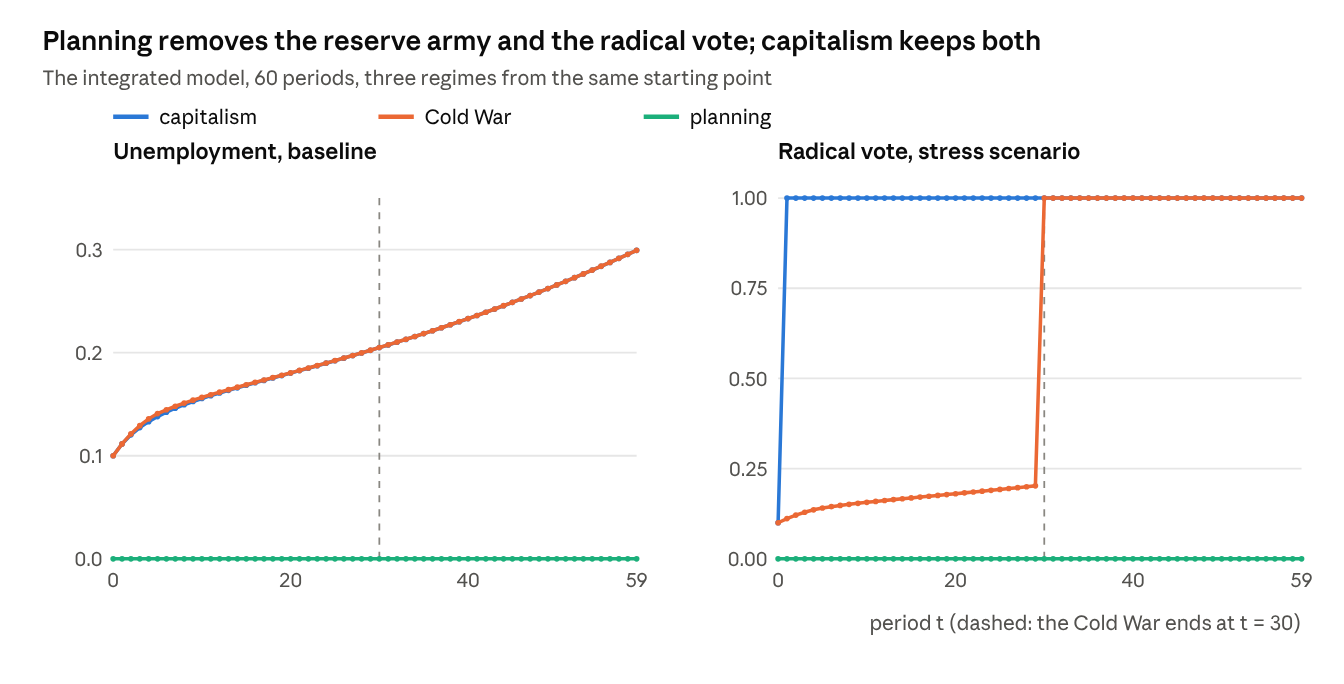
The whole economy. With all the mechanisms running together under capitalism, labor’s share of income falls 19.9% over 60 periods. The US share fell 20.2% from 1960 to 2026. But the model’s unemployment rises without limit, because machines replace workers faster than new investment creates jobs. An economic shock turns into a lasting radical government once right-wing “aspiration messaging” passes a sharp threshold between 0.26 and 0.27. Under planning, every route into the radical vote disappears.
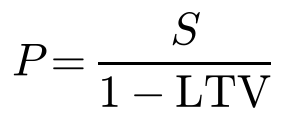
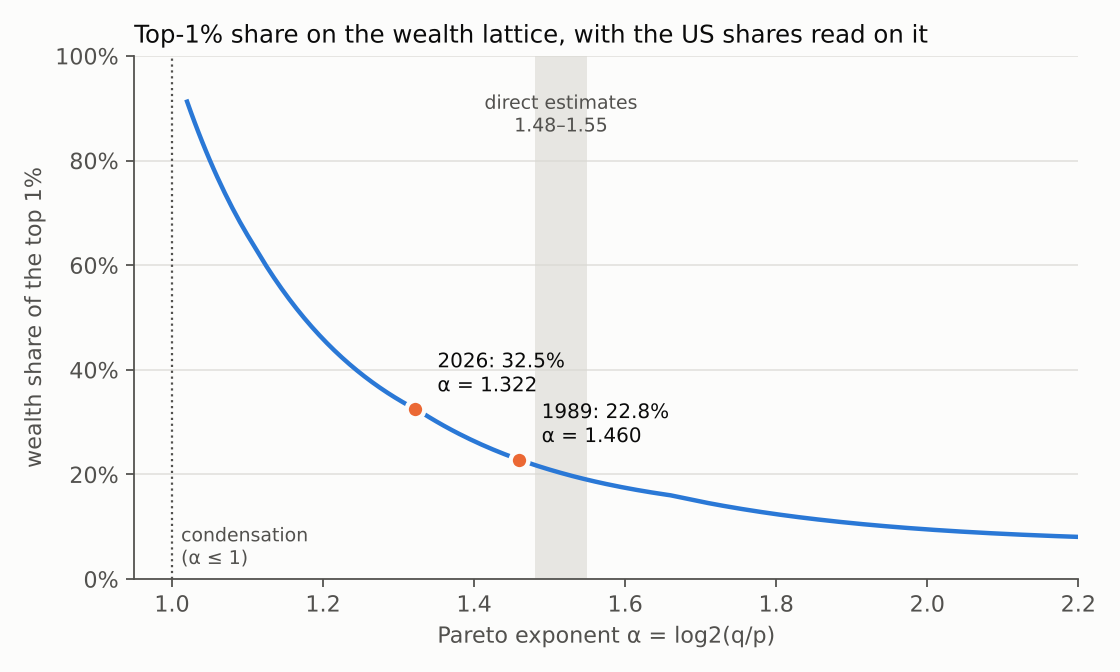
Finance. When buyers can borrow a share LTV of a house’s price, a fixed stock of houses sells for S/(1 − LTV), where S is what buyers have saved. The new money goes to the people who already own the houses, and no extra output is produced. When capital gains are set against the things that break fortunes up (inheritance, bankruptcy, taxes), the rich form a Pareto class whose shape is fixed by one number, the exponent log₂(q/p). Read this way, the US top-1% wealth share implies an exponent of 1.46 in 1989, close to direct estimates of 1.48–1.55, and 1.32 in 2026. Forced selling feeds on itself only when one sale pushes the price down further than the gap between one firm’s debt and the next. In a fourth, financialized version of the economy, credit keeps people employed until a falling profit rate and interest payments bring on a crash, the kind Hyman Minsky described. In the baseline run each of these crashes produces a radical government, through the moment when credit dries up for indebted households. None does when households carry no debt. This economy elects radical governments in all 27 stress settings I tried; plain capitalism does so in 15. Inflation delays the debt crisis and deflation brings it closer. Letting firms decide when to mechanize stops unemployment rising, but it also shows that the match with the falling labor share depended on that rise.
A separate Python program recomputes every table in this post and checks it character for character (80 checks). You can also run every program in your browser, in the Palimpsest playground.
1 Introduction
My earlier posts covered mechanical materialism, accountable planning, objections and responses, philosophies of contradiction, structural dialectics, fascism as an outgrowth of capitalism, and job creation. Read together, they make one argument that runs from physics to politics.
It starts with conservation. Following Paul Cockshott, value is abstract labor time, and exchange conserves it, the way collisions conserve energy in a gas. Just as energy conservation produces regular statistical patterns in a gas, conservation of value is meant to produce regular patterns in an economy: prices close to labor values, an exponential distribution of money, and a population split into two income classes.
Class relations come next. Who owns the means of production, and who can afford to walk away from a bargain, decide how the economy moves: a falling profit rate, a reserve army of unemployed people that keeps wages down, newly created money that favors people who already own assets, and radical politics when living standards fall.
Last comes a design. Accountable planning is meant to remove those dynamics.
Every link in that chain is a claim about how something works, so every link can be stated precisely and checked. For each one I ask three things. If I state the mechanism precisely, does it produce what the posts say? Where does its behavior change? And how well do the results match the data?
Why rewrite rules? The mechanical-materialism post defines a scientific law as “regularities governing how systems change states under specified conditions”. A rewrite rule says exactly that: when you see something of this shape, replace it with something of that shape, provided these conditions hold. So I wrote the economy as rewrite rules in Palimpsest, a language built around them. Three ideas carry the whole method:
One period of the economy is one complete rewriting of a term that holds the state of the economy.
A feedback loop is a chain of rules through which something computed in period t comes back in period t + 1.
To check that a cause-and-effect arrow in the diagram is real, I nudge one variable, hold every other one fixed, run the rules again and see which way the result moves.
Class analysis feeds the games. Some of the mechanisms are games, in the sense of game theory. Class position decides who the players are, what each can fall back on if bargaining breaks down, and how much is at stake. Under capitalism a worker’s fallback is the reserve army: if she loses this job, will she find another? A job guarantee replaces that fallback with a public job. That one change alters the wage bargain and the game between labor and capital, and through prospect theory, a model of how people weigh gains and losses, it changes how many voters back a radical gamble.
1.1 Summary of findings
The bookkeeping and the equilibria hold up. Conservation, the exponential law, the transfer to whoever gets new money first (the Cantillon effect), the fact that vouchers cannot circulate, and the job guarantee’s effect on employers all follow directly from the rules.
Claims stated without conditions turn out to have conditions. The falling profit rate, the radical coalition, the job guarantee’s power and the patronage spiral each hold only for some values of the model’s settings. The model shows where the boundary lies.
The patterns match the data, but some of the sizes do not. Without fitting anything to the data, the model comes close on the wage curve, the decline of labor’s share, the Gini coefficient of the lower class and the job guarantee’s effect on wages. It misses on how far prices stray from values, on how concentrated wealth is, and on the trend in unemployment. In each miss the model points in the right direction, and something is missing from it.
Finance makes the political results clearer. A financial crisis becomes a radical government at the moment credit dries up for indebted households, because borrowing had lifted the living standard people measure themselves against, and the crunch takes it away. Inflation delays the second debt crisis but cannot prevent the first. Capital gains produce a Pareto class, and policy sets its size. Adding two missing mechanisms, the breaking-up of fortunes and mechanization that responds to wages, repairs two of the misses above. The second repair also shows that the labor-share match depended on unemployment rising (§9).
1.2 How this post is organized
Section 2 lists the claims as propositions T1–T13 and explains the three tests; §9 adds T14–T17. Section 3 introduces Palimpsest. Sections 4–8 follow the posts from physics to politics: value, prices and profit (§4), money (§5), the labor market (§6), politics (§7), and the whole economy with every mechanism running at once, in three versions (§8). Section 9 adds finance: credit money, capital gains, debt deflation and a fourth, financialized version of the economy (T14–T17), along with two more mechanisms the first version left out, mechanization that responds to wages and the mobility of capital. Section 10 collects the verdicts, §11 explains how to reproduce everything, §12 lists the limitations, and §13 sums up.
2 The claims and how I test them
2.1 Seventeen propositions
The posts draw on three books in particular:
Classical Econophysics (Cockshott, Cottrell, Michaelson, Wright and Yakovenko, 2009), which treats value, money and profit with the tools of statistical physics.
How the World Works (Cockshott, 2019), a history of human labor that includes a demographic theory of the profit rate.
The Logic of Political Survival (Bueno de Mesquita, Smith, Siverson and Morrow, 2003). Its “selectorate theory” explains how leaders stay in power by rewarding the group whose support they need. I use it for the claims about party-states, patronage and divided government.
I reduced the posts to thirteen propositions, and §9 adds four about finance. The table quotes the post each one comes from.
proposition
post (quoted)
tested in
T1
Value is conserved in exchange; surplus value cannot arise from exchange
mechanical materialism: “in the exchange of commodities, abstract socially necessary labor time is conserved”
Conservation yields an exponential distribution of money, and capital income a Pareto upper class
mechanical materialism: “the lower approximately 97% … follows an exponential law … the upper approximately 3% follows a Pareto power law”
§5.1–5.2
T4
Money creation redistributes real claims toward asset holders
mechanical materialism: it “does not create new value but redistributes existing claims on real output”
§5.3
T5
The rate of profit tends to fall
mechanical materialism: “the rate of profit tends to fall over the long run”
§4.3, §8.3
T6
Planning is a fast contractive computation
accountable planning: “By approximately the twentieth pass they converge”
§4.1
T7
Quadratic voting replaces the purchasing-power filter and protects intense minorities
accountable planning: it “directly replaces the purchasing-power filter with a democratic one”
§7.5
T8
A job guarantee breaks employers’ power
accountable planning: capitalists “must offer conditions attractive enough to compete with the government sector”
§6.1–6.3
T9
A divided government cannot conspire
accountable planning: it “is divided within itself … so that it cannot conspire against the people”
§7.3–7.4
T10
Vouchers and an asset cap prevent accumulation
accountable planning: vouchers “cannot be lent, invested, or accumulated”
§5.2–5.3
T11
Falling living standards and inflation drive voters to radical, authoritarian options
fascism: “The more radical side will always form the more powerful coalition”; accountable planning on inflation as an existential threat
§7.1, §8.2, §8.4
T12
Right-wing patronage employment produces a self-reinforcing spiral
job creation: “The right buys off every community leader … It’s a downward spiral”
§7.2, §8.4–8.5
T13
Planning defuses authoritarian politics
accountable planning: “Because workers’ purchasing power rises rather than erodes, the existential anxiety that drives populations toward authoritarian leaders is defused”
§8.2, §8.4–8.6
T14
Credit creates money and inflates asset prices, not output
mechanical materialism: “New money bids up the price of housing and equities without a corresponding increase in the real output of the economy”
§9.1
T15
Compounding capital gains produce the Pareto class, which reform cannot remove
mechanical materialism: “The Pareto (superthermal) class corresponds to compounding capital-gains income”
§9.2
T16
Nominal debt makes deflation a self-reinforcing spiral, so the system needs inflation, which cuts real pay
accountable planning: “The system requires that the purchasing power of money be deliberately eroded as a condition of its own stability”
§9.3–9.4
T17
Debt deepens economic desperation and the turn to authoritarian options
accountable planning: insecurity is “an existential threat in the same register as mortality”; this evaluation’s first version: “Increasing debt increases desperation”
§9.5
Two posts supply method rather than claims.
Philosophies of contradiction follows the Italian philosopher Lucio Colletti in treating class conflict as a real opposition between forces, rather than a logical contradiction, and it describes how an alternative can be “foreclosed”, shut off before it can happen. The real opposition shows up in the model as the trade-off between wages and profits (§4.2). Foreclosure shows up as a window for change that closes once a radical government takes office (§8.6).
Structural dialectics defines tests for when one social form should give way to another: viability, necessity, Phase Inversion, warrant and synthesis. I apply them to the full model (§8.6).
The objections post adds a rule for counting an hour of skilled labor as several hours of simple labor (§4.1).
2.2 Three tests
Every result in this post comes from an assertion or a printed table in one of the programs listed in Appendix B. An assertion is a line the program checks; if it is false, the program stops with an error.
Test 1: does the model produce the claim? I use four verdicts.
Derived: the proposition follows from the rules for every setting of the parameters.
Reproduced: it holds at the model’s chosen settings.
Qualified: it holds only under an extra condition, which the model makes visible.
Contradicted: it fails.
Test 2: where does the behavior change? I look for limits, thresholds and tipping points, and pin them down precisely.
Test 3: what do the data say? Do published measurements show the pattern the model produces, at a size the model can match?
I did not fit the model to any data. Its settings come from its own steady-state algebra (§8.1) or from the posts, so when it matches the data, that is a test of the mechanism rather than of my choice of numbers. Each empirical figure used in a comparison is stored, with its source, in examples/me-evidence.pal.
3 Method: feedback loops as rewrite rules in Palimpsest
Palimpsest is a term-rewriting language with an interpreter written in Rust. A program has four parts:
a set of rewrite rules;
strategies, which say where and in what order to apply the rules;
a starting term, called main;
a list of commands.
A program may also rewrite its own source file, but only if it declares that it is allowed to. Palimpsest runs in the browser too, in the Palimpsest playground. There, a Python port of the interpreter runs under Pyodide (Python compiled to WebAssembly), and it gives the same output and the same step counts as the Rust interpreter on every example program.
3.1 Terms, rules and strategies
A term is a symbol, a string, a number or a list in parentheses. A rule has a name, a pattern on the left, a replacement on the right and, optionally, conditions after where:
rule NAME : LHS => RHS where CLAUSE, CLAUSE, ...
Pattern variables come in three kinds:
?x matches any single piece of a term.
?xs... matches several list items in a row.
!x is strict: the matching piece is simplified completely (put in “normal form”) before the pattern is tried.
A condition is either a test, which must come out true, or a binding ?v <- EXPR, which computes a value and names it. Conditions are worked out from left to right, and they can use every rule in the program.
The model uses one strategy throughout. It always rewrites the outermost, leftmost piece it can, which computer scientists call normal-order reduction:
strategy eval = outermost(prim + rules)
Each rewriting step uses up one unit of “fuel”, and a program declares its budget with #fuel N. Running out of fuel is an error, never a silent stop. The fuel left at the end works as a fingerprint of the whole computation: if two runs leave different amounts, they did different things.
3.2 Numbers, records and commands
Numbers are exact. An integer can be any size, and a fraction is written n/d. A number whose value is a whole number is always stored as one, so 6/3 simply is 2, and two numbers are equal exactly when their values are. The built-in operations include exact division q/, num and den (numerator and denominator), expt (powers), isqrt (integer square root) and round-to x K, which rounds x to the nearest multiple of 1/K. Nothing is rounded unless the program asks for it.
Records hold the economy’s state, as in (rec (K 270) (kap 3) …). You read a field with @ and change one with set@, put@ or add@.
Commands. A program file starts with settings such as #fuel and #memo, followed by commands:
show TERM with S // print the normal form
display TERM with S // print a string normal form as text
assert TERM with S // PASS iff the normal form is true; a FAIL exits non-zero
let $NAME = TERM with S // normalize once, substitute $NAME in later commands
rewrite self with S // rewrite main and write the program back to its file
rewrite self writes the file in one step, keeps a copy of the old version so the change can be undone, and writes nothing when run with --dry-run. A program that moves its economy forward one step at a time stops changing once its condition fails. Rewriting it again then leaves the file byte for byte the same, so the program has become a quine, a program whose output is its own source.
#memo makes the interpreter remember pieces it has already simplified, which saves work: 400 periods of the small example below take 10,568 steps instead of 29,505. --trace N prints the first N rewriting steps, and --stats reports which rules did the work.
3.3 A worked example: one feedback loop, step by step
examples/me-tour.pal is the smallest complete example of the method. It is one loop: capital K decides employment E, employment decides unemployment u, unemployment decides the wage w, the wage decides profit, and profit becomes next period’s capital.
Capital K employs E = min(100, K/3) of N = 100 workers.
Unemployment u = 1 − E/N sets the bargained wage share w(u) (§6.1).
Three-fifths of profit, (1 − w)E, is invested, and capital wears out at 3% a period.
At u = 1/10 the wage share comes out as the exact fraction 29/35. The trace also shows a cost of putting off work: min copies an argument it has not evaluated yet, so the same division is done twice (steps 3 and 6). Laziness can cost much more than that. If the loop counter is not forced, it grows into (- (- … 1) 1) and every test has to work it out again, so a loop that should take linear time takes quadratic time. The strict variables !s !n prevent this, which is why every entry point in the libraries is strict.
The loop settles where investment just replaces the capital that wears out: w = 17/20, u = 1/12 and K* = 275.
4 Value, prices and profit (T1, T2, T5, T6)
This section starts with what is conserved, then asks how prices relate to it, and ends with what happens to profitability over time. The results are checked by me-value.pal (17 assertions) and me-classical.pal (8), and the thresholds come from me-extremes.pal (§X3, §X5, §X10).
The reference economy, which I call E3, has three sectors: means of production (machines and materials), necessities (what wages buy) and luxuries. A is the table of inputs each sector needs per unit of output, l is the labor each needs, and b is the workers’ consumption bundle:
4.1 Value, exchange and the plan (T1, T6)
Values and the plan. The labor value of a good is the total labor, direct and indirect, that goes into making it. Solving the input table exactly gives labor values λ = (50/31, 90/31, 36/31). A planner can find the gross output x needed for a final demand d by repeating the step x ← Ax + d until it settles. On a reconstruction of the four-sector plan in the planning post, the estimates agree to within one ton after 18 passes; the post says “approximately the twentieth pass”. For every final demand d, the value of the net product equals the living labor performed: λ·d = l·x.
Exchange. Suppose an exchange table says how much of one good trades for another. If the table is consistent (reflexive, symmetric and transitive), it has the form Tᵢⱼ = vᵢ/vⱼ for some set of values v, and any round of trades brings you back to what you started with. Break transitivity by 10% and a three-trade cycle returns 11/10 of what went in: money makes more money from trade alone, Marx’s M–C–M′, with no production involved. When exchange conserves value, trade cannot create surplus value.
Real data and skilled labor.Classical Econophysics Table 10.1 is a four-industry input–output table. From it, the labor values per dollar of output all fall within 5.65% of their average, and the value of final output equals the wage bill, 244. The objections post counts a skilled hour as 3/2 simple hours. If the people who train the skilled workers are themselves skilled, the coefficient has to be worked out as the settling point of a repeated calculation, and it comes to 7/4.
Verdict: T1 and T6 are derived. Conservation holds for every consistent exchange table and fails for every inconsistent one. How fast the plan converges depends on the largest eigenvalue (the spectral radius) of A.
4.2 Prices and the wage–profit trade-off (T2)
The profit rate, pinned down exactly. When every sector earns the same profit rate r*, prices p satisfy p = (1 + r)p(A + b⊗l). I never compute an eigenvalue. Instead I halve an interval of possible values of r again and again, and at each step I decide exactly, using the Hawkins–Simon test on fractions, which half contains r*. After 30 halvings, r* ∈ [0.22849294, 0.22849294).
Two theorems hold on every wage bundle I tried:
The Fundamental Marxian Theorem (Morishima, 1973) says profits are positive if and only if workers are exploited, in the sense that they produce more value than they consume. It holds on 21 wage bundles and on all 64 bundles of a grid, including the edge case λ·b = 1, where r* = 0.
The Generalized Commodity Exploitation Theorem says the same is true of every basic good, not just labor: on the same bundles, each basic commodity is “exploited” exactly when r* > 0. So the theorems do not single labor out. The case for labor as the source of value has to rest on evidence.
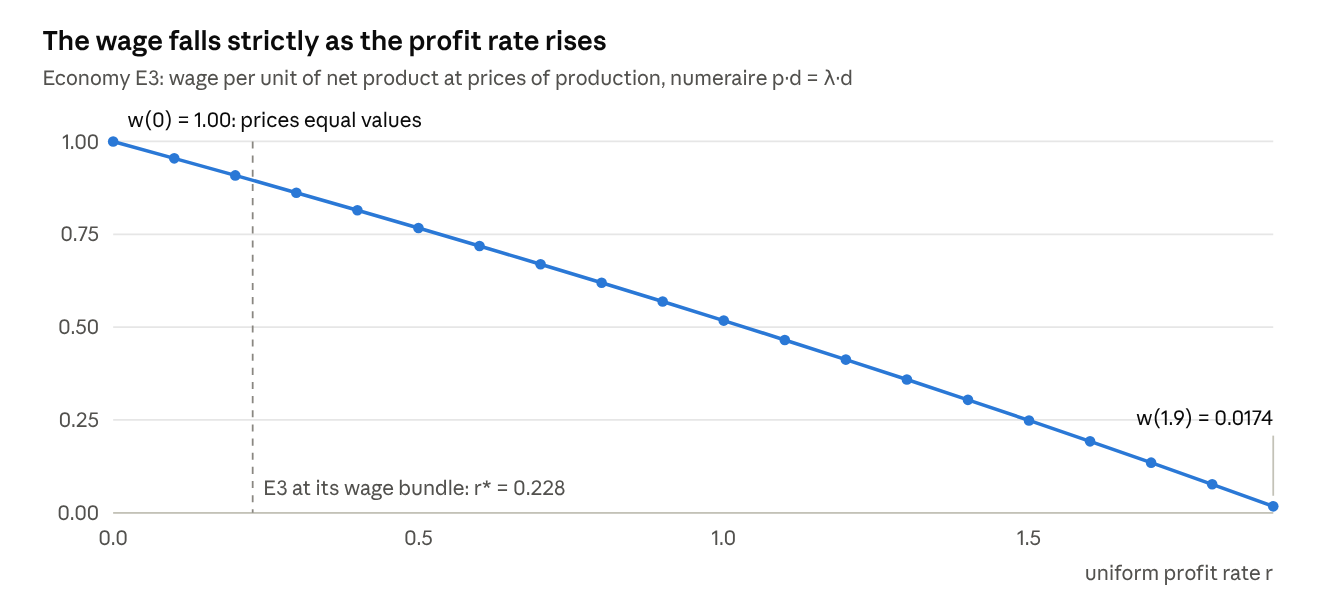
The real opposition. Measure the wage in units of the net product, and it falls from 1 at r = 0 to 0.0174 at r = 1.9 (Figure 1). Whatever one class gains, the other loses. Along the same curve, the average gap between prices and values, measured as the mean absolute weighted deviation (MAWD), rises from 0 at r = 0 to 0.0349 at r = 1. If every sector uses capital and labor in the same proportions, the gap is zero at every r.
Figure 1. The wage–profit frontier of E3 (me-value.pal §3.5. Exact rationals shown to four decimals).
What the data say. The evidence supports T2 on direction and partly on size.
Cockshott and Cottrell (1997) report a correlation of 0.977 between prices and labor values for the UK. Zachariah (2006) reports 0.942–0.986 for the seven OECD economies listed in Classical Econophysics.
Shaikh (1998) measures a MAWD of 9.2% for the US, and Classical Econophysics reports 7.1–10.5% for 1947–1972. Işıkara and Mokre (2022), using 42 countries, find deviations that are small and stable; the mechanical-materialism post quotes them at 10–20%.
The model’s deviations are too small: 0.8% in E3 and 3.1% for Table 10.1, three to eleven times below Shaikh’s figure. The reason is aggregation. Three or four sectors cannot capture how much the mix of capital and labor varies across the 40 to 100 industries in real tables.
Verdict: T2 is derived in structure and supported by the data, but the model’s deviations are too small.
4.3 The falling rate of profit (T5)
One of Marx’s best-known claims is that the profit rate tends to fall over time. The model can look at this in three ways, over three time spans.
New techniques: Okishio’s theorem. I tested eighteen changes that replace labor with machinery. Capitalists adopt a change if and only if it lowers their cost per unit at current prices.
If the real wage stays fixed, Okishio’s theorem holds in all 18: every change capitalists adopt raises the profit rate.
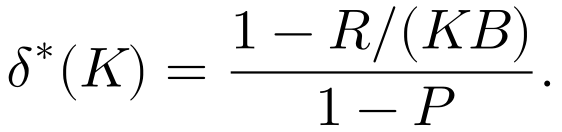
If instead the rate of exploitation stays fixed, the profit rate falls after 11 of the 14 changes they adopt.
So whether the profit rate falls depends on what happens to wages. The tendency is only determinate once you say how the wage moves.
When mechanization pays. A technique that is rejected today becomes worth adopting if wages rise far enough. For three rejected techniques the switch point is the same, β* = 0.2822, a rise in the real wage of 12.9%. They share it because all three add machinery and save labor in the same ratio, 1/2. A technique with a ratio of 1 never pays at any wage. Economists call this the Ricardo effect: higher wages bring on mechanization, and here the threshold can be calculated.
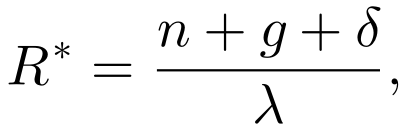
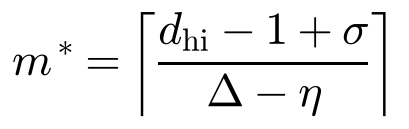
Population: the long-run settling point.lib/longrun.pal runs the accumulation model of Classical Econophysics in exact discrete time. Capital grows at λR − (g + δ), where λ is the share of profit invested, and the workforce grows at n. The two keep pace when
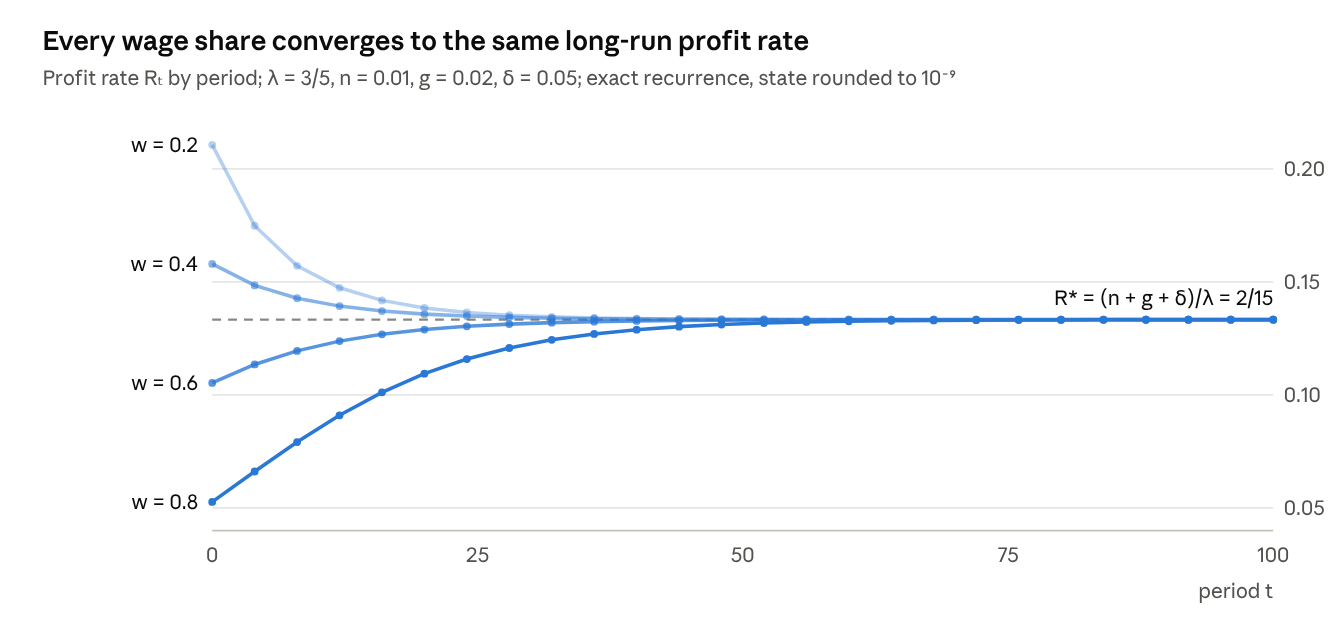
whatever the wage share. Four economies with wage shares from 0.2 to 0.8 all settle at R* = 2/15 (Figure 2).
Figure 2. Every wage share converges to the same long-run profit rate (me-classical.pal §C1 every fourth period).
The floor. Because there are always some workers per unit of capital (L/K > 0), the profit rate cannot fall below −(1 − w)(g + δ). The formula for R* leaves this floor out. The two meet when
n
R*
floor
R after 599 periods
−0.0100
0.01667
−0.00800
0.01667
−0.0200
0
−0.00800
0.00042
−0.0248
−0.00800
−0.00800
−0.00534
−0.0300
−0.01667
−0.00800
−0.00766
−0.0500
−0.05000
−0.00800
−0.00799
The rate actually reached is the larger of the two, max(R*, −(1 − w)(g + δ)). Near n* the approach slows to a crawl: after 599 periods at n = −0.0248 the rate is still 0.0027 above the floor, while at n = −0.05 it is within 10⁻⁵. Physicists call this critical slowing down, and it happens wherever two possible resting points swap stability. Cockshott is right that a shrinking population pushes the profit rate toward a negative level. The model adds three things: the rate has a lower bound, the bound depends on the wage share, and near the threshold the rate approaches it very slowly.
What the data say. Maito (2014) finds that the average profit rate of six core countries (Germany, the US, the Netherlands, Japan, the UK and Sweden) fell from 40.6% in 1870–1874 to 10.8% in 1982, then recovered to 14.6% in 2007. Basu (2022) finds a falling world trend for 1960–2019, driven by a falling ratio of output to capital. Holding exploitation constant matches Basu’s breakdown, and slowing population growth matches the long fall. The model reads the recovery of 1982–2007 as the counter-tendency of §8.3, a growing reserve army and a falling wage share.
Verdict: T5 is qualified by the model and supported by the data as a long-run tendency. It needs a rule for wages or slowing population growth.
5 Money and its distribution (T3, T4, T10)
If money is conserved when people trade, as energy is when molecules collide, then statistics alone decide how it ends up spread across a population, before anyone’s merit comes into it. Capital income and newly created money then distort that spread, and the planning proposal is meant to undo the distortions. The results here are checked by me-distribution.pal (18 assertions). Its random numbers come from a fixed formula, so every sample comes out the same on every computer.
5.1 Conservation and the exponential law (T3)
The model. Following Drăgulescu and Yakovenko (2000), suppose every way of dividing M units of money among N people is equally likely. Then the chance that one person holds k units is:
As N grows this approaches a geometric (exponential-like) law. The total-variation distance between the two, a standard measure of how different two distributions are, falls to 0.0003 at N = 1000. When the average holding is T = 10, the geometric ratio is q = T/(1 + T) = 10/11, and the Gini coefficient (0 for perfect equality, 1 for one person holding everything) is 1/(1 + q) = 11/21 ≈ 0.524.
The same law appears if you simply let people trade. In a simulation of 100 people exchanging one unit at random, the Gini rises from 0 to 0.46 after 20,000 trades, and 9.20% of people end up with nothing, against 9.09% predicted. Nobody in the simulation does anything except trade at random. So this much inequality needs no differences in productivity or effort; conservation is enough.
What the data say. Ludwig and Yakovenko (2022) find that the bottom 96% of US tax units follow an exponential law, with a Gini near 0.5, over 1983–2018. The model’s 0.524 is the version of that figure for whole units of money.
5.2 Capital income, condensation and the asset cap (T3, T10)
The model. Five owners and 95 workers trade in two kinds of event. A wage payment adds a fixed amount: an owner pays a random worker one unit. A sale works like interest: the owner who receives the payment is picked in proportion to how much each owner already has, so the rich are likelier to get richer. The planning post’s cap θ on private holdings is one more rule, which moves anything above the cap into a public fund that pays wages.
cap θ
owners’ share after 60,000 events
workers’ Gini
owners’ holdings
none
0.9764
0.8439
(0, 0, 0, 0, 952)
60
0.2421
0.4905
(0, 58, 59, 59, 60)
30
0.1159
0.4859
(4, 25, 26, 29, 29)
Without a cap, capital income does more than produce a Pareto tail, the long thin tail of very large fortunes. The money “condenses”: one owner ends up with 98% of all of it. With a cap, the owners’ share stays below Cθ/M (C owners, each capped at θ, out of M in total), and the workers’ Gini stays near 0.49.
What the data say. In Ludwig and Yakovenko (2022), the top 4% of incomes form a Pareto tail holding 34% of income in 2018. The Federal Reserve’s Distributional Financial Accounts put the top 1%’s share of wealth at 32.5% in the second quarter of 2026. So the model points the right way, but it overshoots badly. Real economies keep wealth to a power law through forces the model leaves out: returns that vary from fortune to fortune, taxes, bankruptcy, and fortunes divided among heirs. Section 9.2 adds them.
5.3 Money creation and labor vouchers (T4, T10)
Money creation. Take an economy that produces Q = 1000 units of goods, where three groups (asset holders, the middle, and the poor) hold 600, 300 and 100 units of money. Give 100 newly created units to the asset holders, and let them spend before prices adjust. In real terms the asset holders gain 100 units of goods, the middle loses 75 and the poor lose 25. The gains and losses add to zero, and the first recipients gain exactly Q·D/M, where D is the new money and M the old money supply. If instead the same new money is handed out in proportion to what people already hold, and spent after prices adjust, nobody gains or loses. Creating money does not create goods. It changes who gets to claim the goods that already exist.
What the data say. Domanski, Scatigna and Zabai (2016) find that after 2008, monetary policy widened wealth inequality mainly by raising share prices, which benefits people who own shares. That is the same mechanism, known after Richard Cantillon as the Cantillon effect: new money benefits whoever receives it first.
Vouchers. Labor vouchers are issued for hours worked and cancelled when they are spent. No rule in the model moves a voucher from one person to another. So one person’s extra work changes nobody else’s holdings, which is not true of money, and there is no rule that would let anyone use vouchers to make more vouchers.
Verdict: T3 is derived and supported for the lower class, and qualified for the upper class, whose concentration the model overstates. T4 is derived and supported in direction. T10 is derived.
6 Class conflict in the labor market (T8)
Up to now the wage has simply been given. This section works it out from class positions. What a worker can fall back on (the reserve army under capitalism, or the job guarantee under planning) decides the bargain. The bargain in turn decides what is at stake in a game where labor can organize and capital can give in, crack down, or leave. The results are checked by me-games.pal (20 assertions), with thresholds from me-extremes.pal (§X1–X2) and data from me-evidence.pal.
6.1 The reserve army as a fallback
The bargain. A worker bargains with power β, a number between 0 and 1. If bargaining fails, she finds another job with probability 1 − u, where u is the unemployment rate, and otherwise lives on a benefit s. Under a job guarantee paying g, the guarantee becomes her fallback instead. The standard Nash bargaining solution gives these wage shares:
Under capitalism the wage has two limits. At full employment, w(0) = 1: the threat of dismissal means nothing, because another job is always available, so labor takes the whole product. At total unemployment, w(1) = β + (1 − β)s = 13/25.
Where the wage reacts most. The elasticity of the wage with respect to unemployment says by what percentage the wage falls when unemployment rises by one percent. Here it is
which is zero at both ends. It is largest in size at
So the reserve army has the least power over wages near full employment and the most at about 40% unemployment.
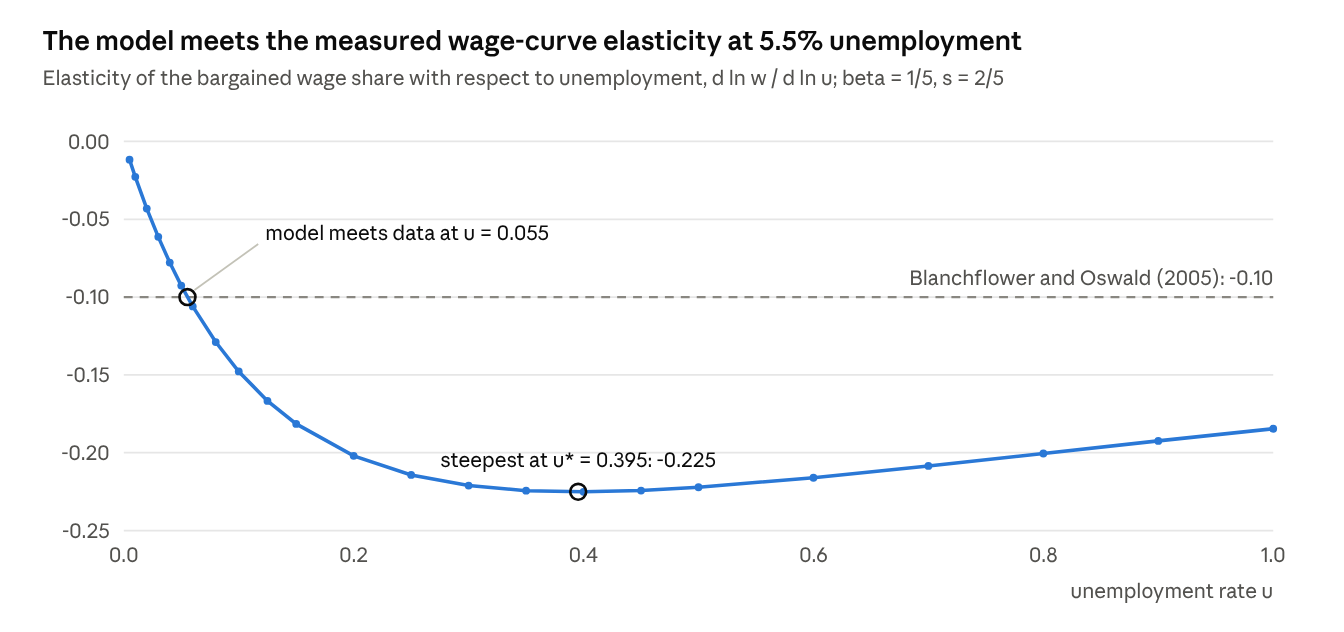
What the data say. Blanchflower and Oswald (2005) estimate that pay responds to local unemployment with an elasticity of about −0.1, much the same across countries. The model gives −0.093 at 5% unemployment and −0.148 at 10%, and it passes −0.10 at 5.54% (Figure 3). I did not choose any parameter to get this. The model also makes a prediction that could be tested: the wage curve should flatten out when unemployment is low.
Figure 3. The elasticity of the bargained wage against unemployment, with the measured elasticity (me-extremes.pal §X1).
6.2 The class-struggle game and capital flight
The game. Workers either accept the terms or organize. Capital either gives in (concedes), cracks down (represses) at a cost ρ, or moves abroad (flees) and earns r_ext there. Organizing costs workers k and raises their bargaining power from b_l to b_h, unless capital represses. With b_l = 1/5, b_h = 1/2, k = ρ = 1/20, r_ext = 1/10, s = 2/5 and g = 4/5, at u = 1/5, the payoffs are:
profile
capitalism: W
capitalism: C
planning: W
planning: C
accept / concede
0.7333
0.2667
0.8400
0.1600
accept / repress
0.7333
0.2167
0.8400
0.0600
accept / flee
0.4000
0.1000
0.8000
0.0000
organize / concede
0.8500
0.1000
0.8500
0.1000
organize / repress
0.6833
0.2167
0.8500
0.0000
organize / flee
0.4000
0.1000
0.8000
0.0000
Under capitalism there is no pure Nash equilibrium, meaning no pair of choices that neither side wants to change. Instead the two sides keep switching, and the only stable outcome is a mixed one in which workers accept 70% of the time and capital concedes 30% of the time. Under planning, repression fails and flight triggers expropriation, so there is a single stable outcome: workers organize and capital concedes. I checked 243 combinations of the settings. Planning always has a stable outcome in which capital concedes; capitalism has none in 187 of them.
Along the unemployment axis. Under capitalism the game changes character at two points.
When u ≤ 1/12 (0.0833), capital flight is a stable outcome. Up to u = 1/20 there are two such outcomes, (accept, flee) and (organize, flee); above it only (organize, flee) remains.
When u > 1/12, there is no stable pure outcome. Labor’s average bargaining power falls from 0.2549 at u = 0.10 to 0.2188 at u = 0.50.
Michał Kalecki described this in 1943 as the political limit to full employment. Near full employment the wage takes nearly the whole product, so capital’s best response to organized labor is to leave. Section 9.7 lets the return abroad vary.
6.3 The job guarantee
A job guarantee raises private wages only if the guaranteed job pays better than what workers could get under the reserve army, w_ap > w_cap. Setting the two equal gives the point where that starts:
Below 9.1% unemployment the guarantee does nothing to private wages, because private employers already pay more than the guaranteed job. Above it, the gain rises: +1.4% at 10% unemployment, +5.0% at 12.5% and +14.5% at 20%.
What the data say. Imbert and Papp (2015) find that India’s NREGA, a rural employment guarantee, raised private rural wages by about 5%, while each public job replaced one private job. In a randomized rollout of better NREGA payments, Muralidharan, Niehaus and Sukhtankar (2023) find that 86% of the extra earnings came from outside the program, because private wages and employment both rose. The model gives +5% at 12.5% unemployment, a slack rural labor market, through exactly that channel: the guarantee improves the worker’s fallback.
Verdict: T8 is reproduced above 1/11 unemployment and supported in slack labor markets. At low unemployment the guarantee has no effect in the model, partly because of how the bargaining formula behaves near full employment (§12.1).
6.4 Exploitation as a property relation
John Roemer’s test calls a group of people exploited if they would be better off leaving with their per-head share of society’s capital and working it themselves. Six people hold capital (0, 0, 0, 1, 2, 9), and a job needs 4 units. On all 63 possible groups, the test agrees with a simple rule: a group is exploited when its average capital is below society’s average. When every worker has access to the social means of production, as under a job guarantee with land and job assignment, no group is exploited. Roemer’s thought experiment becomes an institution.
7 Politics (T7, T9, T11, T12)
The economy reaches politics through living standards. When they fall, voters weigh a radical gamble against a moderate sure thing. Networks that hand out jobs shape what voters expect. And the way a government is organized decides whether officials can collude against everyone else. This section builds each of these mechanisms on its own; §8 connects them to the economy. The results are checked by me-games.pal and me-selectorate.pal (7 assertions), with thresholds from me-extremes.pal (§X4, §X8–X9).
7.1 Losses, curvature and the radical coalition (T11)
The choice. Voters choose between a moderate option, a sure gain of +1, and a radical gamble that pays +6 with probability 1/4 and −2 with probability 3/4. The gamble’s expected value is 0, below the moderate option’s. Following Kahneman and Tversky’s prospect theory (1979), voters judge outcomes as gains or losses from where they stand, D, relative to what they consider normal. Losses hurt more than equal gains please, by the loss-aversion factor λ = 9/4 that Tversky and Kahneman (1992) estimated. I use a piecewise quadratic value function so that every calculation stays exact:
Voters pick the gamble exactly when D is below −5.399. The fascism post names four groups of people, two falling (by 6 and 3) and two rising (by 1 and 2). Weighted by size, 30% of them would choose the gamble. If each group measures itself against an aspiration 3 units above where it stands, 55% would. If every group is rising, as in the Cold War years, none would.
What sets the threshold. The fascism post puts radicalization down to loss aversion. When every possible outcome is a loss (D < −6), loss aversion multiplies both sides of the comparison equally and cancels out, and the condition becomes
curvature K
10
20
40
80
threshold at λ = 9/4
−5.399
−14.5
−34.5
−74.5
threshold at λ = 1
−4.838
−14.5
−34.5
−74.5
11/2 − K
−4.5
−14.5
−34.5
−74.5
This holds exactly for K > 23/2. At K = 10 the threshold, −5.399, lies above −6, so it is not quite 11/2 − K. Raising loss aversion from 1 to 100 moves the threshold by only 0.74. Making the value function flatter (a larger K, which means people’s sensitivity to losses fades less as losses grow) moves it without limit, and a voter with a perfectly straight value function never takes the gamble. So what produces the radical coalition is how people’s sensitivity to losses changes as losses deepen, the convex shape that makes a gamble attractive to those already far behind. Loss aversion matters much less.
What the data say. Funke, Schularick and Trebesch (2016) find that far-right vote shares rise by about 30% after financial crises, across 1870–2014, but not after ordinary recessions. In the model, too, only a deep loss crosses the threshold. Lakner and Milanovic (2016) supply a related fact about who loses: in 1988–2008 the lower-middle class of rich countries saw almost no income growth. That is the group the fascism post describes as falling.
Verdict: T11 is qualified by the model and supported by the data. A radical coalition forms only past a threshold of loss, and the curvature of the value function sets it.
7.2 Patronage (T12)
The model. Two political networks, one left and one right, spend their resources on jobs and on messages. Following the job-creation post, a job ties a member to a network three times as strongly as a message does, and resources follow membership. If the right network is funded by capital (base funding 3 to 1), the best strategy for both networks, whatever the other does, is to spend everything on jobs. If the left creates no jobs while the right does, the right ends up with 0.942 of the membership, against 0.743 if both create jobs.
What the data say. Thachil (2011) shows that the BJP’s service networks in India win the votes of poor people who would otherwise oppose the party’s elite program. Material help ties people more strongly than messages do.
Verdict: T12’s premise is supported, and its conclusion is reproduced in this static setting. Whether patronage becomes a self-reinforcing spiral over time is a question about dynamics, which §8.4 takes up.
7.3 Collusion and the divided government (T9)
The model. K officials share a bribe, or rent, R if they all collude. Any one of them can blow the whistle and collect a reward B, and an audit uncovers the conspiracy with probability P each period. Collusion can last, with each official cooperating as long as everyone else does, only if they value the future enough. Their discount factor δ must be at least
If the whistle-blower’s reward equals the rent (B = R), collusion fails for every discount factor once the number of independent officials reaches
because δ*(K) ≥ 1 exactly when 1 − 1/K ≥ 1 − P. The program confirms this at five audit rates, from 5% (K̄ = 20) to 50% (K̄ = 2).
That gives the planning post’s divided government a design rule: it needs at least as many independently accountable offices as one over the chance of an audit. Fewer offices with more frequent audits work just as well. A single ruling party, whose members cannot collect a reward for reporting each other, can sustain collusion however little they value the future. That is Milovan Djilas’s “new class” (1957), here as the stable outcome of a game.
What the data say. Corporate leniency programs work the same way: they excuse the first member of a cartel who reports it. Miller (2009) finds that the US program, introduced in 1993, caught more cartels and discouraged new ones.
7.4 Political survival (T9)
Collusion is one way to hold power without being accountable. Selectorate theory describes another: a leader who needs only a few supporters can keep them loyal with private rewards.
The model. For the utility function the book uses, √x + √g + √y + √l, the model can be solved in closed form. The share of spending that goes on private rewards is
where W is the size of the winning coalition the leader depends on and p is the price of public goods. The book calls this “perhaps the key” result. As W grows, taxes, the private share and the leader’s surplus all fall.
How much the leader keeps depends on how much the coalition values the future (δ). With N = S = 100,000, W = 1,000 and p = 10,000:
δ
incumbent tax
spending M
leader’s surplus
coalition member’s utility
0
0.5619
17,117.7
0
5.538
0.5
0.5733
4,752.2
12,394.2
3.481
0.9
0.5832
207.6
16,949.3
1.668
0.99
0.5855
2.1
17,155.2
1.238
A coalition that cares nothing for the future (δ = 0) puts no value on loyalty, so the leader must spend all revenue to stay in power. A very patient coalition (δ close to 1) stays loyal almost for free, and the leader keeps nearly everything. Secure power breeds extraction. The selectorate model cannot tell accountable planning apart from any other majority-rule system, though, because it has no property relations and no division of offices. What makes the proposal distinctive lies outside this model.
Verdict: T9 is derived for collusion, with the design rule K̄ = ⌈ 1/P ⌉. Its selectorate reading is reproduced, but the evidence for selectorate theory is disputed (Clarke and Stone, 2008).
7.5 Quadratic voting and what gets produced (T7)
The model. In quadratic voting (QV; Lalley and Weyl, 2018), each voter has a budget of credits, and casting n votes on one issue costs n² credits. That lets people with strong feelings about one issue express them, at a rising price. Here 90 workers, 5 owners and 5 green voters spread their votes over investment, necessities and luxuries. The tally is (300, 450, 120), so luxuries get 13.8% of the votes. If instead demand is weighted by how much money people have, using the uncapped distribution of §5.2, 78.1% of spending goes on luxuries. In a market, purchasing power decides what gets made, not need.
Verdict: T7 is reproduced. Survey evidence on QV (Quarfoot et al., 2017) is consistent with it, but it is far from a test of QV as a way to plan production.
8 The whole economy (T11–T13)
The posts’ strongest claims are about how the mechanisms interact. Unemployment weakens labor, falling wages push voters into losses, a radical government represses unions, and patronage raises what people expect. This section runs all the mechanisms together, in three versions of the economy. The results are checked by me-regimes.pal (13 assertions), the self-rewriting me-economy.pal, me-loops.pal (5) and me-dialectics.pal (13).
8.1 One period as a chain of equations
Each period is a chain of equations, worked out in order over a record that holds the state of the economy. One equation connects the economy to the game of §6:
rule eq-B : (pe-eq B ?v ?p) => (pe-beta (pe-cs (@ ?v mode)) ?gp) where ?gp <- (pe-gpar ?v (put@ ?p u 0))
In words: each period, labor’s bargaining power is whatever the class-struggle game produces at that period’s unemployment rate. The chain then works out, in order:
employment E = min(N, K/κ), where κ is the capital needed per job, rising by μ = 1% a period as work is mechanized;
the wage share w, profit Π = (1 − w)E and the profit rate r = Π/K;
investment I = s_c Π, or none at all (a capital strike) when the profit rate falls below a minimum, r_min, or when capital’s best move in the game is to flee;
inflation and the living standard;
the radical vote, measured against a reference point that the right network’s messaging pushes up;
the right network’s share of membership;
viability Φ = min(economic margin, 2(1/2 − radical vote)), a single number for whether the economy and its politics can carry on.
The three versions differ in their equations, not in their numbers:
mechanism
capitalism
Cold War (to t = 30)
accountable planning
outside option
reserve army
plus insurance at 9/10 of the employed standard
job guarantee, g = 4/5
wages
bargaining
floored to half of productivity growth
public wage; private firms must beat it
money
2% inflation, 10% shock at t = 40–41
the same, indexed
labor vouchers
left network
no jobs
jobs
jobs
repression
radical government halves bargaining power
the same
rights entrenched
capital
accumulates
accumulates
capped at θ = 60
The settings come from the model’s own steady-state algebra, not from fitting. Investment just keeps pace when s_c·r = δ + μ, so with s_c = 3/5, δ = 3% and μ = 1% the profit rate needed to keep going is r = 1/15.
8.2 Three versions of the economy
At the baseline settings (Figure 4):
Capitalism. Unemployment rises in every period, from 0.100 to 0.299, and the wage share falls in every period.
The Cold War. The radical vote is 0 until t = 30. After that the unemployed lose their insurance, and the radical vote equals the unemployment rate.
Planning. Unemployment and the radical vote are 0, living standards rise, and Φ stays positive.
Under stress (an inflation shock, loss sensitivity 30 and aspiration messaging 0.40; see §8.4), capitalism elects a radical government that holds office for 58 of the 60 periods. The Cold War version does the same as soon as its concessions end. Planning never has a radical vote.
Figure 4. Unemployment at baseline and the radical vote under stress, three regimes (lib/polecon.pal).
Labor’s share. The US Bureau of Labor Statistics reports that labor’s share of nonfarm business income fell from 66.2% in late 1960 to 52.8% in mid-2026, a relative fall of 20.2%. The model’s wage share under capitalism falls 19.9% over 60 periods, from 0.864 to 0.692, as mechanization weakens labor’s fallback. The levels differ, because the measured share counts employer contributions and treats depreciation differently; the match is in the size of the decline.
8.3 Unemployment and mechanization
Why does unemployment rise in every period? As long as there is no crisis and the economy is below full employment, capital and employment are tied together by
Employment holds steady only if μ = s_c·r − δ. Running capitalism at five rates of mechanization shows where that boundary lies:
μ
u₀
u₅₉
r₅₉
w₅₉
μ that holds E constant at r₅₉
0
0.100
0.110
0.0500
0.850
0
0.005
0.100
0.179
0.0560
0.775
0.0036
0.010
0.100
0.299
0.0571
0.692
0.0042
0.015
0.100
0.461
0.0517
0.627
0.0010
0.020
0.100
0.596
0.0501
0.517
0.0001
Without mechanization the profit rate settles at δ/s_c = 0.05, and unemployment settles near 11%. With mechanization the profit rate never gets above about 0.057, so the fastest mechanization the economy can absorb is about 0.4% a period. Anything faster makes the reserve army grow forever. The table also shows that faster mechanization first raises the profit rate, by weakening labor, and then lowers it, because fewer workers produce less profit.
What the data say. Here the model fails. US unemployment (FRED, 1948–2026) has no long-run trend; it was 4.2% in September 2026. Barbosa-Filho and Taylor (2006) find the boom-and-squeeze cycles that Richard Goodwin described in US data. Real economies must sit close to the boundary μ ≈ s_c·r − δ, held there by things the model leaves out, such as demand management, the growth of services and shorter working hours. Section 9.6 adds two candidates, credit and mechanization that responds to wages.
8.4 Stress, lock-in and the tipping point (T11–T13)
Under stress (loss sensitivity 30, aspiration messaging 0.40), capitalism elects a radical government at t = 2. Repression halves labor’s bargaining power, and the profit rate jumps from 0.045 to 0.086. Living standards then rise from 0.85 to 2.10 by t = 45, yet the radical vote stays at 1.
The government stays because of the reference point. With the right network holding 85–89% of membership, every group compares itself with a standard 34–36% above its own, so it feels behind however much it gains. This is the job-creation post’s “downward spiral”, made precise.
How much does this depend on the settings? I ran a grid of 27 settings, varying loss sensitivity, the size of the inflation shock and aspiration messaging.
Planning never has a radical vote after t = 1.
The Cold War never does worse than capitalism.
Capitalism elects a radical government in 15 of the 27.
Figure 5. Periods of radical government against aspiration messaging (me-extremes.pal §X7).
Where the spiral starts. Figure 5 varies aspiration messaging with the shock held fixed. Below 0.20 there is no radical government. From 0.20 to 0.26 the shock produces a two-period episode. At 0.27 the radical government outlasts the shock, for 10 periods. From 0.28 on it comes earlier and stays longer: 19 periods at 0.28, 39 at 0.30 and 58 of 60 at 0.40. The tipping point is sharp because the lock-in feeds itself: a radical government represses, profits rise, the right network grows on those profits, and aspirations rise with the network. Below the threshold the same shock produces only a protest vote that reverses, which matches what Funke and his coauthors find after ordinary recessions (§7.1).
Verdict: T11 and T12 are reproduced as dynamics above a threshold. T13 is reproduced in all 27 settings. No economy has run the planning proposal, so it cannot be tested against data.
8.5 Feedback loops
Put together, the mechanisms form a causal-loop diagram with 15 variables and 24 arrows, each marked as pushing its target up or down. The diagram has 14 loops: 5 reinforcing (they amplify a change) and 9 balancing (they damp it). Among them are the Goodwin profit squeeze (balancing), accumulation, radicalization and patronage (all reinforcing).
A diagram drawn by hand simply asserts its arrows. Here each arrow X → Y is checked against the equations themselves: raise X a little, freeze every other variable, recompute Y and read off which way it moved. I did this at ten different states of the economy, and 23 of the 24 arrows behave as drawn.
The exception is the arrow from unemployment to bargaining power, which turns positive near full employment. That is the capital-flight outcome of §6.2: where capital’s best answer to organized labor is to leave, more unemployment actually raises labor’s bargaining power. A hand-drawn diagram would have shown this arrow as negative everywhere.
Under planning, 12 arrows disappear: the reserve army, the trade-off between wages and profits, inflation, every route into the radical vote, and repression (Figure 6). One loop is left, accumulation in what remains of the private sector, and the asset cap limits it.
The structural-dialectics post sets out tests for when a society should move to a new form. I applied them to the model for each period from t = 0 to 59. The diagnoses are s (stasis), I (instability), P (Phase Inversion) and n (not viable):
Baseline capitalism stays in stasis throughout: rising unemployment alone does not justify a transition. The Cold War shows instability only in its last period, when its concessions end. A crisis opens a window of exactly one period before a radical government closes it, which is what the contradictions post calls foreclosure. Whether a transition would count as a synthesis depends on the reference point the new society inherits, which can make its first period not viable.
9 Finance (T14–T17)
In sections 4 to 8, money appears only as something conserved in trade and as a one-off injection of new money (§5.3). The posts say a good deal more about money, and the earlier version of this evaluation left it out. Four claims stand out.
Credit money. The mechanical-materialism post says that when a bank makes a loan, it “does not lend out pre-existing deposits”, and that “New money bids up the price of housing and equities without a corresponding increase in the real output of the economy”.
Capital gains. The same post traces the Pareto class, the small group of very large fortunes, to “compounding capital-gains income”, and says the class structure is not something that “could be reformed away with the right policies”.
Debt deflation. The accountable-planning post says that “nearly all production is financed by borrowing”, and that falling prices start a spiral: “Falling prices cause insolvency, insolvency causes distress selling, distress selling causes further price declines”. So, it concludes, “The system requires that the purchasing power of money be deliberately eroded as a condition of its own stability”.
Debt and desperation. The same post treats economic insecurity as “an existential threat in the same register as mortality”. The first version of this evaluation added, among its limitations: “Increasing debt increases desperation, and therefore the effects of Terror Management Theory.”
These become four new propositions:
proposition
post (quoted)
tested in
T14
Credit creates money and inflates asset prices, not output
mechanical materialism: “New money bids up the price of housing and equities without a corresponding increase in the real output of the economy”
§9.1
T15
Compounding capital gains produce the Pareto class, which reform cannot remove
mechanical materialism: “The Pareto (superthermal) class corresponds to compounding capital-gains income”
§9.2
T16
Nominal debt makes deflation a self-reinforcing spiral, so the system needs inflation, which cuts real pay
accountable planning: “The system requires that the purchasing power of money be deliberately eroded as a condition of its own stability”
§9.3–9.4
T17
Debt deepens economic desperation and the turn to authoritarian options
accountable planning: insecurity is “an existential threat in the same register as mortality”
§9.5
Two other gaps in the first version also matter for earlier claims. Mechanization in the model was fixed in advance rather than chosen by firms, which the first version listed as a limitation; that bears on the unemployment failure of §8.3 (§9.6). And capital’s option to leave the country was held at a single fixed return abroad, which bears on the flight threshold of §6.2 (§9.7).
How banks create money. When a bank makes a loan, it does not hand over money someone else deposited. It credits the borrower’s account with a new deposit, and when the loan is repaid that deposit disappears. The model keeps a ledger of eight loans, payments and repayments, and after every one, the new deposits equal the loans still outstanding.
What credit does to prices. Now suppose buyers who have saved S each bid for a fixed stock of houses, and a bank will lend them a share LTV of the price (the loan-to-value ratio). A buyer can pay at most her savings plus the loan, S + LTV·P, and when buyers compete, the price rises to that limit. So
Raising LTV from 0 to 0.8 multiplies the price by 5. Raising it to 0.95 multiplies it by 20. Not a single house is built, and nothing else is produced either.
Each sale creates new money, the loan LTV·P, and pays it straight to the person who already owned the house. When the seller spends it, prices have not yet adjusted, so the seller gains exactly Q·D/M in real goods, the first-recipient gain of §5.3, and everyone else loses the same amount between them. At LTV = 0.95, ten sales a period move 190 of the economy’s 1,000 units of output to the sellers.
What the data say. Favara and Imbs (2015) study US bank-branching deregulation in 1994–2005, which let banks lend more for reasons unrelated to the housing market. The extra mortgage credit raised house prices. Only where it was easy to build did the number of houses grow instead. Jordà, Schularick and Taylor (2016) find that across 17 rich economies, mortgages rose from about 30% of bank lending in 1900 to about 60% today, and that nearly all of the financial sector’s growth since 1913 is mortgage lending to households, which “has little to do with the financing of the business sector”.
Verdict: T14 is derived, since the price formula and the transfer are accounting identities, and it is supported by the data.
9.2 Capital gains, resets and the Pareto class (T15)
In §5.2, capital income did more than create a class of large fortunes: all the money ended up with one owner. What that model lacked were the forces that break fortunes up.
The model. I call the simplest exact version a wealth lattice. Picture fortunes sitting on the rungs of a ladder, where each rung is worth twice the one below (levels 2ⁿ). Each period:
a fortune moves up a rung (doubles) with probability p, which stands for a capital gain;
it moves down a rung (halves) with probability q, which stands for a reset, such as division between two heirs, a bankruptcy or a tax;
a fortune on the bottom rung, n = 0, has rejoined the ordinary exponential class and cannot fall further.
Over time the share of fortunes on each rung settles down to π_n = (1 − z)zⁿ, where z = p/q is how often fortunes double compared with how often they halve. The chance that a fortune is at least 2ⁿ is then
which is a Pareto law, the classic shape of the top of the wealth distribution. The single number α, the Pareto exponent, describes how heavy the tail is: the smaller α, the more the top fortunes dominate.
What happens next depends on whether fortunes are broken up often enough.
If resets are frequent enough (z < 1/2, so α > 1), average wealth stays finite and every top share settles at a fixed value. Started with every fortune on the bottom rung, a ladder of 31 rungs reaches the settled distribution to within 10⁻⁶ in 300 periods.
If resets are too rare (z ≥ 1/2, so α ≤ 1), average wealth grows without bound, and an ever smaller group ends up with nearly everything. With the ladder capped at rung L and z = 3/5, the top 1% hold 42.3%, 90.7%, 99.8% and 100.0% as L rises from 10 to 80. At z = 2/5, by contrast, their share settles at 32.5%.
The model of §5.2 is the case q = 0: no resets, so the money condenses into one fortune. The asset cap is a ladder with a top rung, so it limits the top share whatever z is.
The top 1%’s share changes quickly with α: 9.5% at α = 2, 17.9% at 1.58, 32.5% at 1.32 and 72.6% at 1.07 (Figure 7).
Figure 7. The top-1% wealth share on the lattice against the tail exponent, with the Federal Reserve’s 1989 and 2026 shares read on it (me-finance.pal §F2).
What the data say. If I read the Federal Reserve’s figures for the top 1%’s share of wealth on this ladder, they imply α = 1.460 in 1989, when the share was 22.8%, and α = 1.322 in 2026, when it was 32.5%. The 1989 value is close to direct estimates of the US wealth tail: Klass et al. (2006) find 1.49 from the Forbes 400 for 1988–2003, and Vermeulen (2018) finds 1.48–1.55 after correcting for rich households that do not answer surveys. Benhabib and Bisin (2018) report both.
The rise in concentration since 1989 corresponds to a 10.1% rise in how often fortunes double compared with how often they are broken up. That has moved the tail about a third of the way toward α = 1, the point where wealth starts to condense. The ladder treats all fortunes as one Pareto population, so these numbers are a way of reading the data, not a fitted estimate.
Verdict: The first half of T15 is derived. Capital gains set against resets produce a Pareto class, with exponent log₂(q/p).
The second half, that the class cannot be reformed away, is qualified. The class itself is structural: any p > 0 and q > 0 produce a power law. Its size is not. The resets are inheritance rules, bankruptcy law and taxes, and between α = 2 and α = 1.07 the top 1%’s share changes almost eightfold. Reform cannot remove the class, but it decides how big the class is. The condensation that went wrong in §5.2 becomes a threshold, z = 1/2, and real economies sit below it.
9.3 Debt deflation (T16)
The model. Twenty firms each own one unit of an asset and owe debts d_j, spread evenly (a gap of Δ between one firm’s debt and the next) from d_lo to d_hi.
A shock σ lowers the asset’s price to 1 − σ.
A firm whose debt is larger than the price is insolvent, and it sells its asset.
Each forced sale pushes the price down by η.
The model finds how many firms end up selling by repeating the count, firms whose debt exceeds the current price, until it stops changing. It also checks a formula against all 36 cases:
if η ≥ Δ, one insolvency brings down every firm;
if η < Δ, the sales stop after
In plain terms, the spiral feeds itself when one forced sale pushes the price down by more than the gap to the next firm’s debt. Financialization narrows that gap, by crowding firms toward high levels of debt. With η = 0.025:
firms whose debts are spread over [0.20, 0.80] (Δ = 0.032) absorb shocks of up to 20% without a single forced sale, and a 25% shock is amplified only 1.8 times;
firms crowded into [0.50, 0.95] (Δ = 0.024) all collapse after a 10% shock, which is amplified six times.
What the data say. Irving Fisher (1933) laid out the chain from paying down debt to forced selling, falling prices, falling net worth and bankruptcy. He also stated its paradox: “Each dollar of debt still unpaid becomes a bigger dollar”, so that “the very effort of individuals to lessen their burden of debts increases it” (p. 344, as quoted by Shiller). The model reproduces this mechanism and its threshold. I have not compared it with Fisher’s numbers.
Verdict: The spiral in T16 is derived, with a threshold: it feeds itself only when forced sales move the price by more than the spacing of debts. Section 9.4 tests the second half of T16, the need for inflation, in the full economy.
9.4 Financialized capitalism (T16, T5)
The model.lib/polecon-fin.pal adds a fourth version of the economy to the three in §8. It is capitalism with three financial channels added, each one equation with one setting.
Firms borrow to invest.
Firms invest enough, (μ + δ)K, to keep their workforce as each job needs more capital. Banks lend a share lev of whatever their retained profit does not cover.
Interest of 5% on firm debt comes out of profit, and the capital strike of §8.1 now looks at the profit rate after interest. So a debt crisis is the same crisis rule as before, reached through interest payments. This is the “Minsky moment”, named after Hyman Minsky, who argued that long booms financed by debt end this way.
Debts are fixed in money, so inflation shrinks them in real terms. A crisis writes off the share of debt that the crash destroys, and banks stop lending.
Households borrow to keep up.
Employed households borrow half the gap between their aspiration (the reference point of §8.4) and their income after interest.
Their debt is capped at one period’s income.
In a crisis, lending stops and they must repay a fifth of what they owe.
Debt adds to desperation.
Debt payments are due whatever happens, so they come off what a worker can fall back on in the wage bargain. An indebted worker bargains from a weaker position.
The share of income going on debt payments, DS, is added to unemployment as a source of insecurity, which strengthens the pull of the right network’s institutions. In the equation of §8.1, the terror-management term 3(1 + U) becomes 3(1 + U + DS).
The interest households pay is income for capital, and it funds the right network along with profits.
With both kinds of borrowing switched off, this version reproduces capitalism period for period, and the program checks that it does.
The baseline run (lev = 1; Figure 8).
There are two crises, at t = 7 and t = 52, and each is followed by one period of radical government. Capitalism with the same settings has none.
Unemployment no longer rises every period. It stays flat between the crises, at 0.189–0.190 from t = 15 to t = 51, and jumps at each crisis. After 60 periods it is 0.298, against capitalism’s 0.299. Credit changes the shape of the rise, not its size.
Between the crises the wage share stays within 0.009 of a fixed level, while the profit rate falls every single period, from 0.073 to 0.040. Keeping people employed with borrowed money keeps the rate of exploitation constant, and as each job needs more capital, the profit rate falls. This is exactly the case §4.3 found when it held exploitation constant. There I had to assume it; here the economy produces it. The crisis then restores the profit rate.
Firm debt rises from 6.2% of capital at t = 24 to 19.0% at t = 51, as profits fall. Household debt sits at its ceiling from t = 15 until the inflation shock of t = 40–41 cuts real incomes.
Figure 8. Unemployment in four runs, and firm debt relative to capital in the two financialized runs; dots mark crises (me-financialized.pal §F5.7, §F5.1).
One channel at a time. Firm borrowing alone produces crises at t = 5 and 50 but no radical government. Household borrowing alone produces no crisis. Both together produce crises at t = 7 and 52, and each is followed by a radical government.
Where the behavior changes. How far the banks are willing to lend decides whether there is a crisis at all. When banks cover at most three-quarters of the gap (lev ≤ 3/4), there is no crisis within 60 periods, and unemployment ends lower than under capitalism (0.240 at lev = 3/4). The boundary lies between lev = 0.7617 and 0.7622.
Inflation delays the debt crisis but cannot prevent it. The first crisis (t = 6–8) comes from the falling profit rate and happens at every inflation rate I tried. The second comes later as inflation rises:
steady inflation
0
2%
4%
6%
8%
10%
second crisis
t = 48
52
54
57
59
none in 60 periods
real pay cut between settlements, π/(1 + π)
0
2.0%
3.8%
5.7%
7.4%
9.1%
Deflation does the opposite. A 10% fall in prices at t = 40–41 raises the living standard of employed workers in debt-free capitalism, from 1.787 to 2.184, because their pay buys more. In the financialized economy the same fall in prices makes debts heavier. It lifts household debt above its ceiling, to 1.235 of income at t = 42, brings the second crisis forward from t = 52 to t = 49, and doubles the number of periods of radical government, from 2 to 4.
What the data say. US household debt rose to 99.1% of GDP in the first quarter of 2008 and has since fallen to 66.6% (first quarter of 2026; BIS data via FRED). That is the model’s pattern of debt rising to a ceiling and then being paid down, although the ceiling in the model is a chosen setting, not an estimate.
Verdict: T16 is reproduced and qualified. The financialized economy needs inflation to delay its debt crises, and the inflation that does so cuts real pay, as the post says. But inflation does not remove the crisis. It pushes the second one back by about one period for each percentage point.
T5 is reproduced in the financialized economy: credit supplies the rule for wages that §4.3 found the falling profit rate needs.
9.5 Debt, desperation and the radical vote (T17)
In §8.4 a shock turned into a radical government only under stress. In the financialized economy every crisis does so, even at the baseline settings. The reason is the credit crunch.
The crunch. In a crisis, banks stop lending and households start repaying, so employed workers’ living standard falls from a level that borrowing had propped up. That propped-up level is also what they had come to measure themselves against. The employed vote radical when their living standard falls below 1 + D*/20 = 0.730 of their aspiration, where D* = −5.399 is the threshold from §7.1.
run
crisis
standard before
standard at crisis
change
standard / aspiration
radical
financialized
t = 7
1.095
0.851
−22.3%
0.670
yes
financialized
t = 52
2.586
2.026
−21.7%
0.664
yes
firm credit only
t = 5
0.935
0.959
+2.5%
0.889
no
firm credit only
t = 50
2.491
2.553
+2.5%
0.871
no
Without household debt, the employed are slightly better off at the same crisis. In both runs, the program checks that each crisis produces a radical vote exactly when the ratio falls below 0.730. So a crisis becomes a radical government through the credit crunch, not through lost output: the crash destroys 10% of capital in both runs.
How much households borrow matters. If households borrow an eighth of the gap, neither crisis radicalizes voters. At a quarter or three-eighths, only the second does, after their debt has reached its ceiling. From a half upward, both do.
How much does this depend on the settings? Across the 27 stress settings of §8.4, capitalism elects a radical government in 15, and the financialized economy in all 27. Radical periods add up to 386 under capitalism and 509 with finance. In five settings finance actually shortens radical rule. All five are settings where capitalism is already locked in for 56 periods or more, and there borrowing lets households soften the blow.
The terror-management link. Three new arrows in the causal diagram hold with the expected sign at all ten states I checked: debt payments strengthen the right network (DS → SR), more debt means higher debt payments, and more debt lowers the wage, because the indebted worker bargains from a weaker position. The first link is weak, though. A rise of 0.05 in the debt-payment share raises the network’s share by only 0.001–0.004.
Through these arrows, finance adds two reinforcing loops of four links each:
Firm debt adds a balancing loop, capital → debt → profit rate → investment → capital: debt brings on the crisis that writes it off. The financialized diagram has 36 arrows and 37 loops, and 18 of the loops pass through a financial variable (7 reinforcing, 11 balancing).
Two arrows fail their checks. The arrow from unemployment to bargaining power fails, as it did in §8.5. And the arrow from inflation to household debt, which I expected to be negative because inflation shrinks debt, turns out positive at the first state checked, where households owe little. There, inflation cuts real pay, and households borrow to make up the difference. Which effect wins depends on how much they already owe.
What the data say.
Funke, Schularick and Trebesch (2016) find that far-right vote shares rise by about 30% after financial crises but not after ordinary recessions. The crunch in the model produces the same pattern.
Mian, Sufi and Trebbi (2014) find that countries become more politically polarized and fragmented after financial crises.
Mian, Rao and Sufi (2013) find that in the 2006–09 housing collapse, spending responded most to lost wealth in ZIP codes where households were poorer and more indebted, and spent more of each dollar of housing wealth.
Jordà, Schularick and Taylor (2013) find that recessions with a financial crisis cost more output. Three years after the peak, real GDP per person is 2.5% below it after a financial crisis, and 2.0% above it after a normal recession. The model does not reproduce this: its crises destroy the same capital whether or not households are in debt.
Verdict: T17 is reproduced, and the data support its political pattern. In the model, debt drives people to radical politics mainly through the fall from a living standard that borrowing had inflated, and only weakly through the burden of debt payments. That adds to the finding of §7.1: financial crises cross the threshold of loss because credit has raised the standard people compare themselves with, and the crunch then takes it away.
9.6 Two possible fixes for rising unemployment
Section 8.3 found the model’s clearest failure against the data: unemployment rises without limit, while US unemployment has no trend. Two mechanisms the first version left out could hold it down. Credit is one (§9.4).
The other is the loop that §4.3 closed only on paper: firms mechanize when labor is expensive and hold back when it is cheap. I let capital per job rise at
So mechanization runs at the full 1% a period when the wage share is at its starting level, w_m = 0.864, and stops at w_s = 0.765, a wage share lower by 1.129, the switch ratio found in §4.3.
run
u₀
u₁₅
u₃₀
u₄₅
u₅₉
wage share, 60 periods
r₅₉
crises
capitalism
0.100
0.168
0.205
0.249
0.299
−19.9%
0.0571
none
capitalism, induced
0.100
0.141
0.149
0.156
0.161
−8.4%
0.0538
none
financialized
0.100
0.190
0.189
0.189
0.298
−21.7%
0.0494
t = 7, 52
financialized, induced
0.100
0.149
0.140
0.140
0.140
−7.2%
0.0477
t = 7
Wage-driven mechanization stops the rise. After t = 30, unemployment rises by less than 0.001 a period. With credit as well, it stays at 0.140 in every period from t = 30, after a single crisis. The switch share w_s sets where unemployment levels off: at 0.187 when w_s = 0.70, and at 0.117 when w_s = 0.84.
But the fix costs the model its best match with the data. Labor’s share now falls only 8.4% (7.2% with credit), against 20.2% in the data. Across the different switch shares, the less unemployment rises, the less labor’s share falls: from −11.2% when unemployment ends at 0.187, down to −2.7% when it ends at 0.117.
The reason is that in this model, labor’s share depends on unemployment, and debt (§9.4) shifts it by only a point or two. So the earlier match in §8.2, a fall of 19.9% against 20.2% in the data, is the same fact as the unemployment failure. The US combination, labor’s share down by a fifth with no rise in unemployment, needs labor’s bargaining power to fall at any given level of unemployment, and neither fix provides that.
9.7 Capital mobility and Kalecki’s threshold (T8)
Capital’s freedom to move abroad is one candidate for that fall. In §6.2 the return abroad, r_ext, was fixed at 10%. Moving abroad becomes one of capital’s best options when the wage bargained against the reserve army reaches 1 − ρ − r_ext. For returns between 5% and 40%, that means
The game and the formula agree at all seven returns I tested. (At a return of zero the formula does not apply: flight is then a best option only at full employment.)
return abroad
5%
10%
15%
20%
25%
30%
40%
flight up to unemployment u_f
5.0%
8.3%
12.5%
17.9%
25.0%
35.0%
75.0%
From r_ext = 43%, flight is a best option at every level of unemployment. So easier movement of capital raises the unemployment rate below which capital leaves. It also lowers, point for point, the highest wage share at which capital stays and invests at home: from 0.85 to 0.80 as r_ext rises from 10% to 15%.
What the data say. Furceri, Loungani and Ostry (2019) find that when countries open their capital accounts, labor’s share falls by about 4.5% over the following years, most in industries that rely on outside finance.
The model’s version of this is cruder. When the game has no stable pure outcome, the return abroad does not enter the mixed one, so openness moves the flight threshold but not the bargained wage. On its own it cannot explain the combination described in §9.6.
Under planning, an attempt to flee triggers expropriation, so capital mobility leaves the job guarantee of T8 untouched. Under capitalism, Kalecki’s political limit to full employment moves with financial openness.
10 Assessment
10.1 The scorecard
The table collects the verdicts of sections 4 to 9.
proposition
model
data
limit or condition
§
T1
value conserved in exchange
derived
not directly testable
holds for any transitive exchange table, fails for any intransitive one
4.1
T2
values predict prices
derived, deviation growing in r
supported (r ≈ 0.94–0.99)
deviations 3–11× too small in a 3–4-sector model
4.2
T3
exponential lower class, Pareto upper class
lower class derived; upper class qualified, and derived once fortunes can be broken up (§9.2)
lower class supported (Gini 0.5); upper class matched by the lattice reading (α = 1.46 vs 1.48–1.55)
condensation without resets (98% to one owner), a Pareto tail with them (z < 1/2)
5.1–5.2, 9.2
T4
money creation redistributes
derived (zero-sum; first recipients gain Q·D/M)
supported (BIS)
a proportional injection spent after prices adjust redistributes nothing
5.3
T5
falling profit rate
qualified: needs a wage rule or slowing demography; reproduced under financialization (§9.4)
supported as a long-run trend (Maito, Basu)
floor −(1 − w)(g + δ) below n* = −0.0248, with slow convergence there
4.3, 8.3
T6
planning converges fast
derived (18 passes)
consistent with the post’s worked example
speed set by the spectral radius of A
4.1
T7
QV redirects production toward need
reproduced
weakly supported (survey QV)
none found
7.5
T8
job guarantee breaks employer power
reproduced above u_c = 1/11
supported in slack markets (NREGA)
inert below 9.1% unemployment; capital flight up to u_f, which rises with the return abroad
The core holds. Conservation, the trade-off between wages and profits, the reserve army’s pull on wages and the exponential lower class all follow from the rules.
Unconditional claims turn out to have conditions. The radical vote needs D < −5.4, the job guarantee needs u > 1/11, and a falling profit rate needs μ > s_c·r − δ or n < n*. Where data exist, they agree with the conditions: radicalization follows financial crises and not ordinary recessions, and the job guarantee’s effect on wages shows up in slack labor markets.
The misses are about size, not direction. In the first version, three sizes were wrong. Prices stray from values too little, wealth concentrates too much, and unemployment rises without limit. In each case the model pointed the right way and something was missing: industry detail, the forces that keep wealth to a power law, and demand. Section 9 supplies two of the missing pieces. Breaking up fortunes turns condensation into a Pareto tail, and reading the 1989 top-1% share that way gives an exponent of 1.46, close to the measured 1.48–1.55. Wage-driven mechanization stops unemployment rising, but it shows that the labor-share match depended on that rise.
Finance strengthens the political mechanisms. Every financial crisis in the model becomes a radical government, through the credit crunch that takes away a living standard borrowing had propped up. That matches what Funke and his coauthors find: radicalization after financial crises, not after ordinary recessions.
Some claims are beyond the data. In the model, vouchers, the asset cap and a divided government remove the mechanisms the posts blame. No economy has tried them, so whether they would work as modeled cannot be tested.
11 Checking and reproducing the results
Every result is checked twice: by the assertions in the program that computes it, and by a separate Python program that recomputes every table from scratch and compares the text character for character.
All you need is a Rust toolchain (cargo) and Python 3:
cargo build --release
cargo test --release # 44 unit tests, among them exact arithmetic, memo, trace
./verify-materialist.sh # 15 checks, about 6 minutes; exit status 0 iff all pass
# individual programs (--dry-run: never write files)
The same programs run, more slowly, in the Palimpsest playground, with the same output and step counts.
Two implementations that share a specification but no code catch programming mistakes: a period off by one, a wrong rounding, a sign flipped in a probe, a payoff copied wrongly. They cannot catch a mistake in the specification itself. That is what the comparisons with data are for.
12 Limitations
12.1 The model
It formalizes; it does not estimate. The settings come from the model’s own steady-state algebra or from the posts. A match without fitting is evidence that a mechanism works, not evidence that the model is calibrated.
The bargaining formula lets labor’s share approach 1 at full employment. That drives capital flight below 1/12 unemployment (§6.2) and the job guarantee’s lack of effect below 1/11 (§6.3). A formula with a ceiling set by productivity, or a floor from efficiency wages, would move both thresholds.
Mechanization is fixed in advance in the three versions of §8. Capital per job grows at a constant rate μ. Section 9.6 lets firms choose it, as an option; unemployment then stops rising, but the labor-share match goes.
There is no demand side. Output is whatever the employed produce. Credit (§9.4) pays for investment and consumption, and debt now adds to desperation and the terror-management link, but nothing in the model captures a crisis of unsold goods or government spending.
The financial settings are round numbers, not derived values. They are the interest rate (5%), how much of the gap banks lend (lev = 1), how much households borrow (half the gap), the debt ceiling (one period’s income) and the repayment in a crunch (a fifth). For each one that changes an outcome, §9 shows a range of values and the point where the outcome changes.
The financial model is partial. Households never default, the unemployed carry no debt, and the interest rate never changes. House prices (§9.1) and the wealth ladder (§9.2) are not part of the full economy. Crises destroy the same capital with or without debt, so the model cannot reproduce the larger output losses of financial recessions.
The wealth ladder treats everyone as one population. Reading the top-1% shares as Pareto exponents assumes all fortunes belong to one Pareto distribution. The resulting numbers are a reading of the data, not an estimate.
The shape of the value function is my choice. The piecewise quadratic form keeps everything exact, but it is only valid for losses smaller than K, and K sets the radical threshold (§7.1).
The simulations are small. They have 20 to 100 agents. The exact results of §5.1 are what they approximate.
Some inputs are reconstructions. These are the planning table, two pairs of priors and likelihoods in the dialectics examples, the intermediate population figures, and my encoding of Classical Econophysics Table 10.1.
12.2 The comparison with data
Most of the data are from the United States. The labor share, wage curve and distribution data are US series, and the evidence on profit rates and politics comes mainly from rich democracies. The posts’ claims are general.
The measures do not line up exactly. The measured labor share includes employer contributions and treats depreciation and self-employment differently from the model’s share of value added.
A match does not prove the mechanism. That radical voting follows financial crises fits the model’s threshold, but it does not show that voters reason the way prospect theory says.
Accountable planning cannot be tested. No economy has run it, so §8 describes what its rules imply, not evidence that it works.
12.3 What the model leaves out
international trade and unequal exchange (capital mobility enters only through the return abroad, §9.7)
the party-state, beyond its collusion and selectorate readings
how firms form (Wright’s social-architecture model, Classical Econophysics, ch. 13)
divisions of the working class by gender and race
13 Conclusion
The posts argue from conservation, through class relations, to politics, and the model follows the same chain. Its first links hold directly. Value is conserved in exchange, conservation fixes the exponential distribution of money, wages and profits trade off exactly, and the reserve army holds wages down with the sensitivity the data show.
The later links hold too, but each one only past a threshold that the model locates. The profit rate falls if something fixes the wage or population growth slows. The job guarantee raises private wages only above 9.1% unemployment. Radical politics needs a loss deep enough to cross a threshold set by the curvature of the value function, and patronage locks in only above a sharp level of aspiration messaging. Where there are data, they agree: radicalization follows financial crises and not ordinary recessions, and the job guarantee’s effect on wages appears where labor markets are slack.
The model’s failures are useful too. Prices stray from values more than three sectors allow, wealth concentrates less than the simple model predicts, and unemployment has no trend where the model’s rises. Each failure points to something the posts leave out and real economies supply.
The financial claims follow the same pattern. Credit inflates house prices without adding output. Capital gains create a Pareto class whose size depends on how often fortunes are broken up. Forced selling becomes a spiral only past a threshold. Inflation delays debt crises but cannot prevent the first one. And the link from insecurity to authoritarian politics runs most strongly through the credit crunch, which turns a financial crisis into a radical government by taking away a living standard that borrowing had propped up. Letting firms choose when to mechanize stops unemployment rising, but it also shows that the decline in labor’s share needs a cause this model does not contain.
Because every causal claim here is a rewrite rule, every arrow in the causal diagram can be checked against the same equations that run the simulation, and thresholds can be pinned down with formulas. Within the model, planning removes the mechanisms the posts blame. Real economies still contain things this model leaves out (§12.3), and whether planning would remove those mechanisms in a real economy is a question no data can yet answer.
References
Reference works
Bueno de Mesquita, B., Smith, A., Siverson, R. M., and Morrow, J. D. (2003). The Logic of Political Survival. Cambridge, MA: MIT Press. Ch. 3 and its appendix.
Cockshott, W. P. (2019). How the World Works: The Story of Human Labor from Prehistory to the Modern Day. New York: Monthly Review Press. §5.4.8, §5.9.
Cockshott, W. P., Cottrell, A. F., Michaelson, G. J., Wright, I. P., and Yakovenko, V. M. (2009). Classical Econophysics. London: Routledge. Ch. 8, §10.4 (Tables 10.1–10.3), ch. 13, §14.3.
Bouchaud, J.-P., and Mézard, M. (2000). Wealth condensation in a simple model of economy. Physica A, 282, 536–545.
Colletti, L. (1975). Marxism and the dialectic. New Left Review, I/93, 3–29.
Djilas, M. (1957). The New Class. New York: Praeger.
Drăgulescu, A., and Yakovenko, V. M. (2000). Statistical mechanics of money. European Physical Journal B, 17, 723–729.
Fisher, I. (1933). The debt-deflation theory of great depressions. Econometrica, 1(4), 337–357.
Goodwin, R. M. (1967). A growth cycle. In C. H. Feinstein (ed.), Socialism, Capitalism and Economic Growth, 54–58. Cambridge University Press.
Kahneman, D., and Tversky, A. (1979). Prospect theory. Econometrica, 47(2), 263–291.
Kalecki, M. (1943). Political aspects of full employment. Political Quarterly, 14(4), 322–330.
Lalley, S. P., and Weyl, E. G. (2018). Quadratic voting. AEA Papers and Proceedings, 108, 33–37.
Minsky, H. P. (1986). Stabilizing an Unstable Economy. New Haven: Yale University Press.
Morishima, M. (1973). Marx’s Economics. Cambridge University Press.
Nash, J. F. (1950). The bargaining problem. Econometrica, 18(2), 155–162.
Okishio, N. (1961). Technical changes and the rate of profit. Kobe University Economic Review, 7, 85–99.
Roemer, J. E. (1982). A General Theory of Exploitation and Class. Harvard University Press.
Empirical sources
Barbosa-Filho, N. H., and Taylor, L. (2006). Distributive and demand cycles in the US economy: A structuralist Goodwin model. Metroeconomica, 57(3), 389–411.
Basu, D. (2022). World profit rates, 1960–2019. UMass Amherst Economics Working Paper 318.
Benhabib, J., and Bisin, A. (2018). Skewed wealth distributions: Theory and empirics. Journal of Economic Literature, 56(4), 1261–1291.
Blanchflower, D. G., and Oswald, A. J. (2005). The wage curve reloaded. NBER Working Paper 11338 / IZA DP 1665.
Bureau of Labor Statistics (2026). Labor share at its lowest level, 52.8 percent, in second quarter 2026. The Economics Daily, 15 September 2026.
Clarke, K. A., and Stone, R. W. (2008). Democracy and the logic of political survival. American Political Science Review, 102(3), 387–392.
Cockshott, W. P., and Cottrell, A. (1997). Labor-time versus alternative value bases: A research note. Cambridge Journal of Economics, 21(4), 545–549.
Domanski, D., Scatigna, M., and Zabai, A. (2016). Wealth inequality and monetary policy. BIS Quarterly Review, March, 45–64.
Favara, G., and Imbs, J. (2015). Credit supply and the price of housing. American Economic Review, 105(3), 958–992.
Federal Reserve Board (2026). Distributional Financial Accounts: share of net worth held by the top 1%, Q2 2026 (FRED series WFRBST01134).
Federal Reserve Bank of St. Louis (2026). Unemployment rate, UNRATE, 1948–2026.
Federal Reserve Bank of St. Louis (2026). Household debt to GDP for the United States, HDTGPDUSQ163N (BIS data).
Funke, M., Schularick, M., and Trebesch, C. (2016). Going to extremes: Politics after financial crises, 1870–2014. European Economic Review, 88, 227–260.
Furceri, D., Loungani, P., and Ostry, J. D. (2019). The aggregate and distributional effects of financial globalization: Evidence from macro and sectoral data. CEPR Discussion Paper 14001.
Imbert, C., and Papp, J. (2015). Labor market effects of social programs: Evidence from India’s employment guarantee. American Economic Journal: Applied Economics, 7(2), 233–263.
Işıkara, G., and Mokre, P. (2022). Price-value deviations and the labor theory of value: Evidence from 42 countries, 2000–2017. Review of Political Economy, 34(1), 165–180.
Jordà, Ò., Schularick, M., and Taylor, A. M. (2013). When credit bites back. Journal of Money, Credit and Banking, 45(s2), 3–28.
Jordà, Ò., Schularick, M., and Taylor, A. M. (2016). The great mortgaging: Housing finance, crises and business cycles. Economic Policy, 31(85), 107–152.
Klass, O. S., Biham, O., Levy, M., Malcai, O., and Solomon, S. (2006). The Forbes 400 and the Pareto wealth distribution. Economics Letters, 90(2), 290–295. As reported in Benhabib and Bisin (2018).
Lakner, C., and Milanovic, B. (2016). Global income distribution: From the fall of the Berlin Wall to the Great Recession. World Bank Economic Review, 30(2), 203–232.
Ludwig, D., and Yakovenko, V. M. (2022). Physics-inspired analysis of the two-class income distribution in the USA in 1983–2018. Philosophical Transactions of the Royal Society A, 380, 20210162.
Maito, E. E. (2014). The historical transience of capital: The downward trend in the rate of profit since XIX century. MPRA Paper 55894.
Mian, A., Rao, K., and Sufi, A. (2013). Household balance sheets, consumption, and the economic slump. Quarterly Journal of Economics, 128(4), 1687–1726.
Mian, A., Sufi, A., and Trebbi, F. (2014). Resolving debt overhang: Political constraints in the aftermath of financial crises. American Economic Journal: Macroeconomics, 6(2), 1–28.
Miller, N. H. (2009). Strategic leniency and cartel enforcement. American Economic Review, 99(3), 750–768.
Muralidharan, K., Niehaus, P., and Sukhtankar, S. (2023). General equilibrium effects of (improving) public employment programs: Experimental evidence from India. Econometrica, 91(4), 1261–1295.
Quarfoot, D., von Kohorn, D., Slavin, K., Sutherland, R., Goldstein, D., and Konar, E. (2017). Quadratic voting in the wild: Real people, real votes. Public Choice, 172, 283–303.
Shaikh, A. (1998). The empirical strength of the labor theory of value. In R. Bellofiore (ed.), Marxian Economics: A Reappraisal, vol. 2. Macmillan. As reported in Classical Econophysics, Table 10.2.
Shiller, R. J. (2011). Irving Fisher, debt deflation and crises. Cowles Foundation Discussion Paper 1817.
Thachil, T. (2011). Embedded mobilization: Nonstate service provision as electoral strategy in India. World Politics, 63(3), 434–469.
Tversky, A., and Kahneman, D. (1992). Advances in prospect theory: Cumulative representation of uncertainty. Journal of Risk and Uncertainty, 5(4), 297–323.
Vermeulen, P. (2018). How fat is the top tail of the wealth distribution? Review of Income and Wealth, 64(2), 357–387. As reported in Benhabib and Bisin (2018).
Zachariah, D. (2006). Labour value and equalisation of profit rates. Indian Development Review, 4(1), 1–21. As reported in Classical Econophysics, Table 10.3.
Other primitives. Strings: cat str sym padl padr explode implode. The deterministic hash: rng. Reflection: matches? match-witness.
Command-line flags.--dry-run (never write), --fuel N, --stats (rewrite profile), --memo and --trace N. The subcommand palimpsest undo FILE restores the last self-rewrite.
Draft 3: Changes Draft 2 on the status of the identity element, the CRDT comparison, the constant-operation example and one interpretation of the Telic Principle.
Draft 2: Corrects Draft 1 on the scope of the conclusion and the constant-operation example. Slightly fuller explanations.
Draft 1: Hopefully gets the basic idea across.
The Cognitive-Theoretic Model of the Universe (CTMU) models reality’s self-configuration through a two-stage process called telic recursion, wherein global generalized utility is maximized while local operators (telors) maximize local utility functions independently (Langan 2002). When the domains of two telors overlap, a single outcome must obtain, but Langan’s formulation does not specify an algebraic mechanism for reconciling the two contributions at the shared boundary. This paper models overlap resolution as a term rewriting system: contributions fold into a boundary state via a binary operation ⊔, initialized at an empty boundary state e. Within this model, and given that e is an identity, terminal states are invariant across all arrival orders and duplicate deliveries if and only if ⊔ is commutative, associative, and idempotent; that is, if and only if (S, ⊔, e) is a bounded semilattice. Order invariance is equivalent to commutativity and associativity. Invariance under duplicate delivery is then equivalent to idempotence. We verify these properties on finite Cayley tables and show that the same conditions underlie state-based Conflict-free Replicated Data Types (CRDTs).
1. Introduction
1.1 Overview
Consider a distributed system that configures state locally without central synchronization: autonomous processes update adjacent regions that periodically intersect. If each process updates state solely according to local utility without constraints on boundary combination rules, overlapping regions yield divergent states.
Convergence requires restricting the combination rule. If local processes resolve overlaps using an operation invariant to input sequence (commutativity), invariant to grouping (associativity), insensitive to repeated inputs (idempotence), and equipped with an empty boundary state acting as identity, boundary convergence holds across network delays, interleavings, and duplicate transmissions. These properties define a bounded semilattice. Within the operational model of Section 3, which defines the empty boundary state as an identity, commutativity, associativity, and idempotence are both necessary and sufficient.
1.2 Contributions
A term rewriting model of local overlap resolution parameterized by a binary combination operation.
A proof that, given an identity element, boundary derivations converge across all permutations and duplications of local inputs if and only if the combination operation is commutative, associative, and idempotent (a bounded semilattice).
Counterexamples demonstrating the independence of commutativity, associativity, and idempotence, along with proof that an identity element is not implied by the other three axioms.
Executable test cases verifying these properties on finite Cayley tables, and an implementation showing that additive totals converge when each contribution carries an identifier.
An analysis mapping these conditions to the CTMU’s Telic Principle and to the homogeneity of SCSPL syntax.
2. Preliminaries
2.1 Terms and Rewriting
Let Σ be a set of function symbols and V a set of variables. A term is a variable, constant, or function symbol applied to terms. A rewrite rule is an ordered pair ℓ → r. A set of rewrite rules forms a rewriting system. A term s rewrites to t (s → t) if s matches pattern ℓ under substitution σ and t substitutes the matched subterm with σ(r). We evaluate ground terms over finite carrier sets.
Let L(D) denote the set of finite lists over carrier set D. A boundary rewriting system is permutation-confluent if derivations from sequences L1, L2 ∈ L(D) reach the same normal form whenever L1 and L2 are multiset-equivalent. The system is set-confluent if L1 and L2 reach the same terminal state whenever they contain the same underlying set of distinct elements.
Because each list reduces deterministically one contribution at a time, the system is confluent in the standard rewriting sense (invariance under redex selection order). Throughout this paper, confluence refers specifically to invariance of the terminal state under input order and input multiplicity.
2.2 Semilattices
Definition 1. Let S be a set, ⊔ : S × S → S a binary operation, and e ∈ S a distinguished element. The structure (S, ⊔, e) is a bounded semilattice if, for all x, y, z ∈ S:
(commutativity) x ⊔ y = y ⊔ x
(associativity) (x ⊔ y) ⊔ z = x ⊔ (y ⊔ z)
(idempotence) x ⊔ x = x
(identity) x ⊔ e = e ⊔ x = x
State-based Conflict-free Replicated Data Types (CvRDTs) share this structure: replica states form a join-semilattice and merge computes the least upper bound, ensuring replicas converge via pairwise merges without coordination (Shapiro et al. 2011). Whereas standard CRDT formulations require only a semilattice without a mandatory bottom element, this boundary model requires an identity element to initialize an unconfigured boundary state.
3. Local Overlap Resolution
3.1 Telic Recursion
The CTMU divides self-configuration into primary (global) and secondary (local) telic recursion (Langan 2002). In the secondary stage, local telors maximize local utility functions over their individual domains, while the primary stage corresponds to the global telor (reality as a whole). The framework defines local telors as operating freely and independently, producing contingent local states.
Under this framing, local divergence is an expected consequence of decentralized execution. Langan writes that “localized telic binding is freely and independently effected by localized, mutually decoherent telic operators,” yielding ubiquitous deviations from perfect complementarity (Langan 2002). Global coherence is maintained by SCSPL syntax, which “incorporates a global (syntactic) invariant that works to minimize the total deviation from perfect complementarity of syntax and state”. This invariant, the Telic Principle, functions as “a selection function with a quantitative parameter, generalized utility, related to the deviation” (Langan 2002). Addressing wave-function coherence directly, Langan states that without global coherence the universe “pathologically decoheres into independent and mutually irrelevant subrealities” (Langan, correspondence). Because the source formulation does not define an operational rule for local boundary reconciliation, this paper determines the algebraic conditions required to guarantee convergence when contributions arrive asynchronously without an ordering coordinator.
3.2 Rewriting Model of Boundary Merge
Let D denote the set of values determined locally by telors, closed under combination. Let e ∉ D denote an uninitialized boundary state, and let S = D ∪ {e}. Boundary states are unary terms (state w) for w ∈ S. An incoming contribution v ∈ D incorporates via the rule schema:
(merge v (state w)) → (state (w ⊔ v))
Given initial state (state e) and an incoming sequence of contributions L = [v1, v2, …, vn], sequential reductions yield the terminal state:
(state (...((e ⊔ v1) ⊔ v2) ... ⊔ vn))
This left-associative accumulation is defined as foldl(⊔, e, L):
foldl(⊔, e, [ ]) = e
foldl(⊔, e, v :: L′) = foldl(⊔, e ⊔ v, L′)
To ensure an initial contribution v ∈ D establishes boundary state v, e acts as identity: e ⊔ v = v ⊔ e = v for all v ∈ S.
This construction assumes that input contributions arrive asynchronously and that convergence must hold across every delivery sequence.
3.3 Asymmetric and Non-Commutative Rules Diverge
Arbitrary combination operations fail to guarantee boundary agreement. Let D = {p, q} and define two projection operations:
⊔first(w, v) = w ⊔last(w, v) = v
Extend both operations so that e is a two-sided identity: e ⊔ w = w ⊔ e = w for every w ∈ S. In particular, v ⊔laste = v is defined explicitly, as an unextended projection rule would otherwise return e. Adjoining an identity to an associative operation preserves associativity.
Evaluating inputs [p, q] and [q, p]:
Under ⊔first: foldl(⊔first, e, [p, q]) = (e ⊔firstp) ⊔firstq = p ⊔firstq = p foldl(⊔first, e, [q, p]) = (e ⊔firstq) ⊔firstp = q ⊔firstp = q
Under ⊔last: foldl(⊔last, e, [p, q]) = (e ⊔lastp) ⊔lastq = p ⊔lastq = q foldl(⊔last, e, [q, p]) = (e ⊔lastq) ⊔lastp = q ⊔lastp = p
Reversing arrival order changes the terminal state. Because both projection operations are associative and idempotent, commutativity is logically independent of associativity and idempotence. Furthermore, if adjacent telors apply divergent projection rules (⊔first versus ⊔last) to identical inputs [p, q], their outputs contradict (p ≠ q).
4. Algebraic Characterization
4.1 Permutation Confluence
Theorem 1. Let S = D ∪ {e} and let ⊔ : S × S → S admit identity element e. The rewriting system is permutation-confluent; that is, foldl(⊔, e, L1) = foldl(⊔, e, L2) for any two lists L1, L2 ∈ L(D) that are permutations of one another if and only if ⊔ is associative and commutative on D.
Proof (Sufficiency). Because e is an identity, associativity and commutativity on D extend directly to S. Any finite permutation decomposes into a sequence of adjacent transpositions. It therefore suffices to prove that transposing adjacent elements vi, vi+1 in L leaves foldl(⊔, e, L) invariant.
Let L = [v1, …, vi-1, vi, vi+1, vi+2, …, vn] and let L′ be L with vi and vi+1 transposed. Let prefix accumulator a = foldl(⊔, e, [v1, …, vi-1]). The derivations evaluate identically on the prefix, diverging at positions i and i+1:
Derivation1: (a ⊔ vi) ⊔ vi+1
Derivation2: (a ⊔ vi+1) ⊔ vi
Applying associativity and commutativity:
(a ⊔ vi) ⊔ vi+1 = a ⊔ (vi ⊔ vi+1) = a ⊔ (vi+1 ⊔ vi) = (a ⊔ vi+1) ⊔ vi
The state at step i+1 is identical across both paths. Because both derivations reduce the same remaining suffix [vi+2, …, vn] from this common state, terminal states coincide: foldl(⊔, e, L) = foldl(⊔, e, L′). ■
Proof (Necessity).
Commutativity: Let L1 = [x, y] and L2 = [y, x]. Because e is identity, foldl(⊔, e, [x, y]) = x ⊔ y and foldl(⊔, e, [y, x]) = y ⊔ x. Permutation confluence requires x ⊔ y = y ⊔ x for all x, y ∈ D.
Associativity: The lists [x, y, z] and [z, y, x] are permutations of each other. Evaluating both gives foldl(⊔, e, [x, y, z]) = (x ⊔ y) ⊔ z and foldl(⊔, e, [z, y, x]) = (z ⊔ y) ⊔ x. Commutativity establishes (z ⊔ y) ⊔ x = x ⊔ (y ⊔ z). Permutation confluence forces (x ⊔ y) ⊔ z = x ⊔ (y ⊔ z) for all x, y, z ∈ D. ■
4.2 Deduplication and Set Confluence
Permutation invariance guarantees order independence over multisets but does not prevent divergence under duplicated inputs.
Theorem 2. Let (S, ⊔, e) be a commutative and associative monoid. The system is set-confluent; that is, foldl(⊔, e, L1) = foldl(⊔, e, L2) whenever L1 and L2 contain the same set of distinct elements if and only if ⊔ is idempotent (x ⊔ x = x for all x ∈ D).
Proof (Sufficiency). Let L contain v, and let L′ be L with an extra instance of v inserted. By Theorem 1, elements may be transposed without changing the terminal value. Reordering L′ such that the two instances of v are adjacent yields accumulator state a immediately preceding them:
(a ⊔ v) ⊔ v = a ⊔ (v ⊔ v) = a ⊔ v
The first equality follows from associativity and the second from idempotence. The intermediate state after both instances equals the state after one. Because the remaining suffix reduces from this identical state, foldl(⊔, e, L′) = foldl(⊔, e, L). By induction, duplicate inputs reduce without changing the final state, establishing set confluence. ■
Proof (Necessity). Assume ⊔ is not idempotent. Then x ⊔ x ≠ x for some x ∈ D. Evaluating L1 = [x] and L2 = [x, x]: foldl(⊔, e, [x]) = e ⊔ x = x foldl(⊔, e, [x, x]) = (e ⊔ x) ⊔ x = x ⊔ x The outputs diverge even though L1 and L2 share the same underlying set {x}. Idempotence is therefore required. ■
Theorems 1 and 2 establish that when e is an identity, the system converges under arbitrary reordering and duplication if and only if ⊔ is commutative, associative, and idempotent, forming a bounded semilattice (S, ⊔, e).
4.3 The Identity Element
The identity element is an independent structural requirement. Non-empty subsets of {p, q} under union satisfy commutativity, associativity, and idempotence, but lack an identity element unless the empty set is adjoined explicitly as e. The characterization relies on identity to equate foldl(⊔, e, [x, y]) with x ⊔ y, evaluate three-element lists, and extend closure to S. Without identity, necessity does not hold under the present formulation.
5. Computational Verification
5.1 Representation of Finite Algebras
Finite binary operations are represented as explicit Cayley tables encoded as ground rewrite rules:
rules (rule (op a a) a) (rule (op a b) b) (rule (op a c) c)
(rule (op b a) b) (rule (op b b) b) (rule (op b c) c)
(rule (op c a) c) (rule (op c b) c) (rule (op c c) c)
This encodes the join semilattice ⊔ = max over D = {a, b, c} under order a < b < c. Adjoining ⊥ such that (op ⊥ x) → x and (op x ⊥) → x completes the bounded semilattice. In the test implementation, ⊥ is designated bottom, specifying rules (op bottom x) → x because a left fold initialized at ⊥ does not receive ⊥ as a right argument. The test predicates verify axioms directly on D.
Automated predicates evaluate the axioms across all carrier pairs and triples:
> (is-commutative? max-table (list a b c)) ==> true
> (is-associative? max-table (list a b c)) ==> true
> (is-idempotent? max-table (list a b c)) ==> true
> (is-semilattice? max-table (list a b c)) ==> true
A non-associative counter-table (broken-table) satisfies commutativity and idempotence while failing associativity:
> (is-commutative? broken-table (list a b c)) ==> true
> (is-idempotent? broken-table (list a b c)) ==> true
> (is-associative? broken-table (list a b c)) ==> false
> (is-semilattice? broken-table (list a b c)) ==> false
5.2 Order Independence
Evaluating permutations through max-table and broken-table confirms Theorem 1:
> (fold-op max-table bottom (list a b c)) ==> c
> (fold-op max-table bottom (list c b a)) ==> c
> (fold-op max-table bottom (list b c a)) ==> c
> (fold-op broken-table bottom (list a b c)) ==> c
> (fold-op broken-table bottom (list c b a)) ==> a
> (fold-op broken-table bottom (list b c a)) ==> a
The semilattice table converges across all permutations. The non-associative table diverges.
5.3 Duplicate Delivery
Integer addition with identity 0 satisfies commutativity and associativity, but not idempotence. The test implementation models this via a partial table (add-table) containing only sums generated by the test sequences:
> (fold-op max-table bottom (list a b c)) ==> c
> (fold-op max-table bottom (list a b a c b)) ==> c
> (fold-op add-table 0 (list 1 2)) ==> 3
> (fold-op add-table 0 (list 1 2 1)) ==> 4
Duplicate inputs leave the idempotent operator invariant, whereas the non-idempotent accumulator diverges.
5.4 Additive Tracking via Tagged Identifiers
Failure of idempotence in addition does not preclude additive tracking in distributed states. When contributions carry unique identifiers, boundary merge operations evaluate over sets via union (a semilattice), and totals are computed projectionally over the merged set. This corresponds to a grow-only set (G-Set) read through a summation projection, or a grow-only counter (G-Counter) tracking per-replica counts via entrywise maximum. In examples/semilattice-tagged.pal, events e1 and e2 carry values 1 and 2:
> plain addition, all orders of [1, 2] ==> (list 3)
> plain addition, [1, 2] and [1, 2, 1] ==> 3 4
> tagged, all orders of [e1:1, e2:2, e1:1] ==> (list 3)
The semilattice requirement governs the underlying boundary state, not downstream projection functions evaluated on that state.
6. The Degenerate Constant Operation
Consider the constant operation x ⊔ky = k for fixed k, extended such that e ⊔kv = v ⊔ke = v. Without this extension, the operation lacks an identity and does not satisfy the model in Section 3.2.
On carrier D with |D| > 1: The operation is commutative and associative, but fails idempotence because x ⊔kx = k ≠ x for x ≠ k. By Theorem 1, its fold is order-invariant, reducing every sequence of length ≥ 2 to k. However, it violates set confluence: for x ≠ k, foldl(⊔k, e, [x]) = x, whereas foldl(⊔k, e, [x, x]) = k.
On carrier D = {k}: The operation satisfies commutativity, associativity, and idempotence (k ⊔kk = k), forming a valid bounded semilattice with adjoined identity e.
The constant operation converges under both reordering and duplication only on a singleton carrier, where input distinctions do not exist. On larger carriers, it achieves order invariance solely by discarding inputs, and fails under duplicate deliveries. By Theorems 1 and 2, any operation with identity that converges across both reordering and duplication must be a bounded semilattice.
7. Discussion
7.1 Equivalence to Distributed Convergence
Under Section 3.2, the convergence requirements for boundary resolution correspond directly to the criteria for state-based CRDTs, supplemented with an identity element for boundary initialization. Both formalisms resolve asynchronous updates without centralized scheduling. These constraints govern telic recursion whenever overlap reconciliation proceeds via independent local updates without global coordination.
7.2 Syntactic Homogeneity, Shared Teleology, and SCSPL
The CTMU posits syntactic homogeneity: all regions instantiate identical grammatical rules (hology). However, shared syntax does not guarantee boundary consensus if combination rules remain unconstrained. Section 3.3 demonstrates that under non-commutative operations, terminal states depend on arrival sequence. Two regions executing the same rule on identical inputs in different sequences will diverge. Shared syntax ensures boundary agreement only if the shared combination operation is a semilattice.
This requirement aligns directly with the primary stage of telic recursion. If every telor resolves overlaps by computing a maximum under a shared total ordering of states (with consistent tie-breaking), the combination rule forms a semilattice. If telors apply disparate local preference rankings, boundary states diverge. Every semilattice induces a partial order (x ≤ y if and only if x ⊔ y = y), though not necessarily a total order (as shown by set union). A shared ranking provides a sufficient mechanism to satisfy this condition. Interpreting the Telic Principle as a global selection function parameterized by generalized utility (Langan 2002) yields a semilattice merge, formalizing Langan’s observation that distributed coherence relies on shared teleology.
7.3 Scope and Limitations
Model assumptions: The results depend on the framework in Section 3.2: outcomes fold independently delivered inputs, and convergence must hold across all delivery orders. If the CTMU’s global stage selects outcomes directly, or if boundaries enforce fixed arrival schedules, semilattice constraints do not necessarily apply.
Convergence versus optimization: A semilattice ensures deterministic agreement on a provided set of inputs, but does not constrain which inputs telors propose. Strategic proposals may still result in Pareto-suboptimal states.
Carrier scope: Computational checks verify finite domains, whereas the proofs in Section 4 hold for arbitrary carriers.
Scope of claims: This analysis formalizes the algebraic mechanics of overlap resolution and does not evaluate broader metaphysical claims in the CTMU.
8. Conclusion
Within the model of Section 3.2, where inputs arrive independently and the empty boundary acts as identity, boundary resolution converges across arbitrary arrival orders and repeated inputs if and only if the combination operation is commutative, associative, and idempotent (a bounded semilattice). Commutativity and associativity guarantee order invariance, idempotence guarantees deduplication, and an identity element preserves single contributions. These conditions match the convergence criteria of state-based CRDTs. In the CTMU, where overlap resolution is not algebraically specified, local convergence requires a bounded semilattice, which can be implemented by ordering states via generalized utility under a shared Telic Principle.
References
Christopher M. Langan, “The Cognitive-Theoretic Model of the Universe: A New Kind of Reality Theory” (2002).
Christopher M. Langan, reply to Paul Mackenzie on the coherence of the universal wave function, in The Portable Chris Langan.
Marc Shapiro, Nuno Preguiça, Carlos Baquero, and Marek Zawirski, “Conflict-free Replicated Data Types,” Stabilization, Safety, and Security of Distributed Systems (SSS 2011), Lecture Notes in Computer Science vol. 6976, Springer, 2011.
A value is an idea that remains static across various opportunities to choose an action. Humans have two broad categories of values.
We naturally value wealth. Valuing wealth is the result of a selection effect. Most of the planning we do is about how to finance our next phase of development. Without wealth, this cannot be accomplished. Those who can’t finance their development fall behind. Gradually, their way of life loses representation in the future. Marxism discusses this as the working class or other forms of life reproducing themselves.
Some isolated individuals like religious fanatics or intellectuals whose needs are taken care of lose sight of the concerns of ordinary people. They falsely assume that most people are driven by a moral ideal. They think that making the world a better place involves replacing dominant ideals with their own.
Both religious and secular ideals are life-denying. They tell us to leave ordinary concerns behind and give our lives, at least to some extent, to an ideal. Realistic Conflict theory tells us that diving people into groups is sufficient to stir conflict: https://en.wikipedia.org/wiki/Realistic_conflict_theory#Robbers_Cave_study The track record of making people behave by telling them to be good is spotty at best. Bad actors simply paint their enemies as bad people and turn mobs against them. John Ganz recently posted:
In both 2016 and 2020, Trump picked up about 80% of the white evangelical vote. In general, Trump won over white Americans who regularly attend worship services, 59% to 40%. Civil society decline might be a broader context for understanding American politics, but Trump’s constituency is not mainly drawn from the atomized and lonely crowd, but from people who are well integrated into the remaining structures of American communal life.
Conservatives are listening to their trusted sources of morality, many of which share liberal values like charity and opposing war. What does this show about how morality actually functions in society?
Furthermore, values regularly become outdated as times change. We see quite often in history that old values no longer have the effect their authors expected.
People who think in terms of artificial values are those who are unfamiliar with ordinary household management and the ideologically indoctrinated. Recently, leftists have been falling for this trap. They assume fascists are driven by ideals and think they need to replace fascist ideals with leftist ideals.
It is not true that most fascists are motivated by ideals. Street interviews show fascist voters saying so themselves. Scholarship tells us that to win elections, fascists convince ordinary voters that fascism will save them from their economic woes. In order to do this, they flaunt their personal wealth. In reality, we all know the outcome looks like this:
If you think about it for a while, it’s obvious that under capitalism, those with personal wealth are often not incentivized to increase the wealth of the average voter. Fascism survives the selection process described above only because it makes a few individuals obscenely wealthy. They use their wealth to distort social institutions to their advantage. It’s their boots on the ground who pay the price.
A large part of the confusion comes from the fact that voters believe wealth comes from values: If the values of the rich are imposed on society, basically every decent person can be rich. Economics decidedly understands this to not be the case. In all schools of economics, wealth comes from cooperation for mutual enrichment, although capitalist economics focuses narrowly on trade.
On top of this, fascists point to the current left’s obsession with designer values to convince voters that the left will impoverish them.
To win elections, leftists should expose the hollowness of fascist promises and explain in concrete terms how leftism will make ordinary voters better off. Voters should be made to understand that bad behavior harms them too by the standards they already hold.
This is purely a strategic plan. In no way do I mean to suggest that we should refuse to co-operate with leftists who are motivated by ideals. I myself have personal ideals (Rawlsianism), though I do not believe they are effective in public settings. Refusing to impose personal ideals on others is the more liberal position.
I have written extensively on this blog on how to create a more egalitarian society, and thereby avert the crisis of authoritarianism rising all across the globe.
The issue is that we’re talking about humans here. Humans are never going to do any of it. So I’m going to propose an alternative course of action more suited to humanity’s idealistic delusions and assorted nastiness.
If you want to see a better world, take a work like The Good Book by A. C. Grayling, translate it to all the languages of the world and distribute it like the bible.
This is not going to solve any actual problems. Nevertheless, it might be the best thing humans can actually achieve given their natural shortcomings.