These are disconnected mutterings of the mad hermit Saunmo (Whiny Dog, but saun “whiny” has esoteric connotations). Although often dismissed as the ravings of a lunatic, these sayings have a cult following within the Mneka war-shrine. Unironically analyzing events using terms like “xorn” and “norn” is associated with Mneka personnel.
The text relies on several puns; most notoriously, the termination of measurement is identified with us giving restitution where we fall short. Effectively, the text refuses to distinguish between personal shortcomings and the crooked beings of deep space. The cosmic war is internalized and given a spiritual dimension.
The Order says its doctrines are the teaching. Saunmo seemed to be talking about teachings that transcend its boundaries. The Order might have been threatened by this if it considered a challenge so feeble to be a real threat.
Kosm sništka fonexatom: A Teaching comes down upon me from the cosmos.
Sništ, mern somernkat. The Teaching comes in parts.
Mernsep sništkne nes ontom. A miracle teaches nothing.
Paraktrapom, ontrapom. What terminates (lit. is given restitution), is.
Nes paraktrapom: mam ontom. What runs forever is crooked.
Pamampol nes pamespol ontom. Pamampol nes paraktom. Crookedness is not misbehavior. It simply runs forever.
Aldi, kradankne, semom. Two shortfalls pulling in opposite directions chant (their) harmony.
Nes sontrapom: plio ontom. Without this, there is dissonance.
Plio sništkne ontom; nes anθkne. Dissonance is something the cosmos teaches. It doesn’t come from a person.
Plies kradan elarelom. Within dissonance brew (eddies of) harmony.
Sništ sočmpom. Mamtel napašainai. What the cosmos teaches either stands still or runs to crookedness.
Sočmpom, nes paraktalom. When (the Teaching) stands still, (we) fall short.
Paraktalom, nes tsa paraktai. Falling short does not (always end in) restitution.
Nes sočmpe, paraktrapom: xorn elačelom. That which never stands still and (where we) fall short: (this is) called the Break (xorn).
Xorn ontom; rak nes sočmperapom. When the Break occurs, the balance (rak) falls apart.
Nes sočmpom, nes paraktrapom: norn elačelom. Nothing stands still, there is no restitution: (this is) called the norn.
Xorn ontom; sništdi nes soθopom. When the Break occurs, that doesn’t mean the Teaching changes.
Xorn ontom; pons nes ontom. When the Break occurs, there aren’t always opportunities.
Lok soplikat, rak. Through the reckoning, the Word makes whole (balanced).
Paraktalkne, plišt ontrapom. Xornkne, plišt ontrapom. If (we) fall short, there may be a reckoning. During the Break, there may be a reckoning.
Xap sormam θomkne melai. Xap θomam sormkne melai. Power is not truth; nor truth power.
Note: Greek style emulated from official texts such as the akousmata.
Sništdi soθopai. (However,) the Teaching (does) change (over time).
Soθopom, pons nes ontom. Its changing does not itself present an opportunity.
Rakaps, soθopom; sočmpom: pons ontom. (Even) from (within) the balance, it (the Teaching) changes; once it stands still: the opportunity is witnessed.
Note: This muttering is effectively untranslatable. It could mean something like: What the cosmos teaches changes (or begins to change) even while things are otherwise in balance. When the Teaching holds still for a moment, that is our window of opportunity to act.
Paraktrapom nes paraktalom. (Where we) fall short is not always given restitution.
Paraktalom rak nes ontom. What is given restitution is not always made balanced.
Rak nes soθopom. The balance does not always change.
Soθopom pons nes ontom. Changing does not itself present an opportunity.
…
It goes on like this. No two versions are the same. It is unknown which version, if any, is the original. A common assumption is that Saunmo muttered all the versions at different times.
Every sentence exhibits extreme brevity. The text relies on the hearer to supply a clear interpretation. This is characteristic of several Laulai genres. It’s not unique to this text. There is a common attitude that explaining deep realizations for those without the reach of understanding (sorm) is to cast pearls before swine. No matter how much effort you expend, they will always find a way to arrive at some misinterpretation. On the other hand, this means there is often no agreement on what common sayings mean.
Draft 7: Increased the simulation periods. Some writing changes.
Draft 6: Updated the simulation and all the charts. PS. Fixed the broken charts.
Draft 5: Still finding inconsistencies introduced during the rewrite.
Draft 4: Fixed syntactic inconsistencies.
Draft 3: Editing and expanding. Decided to remove the tables.
Draft 2: Substantial rewrite. Not sure the tables are correct.
Structural Dialectics is a formal framework for analyzing institutional transformation as a sequence of constrained state transitions. It separates five questions that are often collapsed into a single claim about historical change: whether a transformation is possible, whether it is necessary, whether the evidence warrants treating it as the relevant alternative, whether it is realized, and whether the resulting state is viable. The Bayesian component concerns evidential support. The dynamical component specifies the transition from one structural state to another.
1. The State-Transition Model
Let the structural state at period t be represented by:
Ωt = ⟨St, Rt, Tt, Bt, Kt⟩
St: structural relations
Rt: material and institutional resources
Tt: tensions or contradictions
Bt: behavioural or institutional constraints
Kt: accumulated knowledge or information
The state is multidimensional, but the numerical examples reduce it to a scalar viability measure, Φ(Ωt). This reduction makes it possible to examine the logical structure of a transition without assigning numerical values to every component of the state vector.
The general state transition under candidate transformation x is written:
Ωt+1 = FΩ(Ωt, Et, Ut, x)
Here Et represents evidence relevant to epistemic assessment, Ut represents environmental background inputs, and x represents the candidate transformation being evaluated. FΩ denotes the conceptual transition of the full structural state. FΦ denotes the scalar transition rule used in the numerical illustrations. The scalar rule is the viability projection of the full-state transition:
FΦ(Ωt, Et, Ut, x) := Φ(FΩ(Ωt, Et, Ut, x))
The scalar rule is specified directly rather than estimated from historical observations.
The numerical examples use a reduced transition specification for viability:
For a candidate transformation x, define the predicted successor state:
Ω̂xt+1 := FΩ(Ωt, Et, Ut, x)
The numerical examples display its scalar viability projection:
Φ(Ω̂xt+1) = FΦ(Ωt, Et, Ut, x)
A transition occurs on the edge from t to t+1. Thus, if synthesis occurs on P5 → P6, P5 is the incumbent state and P6 is the successor state. Following a successful transition:
Ωt+1 := Ω̂xt+1
The successor therefore becomes the incumbent state for the following period.
2. The Five Predicates
Possibility
Let At be the set of transformations structurally admissible at period t. Possibility is defined as:
Posst(x) ⇔ x ∈ At
Possibility is therefore an admissibility relation, not a probability. A transformation may be structurally admissible while having little evidential support. Conversely, evidence may favour an outcome that is excluded by the structural constraints.
The boundary is a stipulated feature of the numerical model. It is not presented as an empirically established threshold.
For a candidate transformation x, its removal is represented by:
Φ(Ωt | ¬x) = Φ(Ωt) − dt(x)
Here dt(x) ≥ 0 represents the modeled structural contribution attributable to candidate-associated mechanisms already active in period t. If x is withheld, viability drops by dt(x) regardless of whether the incumbent is baseline viable or already in crisis. The vertical bar denotes a counterfactual intervention and is not conditional-probability notation.
Necessity
Necessity concerns a candidate that is admissible and necessary for a currently viable incumbent. It is defined as:
Nect(x) ⇔ Posst(x) ∧ Φ(Ωt) > 0 ∧ Φ(Ωt | ¬x) ≤ 0
The definition has three parts: the candidate must be admissible; the incumbent must still be viable; and removing the candidate must move incumbent viability to or below the non-viability boundary.
Necessity is consequently relative to the state representation and the counterfactual specified by the model. It does not imply metaphysical inevitability or historical predestination.
Bayesian Support and Warrant
Let D denote the evidence used in the Bayesian calculation. The posterior probability of the candidate is:
Warrant therefore requires two conditions: the candidate must be structurally relevant, either as a condition of incumbent survival (necessity) or as an admissible candidate during an incumbent crisis (Phase Inversion). The evidence must raise its posterior probability to the specified threshold. Bayesian support by itself does not establish warrant.
The numerical examples assign a prior and likelihood pair separately for each period. A posterior from one period is not automatically used as the prior for the next.
Worked example: cultivation at P5. Suppose the prior probability of cultivation is 0.40, the likelihood of the observed evidence under cultivation is 0.75, and the likelihood under its negation is 0.18. Then:
The P5 threshold is 0.55, so the Bayesian condition is satisfied. Because the incumbent is non-viable (Φ = −0.050) and cultivation is admissible at P5, it satisfies the Phase Inversion condition, establishing warrant.
Realization
Realization concerns the transition from the incumbent state to the specified successor:
Realt(x) ⇔ Ωt+1 = Ω̂xt+1
Equivalently, full-state realization occurs when the actual successor state equals the state generated by the full transition function:
Ωt+1 = FΩ(Ωt, Et, Ut, x)
In the numerical implementation, the transition schedule specifies when a candidate transition is enabled, while the scalar transition rule specifies the normalized viability of the predicted successor. The figures therefore display the viability projection of the successor rather than all components of the full state vector.
Structural Synthesis
Synthesis requires warrant, realization, and a viable successor:
Synt(x) ⇔ Warrt(x) ∧ Realt(x) ∧ Φ(Ωt+1) > 0
Because warrant already entails structural admissibility (via necessity or Phase Inversion), possibility does not need to be restated. Synthesis is an event on the transition edge t → t+1. It is not a label that persists across both states.
3. Phase Inversion and the Diagnostic Taxonomy
Phase Inversion describes a different situation. It occurs when the incumbent has become non-viable while an admissible alternative exists:
PhaseInversiont(x) ⇔ Φ(Ωt) ≤ 0 ∧ Posst(x)
Phase Inversion identifies an acute structural crisis rather than an automatic resolution. On its own, it does not guarantee evidential support, realization, or successor viability. However, it satisfies the structural precondition for epistemic assessment: when an incumbent is non-viable, Phase Inversion replaces the necessity condition in allowing an alternative for Bayesian warrant evaluation.
Before synthesis, the numerical diagnostics are:
Structural Stasis: the incumbent is viable and no necessity condition is active.
Instability: the incumbent is viable and an admissible candidate is necessary.
Phase Inversion: the incumbent is non-viable and an admissible candidate exists.
Non-viable incumbent: the incumbent is non-viable and the modeled candidate is inadmissible.
These categories describe the configurations represented in the numerical examples. They are not intended as an exhaustive classification of all institutional states.
After a successful synthesis, the successor is treated as the new current state. It is not retrospectively classified as a state of the former incumbent.
4. Hunting-and-Gathering → Cultivation
The first example uses the transition from hunting-and-gathering toward sedentary cultivation as a historical analogy. The numerical sequence is not a reconstruction of a particular archaeological chronology.
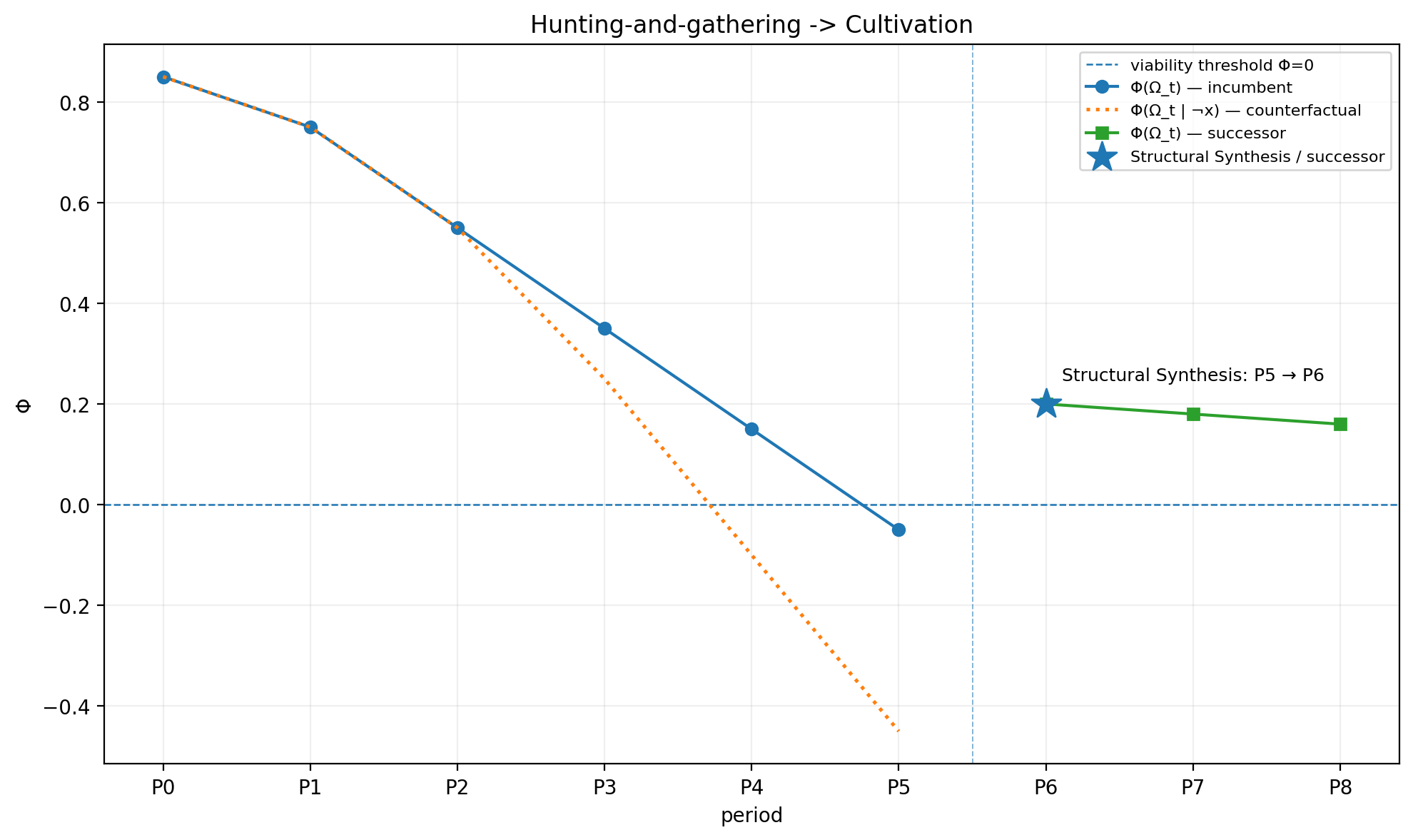
The modeled incumbent viability is Φ = 0.850 at P0, 0.750 at P1, 0.550 at P2, 0.350 at P3, 0.150 at P4, and −0.050 at P5. Cultivation becomes admissible at P3. At P4 the incumbent remains viable (Φ = 0.150), but counterfactually withholding the candidate yields a viability of −0.100 (dependence d4 = 0.250). Because cultivation is structurally admissible and necessary for incumbent survival, P4 satisfies the diagnostic condition for Instability.
At P5 the incumbent crosses below the viability boundary (Φ = −0.050) with counterfactual viability falling to −0.450 (dependence d5 = 0.400), entering Phase Inversion. The Bayesian posterior for cultivation reaches 0.735 against a threshold of 0.550, establishing warrant. The transition is specified on the edge from P5 to P6.
Figure 1. Hunting-and-gathering → cultivation: modeled incumbent viability, counterfactual dependence, and the P5 → P6 transition.
The synthesis marker appears at P6 because P5 is the originating period on which the transition condition Syn5(x) evaluates, whereas P6 is the period in which the viable successor state Ω̂x6 is realized. The successor continues across the simulation window with Φ = 0.200 at P6, Φ = 0.180 at P7, and Φ = 0.160 at P8.
The sequence illustrates the distinction between admissibility, necessity, evidential support, realization, and successor viability. None of these conditions alone constitutes a completed synthesis.
5. Captive-Supply-Dependent Coercion → Alternative Labor Institution
The second example considers a transition from a captive-supply-dependent coercive labour arrangement toward an alternative labour institution. It is used as a historical analogy rather than as a quantitative reconstruction of a particular labour market.
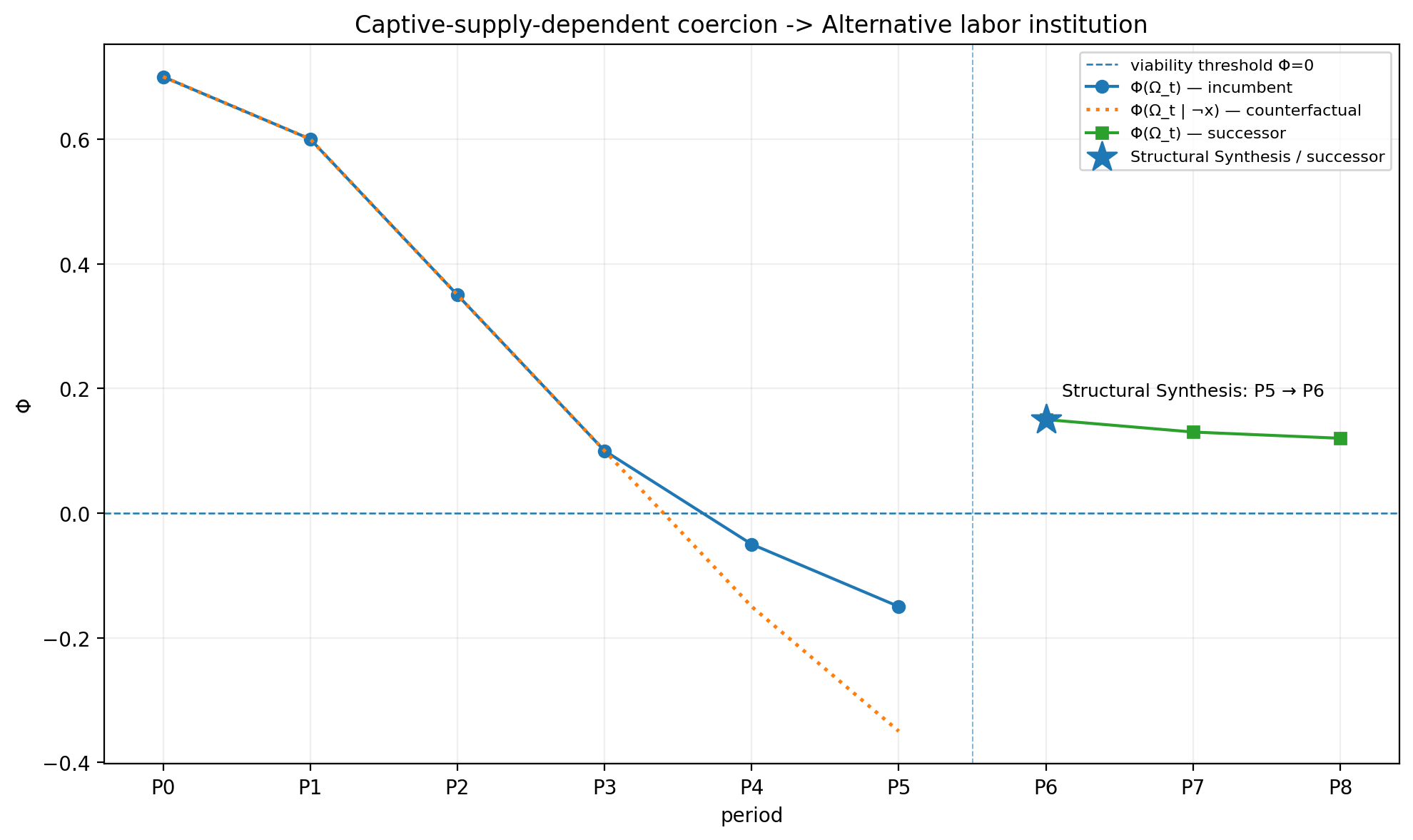
The incumbent remains viable through P3 (Φ = 0.100) and crosses below the viability boundary at P4 (Φ = −0.050), where the candidate becomes admissible and counterfactual viability drops to −0.150 (dependence d4 = 0.100). Because the incumbent is non-viable and an admissible alternative exists, P4 satisfies the diagnostic condition for Phase Inversion.
At P5 incumbent viability deteriorates further to −0.150, with counterfactual viability falling to −0.350 (dependence d5 = 0.200). With admissibility maintained, the posterior probability reaches 0.607 against a threshold of 0.600, establishing warrant under Phase Inversion. The transition is scheduled across the P5 → P6 edge, producing a viable successor state with Φ = 0.150 at P6, Φ = 0.130 at P7, and Φ = 0.120 at P8.
Figure 2. Captive-supply-dependent coercion → alternative labour institution: modeled crisis, evidential support, transition, and successor viability.
The example shows why incumbent failure and institutional replacement are separate questions. The disappearance of viability does not by itself establish an admissible alternative, and admissibility does not by itself establish warrant or realization.
The third example considers serfdom under a Domar-style constraint and a transition toward capitalist tenancy. As with the preceding examples, the numerical parameters illustrate the formal mechanism rather than reconstructing the historical transition quantitatively.
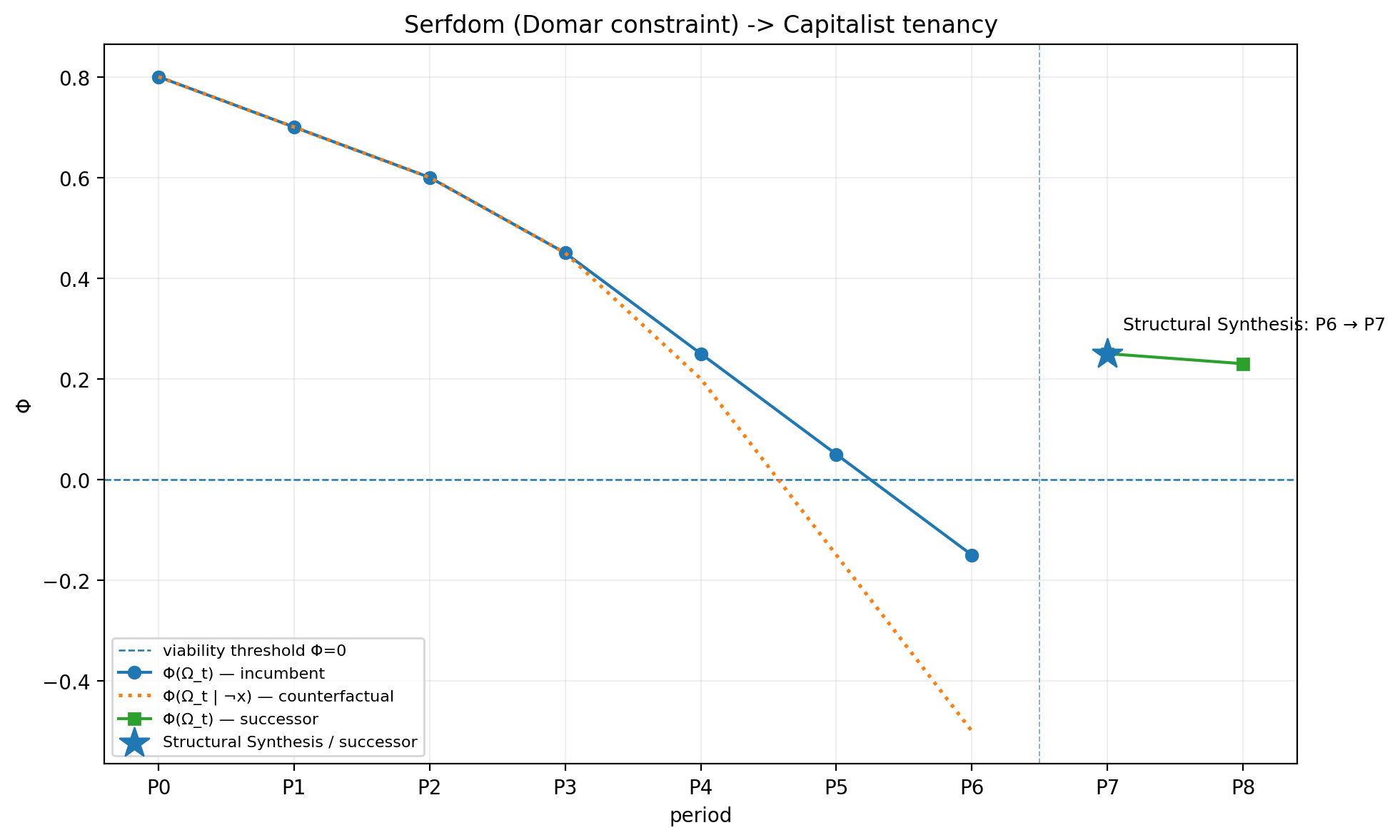
The candidate becomes admissible at P5. At P5 the incumbent remains viable with Φ = 0.050, but removing the candidate drops counterfactual viability to −0.150 (dependence d5 = 0.200). Because the candidate is necessary for incumbent viability, P5 produces the diagnostic condition Instability. At P6 the incumbent viability falls to −0.150 with a counterfactual value of −0.500 (dependence d6 = 0.350), entering Phase Inversion. The posterior probability reaches 0.827 against a warrant threshold of 0.600, establishing warrant.
The transition occurs on the P6 → P7 edge and produces a viable successor state with Φ = 0.250 at P7, continuing to Φ = 0.230 at P8.
Figure 3. Serfdom (Domar constraint) → capitalist tenancy: the modeled P6 → P7 transition and viable successor.
The case separates evidential support from transition. A high posterior does not itself produce the successor. The successor appears only when the transition rule generates it.
7. Capitalism and Demography: Incumbent Viability
The capitalism-and-demography example does not specify a candidate transformation. It therefore evaluates incumbent viability only. The predicates of possibility, necessity, warrant, realization, and synthesis are not applied to a particular alternative.
The normalized viability function is:
Φcapitalism = 0.5n + g − δ − Δ(K/L) + 0.15
n: modeled demographic-growth term
g: productivity-growth term
δ: fixed normalized demographic-pressure parameter, set to 0.010
Δ(K/L): change in capital-labor ratio (capital deepening) used by the simulation
0.15: fixed normalized baseline contribution
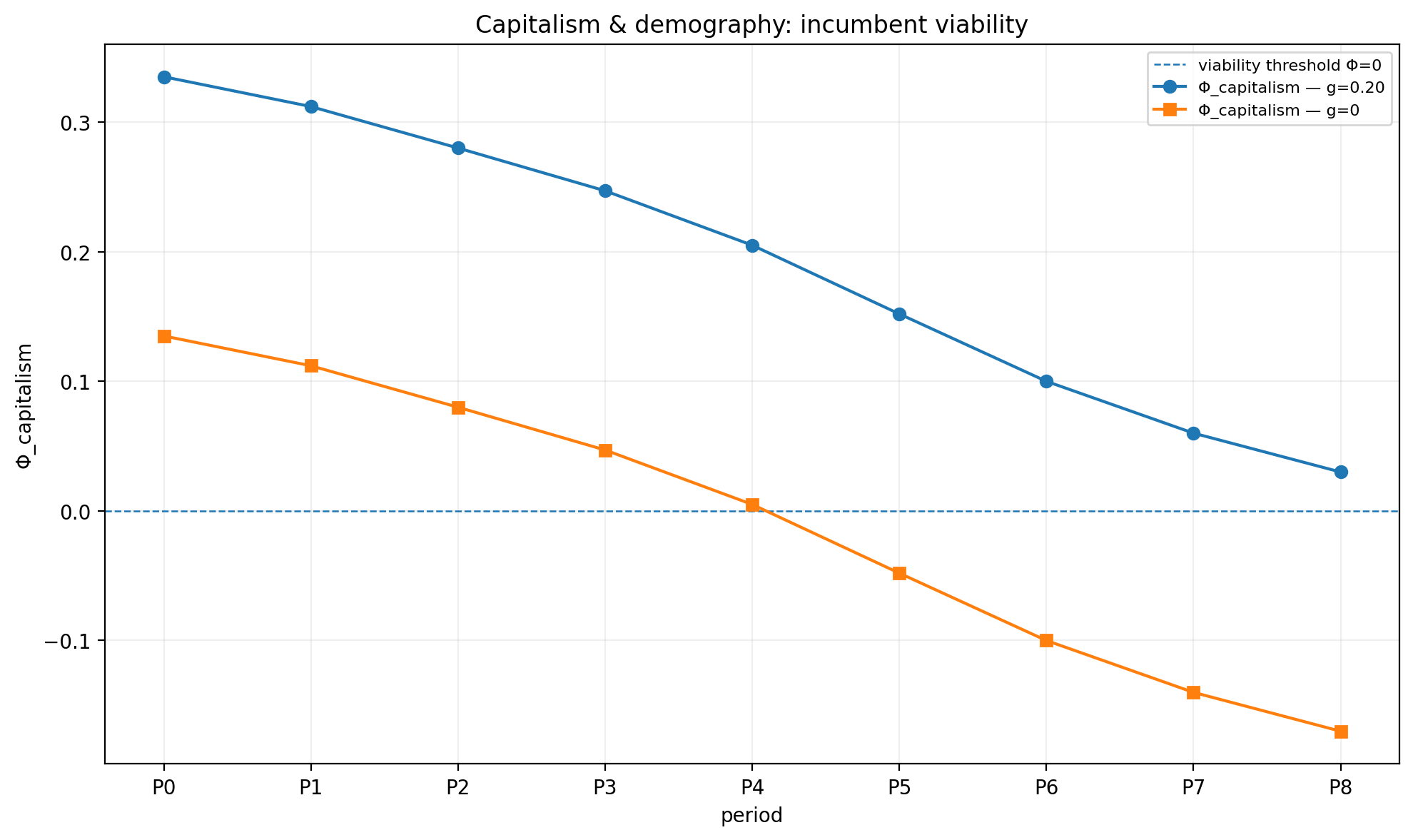
In the simulation, demographic growth declines steadily from n = 0.030 at P0 to 0.000 at P6–P8, while capital deepening increases from Δ(K/L) = 0.020 at P0 to 0.310 at P8 (with δ fixed at 0.010). Figure 4 compares the resulting viability trajectories under sustained productivity growth (g = 0.20, where viability remains positive through P8 at Φ = 0.030) versus zero productivity growth (g = 0, where viability crosses into non-viability at P5 with Φ = −0.048, falling to −0.170 at P8).
Figure 4. Capitalism and demography: incumbent viability under two productivity-growth assumptions across P0–P8.
The figure is a parameterized comparison of viability. It is not a forecast of the future trajectory of capitalism.
8. Verification and Scope
The numerical implementation checks the internal relations specified by the model. For each transition scenario it checks:
that the counterfactual equals Φ(Ωt) − dt(x);
that possibility and the incumbent-viability condition are satisfied when necessity is reported;
that the posterior is calculated from the stated prior and likelihood values;
that warrant is reported only when the posterior threshold is met alongside either necessity or Phase Inversion;
that the scalar transition rule produces the specified successor viability when the transition is enabled;
that synthesis requires warrant, realization, and successor viability;
that the successor becomes the current state after a successful transition;
that incumbent-specific diagnostics are not carried over to the successor state.
The verification concerns the arithmetic and logical consistency of the specified model. It does not demonstrate that the model’s assumptions, parameters, or historical analogies are empirically correct.
The historical examples therefore remain open to empirical and historiographical evaluation. In particular, the numerical values do not establish historical dates, causal magnitudes, or empirical probabilities.
9. The Temporal Structure of Synthesis
The distinction between an event and the state produced by that event is central to the framework. If synthesis occurs at t, then:
Synt(x) → Ωt+1 = Ω̂xt+1
The event belongs to the transition edge t → t+1. The successor belongs to period t+1. Thus a chart may place a synthesis marker at P6 while identifying the transition as P5 → P6.
After the transition:
Ωt+1 := Ω̂xt+1
The successor is then treated as the new incumbent state. Counterfactuals concerning the former incumbent do not automatically carry over to the successor.
This distinction prevents two errors. The first is to treat synthesis as though it were a state that persists across periods. The second is to treat the successor as another observation of the institutional arrangement that preceded it.
10. The Central Distinction
Possible ≠ Necessary ≠ Warranted ≠ Realized ≠ Synthesized.
Possible: the candidate is structurally admissible.
Necessary: the candidate is admissible, the incumbent is viable, and removing the candidate makes the incumbent non-viable under the specified counterfactual.
Warranted: the candidate is necessary or admissible under Phase Inversion, and its posterior probability meets the specified evidential threshold.
Realized: the actual successor satisfies Ωt+1 = FΩ(Ωt, Et, Ut, x), so the full structural state generated by the transition is realized.
Synthesized: the candidate is warranted, the transition is realized, and the resulting successor is viable.
These distinctions separate structural admissibility from structural dependence, evidential support from occurrence, and occurrence from successful institutional replacement. A contradiction or crisis does not determine its resolution. Evidence does not itself produce a transition. A realized transition does not guarantee that the resulting state will remain viable.
11. Conclusion
Structural Dialectics treats institutional transformation as a sequence of formally distinguishable claims. Possibility concerns admissibility. Necessity concerns the dependence of an incumbent on a candidate under a specified counterfactual. Bayesian warrant adds an evidential condition. Realization concerns the transition from one state to another. Synthesis requires the resulting state to be viable.
The distinction between these conditions matters because historical transformation is not exhausted by the presence of contradiction or crisis. An institutional arrangement may become unsustainable without a viable alternative being available. An alternative may be available without being necessary. A necessary alternative may lack sufficient evidential support. A well-supported alternative may fail to be realized. And a realized transition may produce a successor that is itself unstable.
The temporal structure follows directly from this logic. Synthesis is an event on the transition from t to t+1; the successor becomes the current state at t+1. The numerical examples illustrate this structure using normalized values rather than quantitative reconstructions of historical processes.
The claim is that institutional transformation should not be described as a single condition when the relevant questions concern admissibility, dependence, evidence, occurrence, and viability. Keeping those questions distinct makes it possible to say exactly what a formal model establishes and what it leaves open.
All numerical examples in this post use normalized simulation values. They are illustrative model outputs rather than historical measurements.
A while back, I offered some suggestions for a daily training regimen to improve the mind as an alternative to Buddhist meditation. After a little experimentation, I’m ready to try one.
Pills: Omega-3, Magnesium supplements, Citicoline, Lion’s Mane extract. (Indians eat turmeric with every meal. It’s sometimes recommended as a supplement.)
Android apps:
Dominion by Temple Gates Games LLC: Daily challenge for reasoning about dynamic systems.
Logic: code breaking by Logicom Apps: Extreme difficulty for reasoning about permutations. I believe this has an offline version called Mastermind.
Lichess: Puzzle Streak. I think chess trains reasoning about ordered actions when studied in moderation.
Calcudoku by Razzle Puzzles: 9×9 for mental arithmetic and deduction.
Xiangqi Chinese Chess Online by Xiangqi.com, Inc.: Puzzles because I want variation in ordered actions instead of just training on the chess ruleset. I also play a daily game since, for some reason, Chinese Chess is the hardest game for me to wrap my head around, harder than Shogi; plus, it’s short.
Poverty expert Jason Hickel says the living standards of the poorest of the poor are rising while the living standards of people who are slightly wealthier are falling.
In the past, the right wanted to maintain civilized standards of behavior (which was always a lie). The left wanted to radically restructure society to create universal prosperity.
Nowadays, the left says that if everyone moderates their greed, we can all have a reasonably good life. The right says that if you let us get rid of those parasites, “we” can all be rich, rich, RICH!!!
The point I want to emphasize is that the right’s program, despite being made up of lies, sounds more radical. The more radical side will always form the more powerful coalition.
1. Why is this?
Those whose living standards are falling feel like they have nothing left to lose.
Those whose living standards are rising feel like the promised land is just over the horizon. One last assault!
2. Why didn’t this happen before?
In the recent past, the wealthiest countries were afraid of the Soviet Union. They forced their capitalists (a historical fact) to pursue policies that universally raised living standards across society.
This looked like the inevitable march of progress and bound all classes to a common project.
It took decades to sink in that conditions had irrevocably changed.
3. How would doing away with capitalism improve things?
By cutting the power of merchants down to size, all countries can pursue policies that raises the living standards of the majority while halting the insane money grubbing activities of the upper class.
If this happens, the majority will vote for policies that advance a common project once again.
Manim is a Python library that draws math and science animations. You write Python code that says “put a circle here,” “now move it there,” “now turn it into a triangle,” and Manim renders that into an actual video file.
How to read this: each section is a concept, a tiny working example, a plain-English explanation, and two exercises. Sections build on each other in order, so it’s best read top to bottom the first time. Everything in this tutorial is real code.
Table of Contents
Getting Started & Rendering
Your Lego Bricks: Shapes, Colors, and the Coordinate Grid
Moving Things Around: The Positioning Toolbox
Bringing Things to Life: self.play
The Caption Relay: Swapping Text Smoothly
Teams of Shapes: VGroup & Falling Dominoes
The Invisible Remote Control: ValueTracker & Updaters
Live Text Counters: mob.become
Drawing Instantly: Fast Multi-Path Fans
The Sparkler Trail: TracedPath
Arrows With a Mind of Their Own
Graph Paper: Axes, Plotting, and Area Under a Curve
Write Your Own Physics Engine
Morphing: Transform
Faking 3D: The Coin Flip Illusion
The Flying Drone: MovingCameraScene
Video Game HUD & the Shrinking-Zoom Trick
Example 1: The Quantum Slit Experiment
Example 2: A Planet in Orbit
1. Getting Started & Rendering
Before you animate anything, you need a movie set. In Manim, that set is called a Scene. Everything you draw and move happens inside one method called construct. When you’re done writing the code, you don’t press a “play” button. You type a command into your terminal, and Manim renders (builds) your code into an .mp4 video file, frame by frame.
from manim import *
class HelloWorld(Scene):
def construct(self):
circle = Circle(color=BLUE, fill_opacity=0.5)
self.play(Create(circle), run_time=2)
self.wait(1)
# Save this as tutorial.py, then in your terminal:
# uv run manim -pql -o text.mp4 .\tutorial.py HelloWorld
Think of -pql as “preview, quality: low.” It builds fast but looks blurry, which is fine while you’re still fixing bugs. -pqh is “quality: high,” for your final export. -o specifies the output video file. Find it under .\media\videos\<project name>.
Every scene file in the set starts the exact same way:
class KeplersPattern(Scene):
def construct(self):
self.camera.background_color = "#0b0b0f"
...
That self.camera.background_color line is the very first thing to set. It paints the whole background a near-black color before anything else gets drawn, so nothing ever flashes white.
Exercises
Speed Test: Render HelloWorld with -pql, then again with -pqh. Time how much longer the high-quality version takes.
Ghost Buster: Add --disable_caching to your render command. Manim sometimes remembers old edits and reuses stale frames. This flag forces a fresh build.
2. Your Lego Bricks: Shapes, Colors, and the Coordinate Grid
What it is: Manim’s canvas is a coordinate grid, just like graph paper. The very center of the screen is ORIGIN, the point [0, 0, 0]. Everything you draw needs a shape and, usually, a color.
The basic shapes you’ll use constantly across all scenes:
Dot(ORIGIN, radius=0.16, color="#e8a23d") # a filled circle point
Circle(radius=2.6, color=GREY_C, stroke_width=2,
fill_color="#22303f", fill_opacity=0.9) # a ring, or filled disc
Line(LEFT * 5.5, RIGHT * 5.5, color=GREY_D) # a straight segment
DashedLine(ORIGIN, [1, 0, 0], color=GREY_D) # a dashed segment
Polygon(p1, p2, p3, p4, color=BLUE,
fill_color=BLUE, fill_opacity=0.45) # any closed shape (will not work as written)
Triangle(color=GREY_B, fill_color=GREY_B,
fill_opacity=1) # a filled triangle
After you define the shapes, you can add them to the scene without animations with self.add() like this:
self.add(dot, circle line)
Manim gives you built-in color names in capital letters: BLUE, RED, GREY_A through GREY_E (a whole ramp of greys, A lightest to E darkest), YELLOW, GREEN, and so on. You can also use a hex code string, the same way you would in web design: "#e8455c". Every scene in this project builds its own small named palette at the top of the file, like:
SUN_COLOR = "#e8a23d"
PLANET_COLOR = "#4fc3f7"
SWEEP_COLOR = "#e8455c"
This is a good habit. Name your colors once, by what they mean (“sun,” “force,” “resolved answer”), and reuse the name everywhere.
The direction words:UP, DOWN, LEFT, RIGHT are actually tiny vectors (arrows with a length of 1), and you can multiply and add them like numbers:
UP * 2.3 # two-and-a-bit units up from wherever you're measuring from
LEFT * 4.5 + UP * 1.7 # up and to the left, combined
Exercises
Palette Builder: Make a scene with five Dots in a row, each one a different named color (RED, BLUE, GREEN, YELLOW, PURPLE).
Hex Hunter: Pick your favorite color from an online color picker, copy its hex code, and use it to color a Circle.
3. Moving Things Around: The Positioning Toolbox
What it is: Once a shape exists, you have several tools to place it exactly where you want.
dot.move_to(ORIGIN) # teleport to an exact point
dot.move_to([3, 1, 0]) # or an exact [x, y, z] coordinate
dot.next_to(other_dot, UP, buff=0.3) # sit just above another object,
# with a small gap ("buff") between
dot.to_edge(UP, buff=0.6) # stick to the top edge of the screen
dot.shift(RIGHT * 2) # nudge it: move relative to where it already is
dot.scale(0.5) # shrink to half size (or scale up if > 1)
dot.rotate(PI) # spin it, in radians (PI = 180 degrees)
move_to teleports to an absolute spot. shift moves relative to wherever the object currently is: the difference between “stand at the corner of 5th and Main” and “take two steps to your left.”
next_to is the one you’ll use most for labels: “put this text just above that dot.” buff only works for next_to, not move_to.
label = Text("the sun", color=GREY_D).scale(0.3)
label.next_to(sun_dot, DOWN, buff=0.3)
Exercises
Label Everything: Draw three dots in a triangle shape and label each one with next_to.
Corner Crawl: Take one square and animate it moving to all four edges of the screen in a row, using .animate.to_edge(...).
4. Bringing Things to Life: self.play
What it is: Just creating a shape with self.add(shape) makes it appear instantly, with no animation. self.play(...) is how you tell Manim “animate this transition, over this many seconds.”
The animation verbs you’ll use over and over:
self.play(Create(circle), run_time=2) # draw its outline, like a pen tracing it
self.play(FadeIn(circle), run_time=1) # appear by fading in
self.play(FadeOut(circle), run_time=1) # disappear by fading out
self.play(Flash(dot, color=RED), run_time=0.5) # a quick starburst flash, good for "impact!"
self.play(dot.animate.move_to(RIGHT * 3)) # animate ANY property change smoothly
self.wait(1) # just pause, nothing moving
That .animate trick is the most powerful one: stick .animate in front of almost any object, then call whatever method you’d normally call, and Manim smoothly tweens (interpolates) from the current state to the new one instead of snapping instantly.
rate_func controls the pacing of the motion. linear means constant speed, no easing. smooth (the default) eases in and out gently. rush_into starts slow and rushes toward the end; it’s used in the integral scene to make a counter “race” toward its final answer.
You can animate a change of color with .animate.set_color() inside self.play():
self.play(dot.animate.set_color(RED))
You can animate several things in the same self.play call, and they’ll all happen together:
            Flash(
                dot,
                flash_radius=0.9,  # Default depends on object size/buffers
                line_length=0.8,   # Length of the flashing lines
                num_lines=40,       # Number of individual lines
                color=RED
            )
Exercises
Race the Rate Functions: Animate the same dot moving the same distance three separate times, using rate_func=linear, then rate_func=smooth, then rate_func=rush_into. Watch how differently each one feels, even though the start and end points never change.
Impact Moment: Animate a ball falling, then call Flash the instant it lands.
5. The Caption Relay: Swapping Text Smoothly
What it is:Never let two captions be visible at once. Every time the narration needs to say something new, the old caption fades out at the exact same moment the new one fades in.
caption = Text("Each planet traces an ellipse.", color=GREY_A)
caption.scale(0.48).to_edge(UP, buff=0.6)
self.play(FadeIn(caption), run_time=0.8)
self.wait(1.0)
new_caption = Text(
"The sun sits at one focus — not the center.", color=GREY_A
caption = new_caption # <-- IMPORTANT: reassign the variable!
After the swap, caption now refers to the new text object, so the next swap can fade it out correctly. Forgetting to reassign is an easy bug to make in Manim. You’ll end up trying to fade out something that’s already gone, and Manim gets confused.
The same “old fades out as new fades in” idea also works for whole groups of objects, not just captions. Swap one shape for a completely different one, over and over, without ever leaving stale objects to clutter the screen.
Exercises
Five-Line Story: Write a five-caption story (like a joke with a punchline) using this relay pattern, one self.wait() between each line for comic timing.
Two-Line Caption: Use \n inside a Text(...) string to make a caption wrap onto two lines, like Text("First line\nSecond line").
6. Teams of Shapes: VGroup & Falling Dominoes
What it is: A VGroup bundles several mobjects (“Manim objects”) into one team, so you can move, color, or animate all of them together with a single command.
squares = VGroup(*[Square(side_length=0.5, color=BLUE) for _ in range(10)])
squares.arrange(RIGHT, buff=0.2) # line them up in a neat row automatically
arrange saves a lot of work. Instead of computing ten x-coordinates by hand, just say “put these in a row,” or arrange(DOWN) for a column.
If you make all ten squares appear at the exact same instant, it looks flat and boring. LaggedStartMap staggers the start time of each one’s animation by a tiny amount, so they cascade like dominoes:
lag_ratio=0.1 means each square starts its own animation 10% of the total duration after the previous one started. The “same pull, everywhere” scene uses this same idea (with LaggedStartMap(FadeIn, arrows, lag_ratio=0.05)) to make sixteen little particle arrows pop in around a mass one after another, like a burst rather than a single flat pulse.
You can also grab specific members out of a group using conditions. The “why gravity” scene picks out just the arrows pointing toward a second mass, out of a full ring :
That’s a dot product doing the work (a bit of vector math: it’s large when two directions point roughly the same way, and small or negative when they don’t), answering “which arrows are aimed toward the second mass?” and fading only those out.
Exercises
Raindrops: Make 15 dots fall from the top of the screen to the bottom using LaggedStartMap, so they don’t all land at once.
Half a Circle: Arrange 12 arrows in a ring pointing outward (like a clock), then use a dot-product filter like the one above to fade out only the ones in the top half.
7. The Invisible Remote Control: ValueTracker & Updaters
What it is: A ValueTracker is an invisible dial. It holds a single number and doesn’t draw anything on screen by itself. An updater is a tiny robot you attach to a shape. Every single frame, that robot checks the dial’s current number and redraws the shape to match.
heart.clear_updaters() # ALWAYS turn the robot off when you're done!
That last line is critical. If you forget clear_updaters(), the robot keeps running forever, checking a dial that’s no longer changing, silently wasting time and sometimes causing weird bugs in later parts of your scene.
A planet’s position keeping pace with orbit progress, a rod’s rotation angle in the Cavendish experiment, an arrow that always points from a dot toward a moving target. The Cavendish torsion balance scene, for example, ties a rotation angle to a dial:
theta = ValueTracker(0.0)
def right_end():
a = theta.get_value()
return np.array([L * np.cos(a), L * np.sin(a), 0])
The Fading Ghost: Change the heartbeat example so the updater changes the dot’s opacity instead of its radius.
Double Speed: Change the math inside the sine wave (t * PI * 2 → t * PI * 4) so the pulse happens twice as fast for the same dial speed.
8. Live Text Counters: mob.become
What it is: Text objects showing numbers (“576 ft”, “160 ft/sec”) can’t just have their number changed. Manim text is drawn as a fixed shape, not a live variable. The fix is the same updater trick from Section 7, but instead of resizing a shape, the robot builds a brand-new Text object every frame and swaps it in with .become().
The line new_text.move_to(mob.get_center()) matters. Without it, every new number would snap back to the screen’s default center instead of staying where the old one was.
This same trick is used in this Zeno’s Paradox scene:
Remember: attach the updater after your FadeIn finishes, not before. Attaching it too early can make the fade-in animation and the .become() rebuild fight over the object’s internal state and crash.
Exercises
Countdown: Build a rocket-launch timer counting from 10.0 down to 0.0.
Big Numbers: Use Python’s comma formatting (f"{int(val):,}") to build a counter that races up to 1,000,000.
9. Drawing Instantly: Fast Multi-Path Fans
What it is: Animating 50 or 150 separate objects one at a time, step by step, will slow down your computer. The trick is to do all the math first, in plain Python/NumPy (instantly, with no animation involved), and only hand the final points to Manim to draw as one shape.
import numpy as np
points = [np.array([x, y, 0]) for x, y in zip(x_positions, y_positions)]
path.set_points_as_corners(points) # connect the dots instantly
set_points_as_corners takes a plain list of coordinates and draws straight segments between them, like a connect-the-dots puzzle, computed in one shot instead of animated point by point. This is how the ellipse-tracing math in Kepler’s First Law and the zig-zag particle paths in the quantum slit scene both get built: hundreds of points calculated with numpy, then drawn as a single VMobject.
You can build many of these at once and let Create (or LaggedStartMap(Create, ...)) animate all of them together:
all_paths = VGroup()
for _ in range(50):
... # calculate points for one path
all_paths.add(path)
self.play(Create(all_paths), run_time=2.5)
Exercises
Color Variation: Color each path RED if it ends up high on screen and BLUE if it ends up low, based on its last point’s y-coordinate.
Burst Effect: Make every path start at the exact center of the screen and shoot outward in a random direction, like fireworks.
10. The Sparkler Trail: TracedPath
What it is:TracedPath is like tying a lit glowstick to a moving dot. It automatically draws a glowing trail behind whatever point you give it, updating every frame, with zero manual math required.
self.add(trail, dot) # add BOTH: the trail needs to exist before the dot moves
self.play(dot.animate.move_to(UP * 2))
self.play(dot.animate.move_to(RIGHT * 4))
You pass dot.get_center (the function itself, without parentheses), not dot.get_center(). TracedPath calls that function every frame to ask “where are you now?”
A cannonball’s flight path and the “falling sideways” parabola both leave a visible arc behind them as they move:
(MoveAlongPath is covered properly in Section 13. It’s how you move a dot along a pre-computed curve rather than a straight line.)
Exercises
Loop-de-Loop: Animate a dot moving in a circle (dot.animate.move_to(...) at several points around a circle, or use Rotate) to draw a glowing hula hoop.
Stock Market: Move a dot to a series of random y-coordinates, one after another, to draw a jagged trail.
11. Arrows With a Mind of Their Own
What it is: An Arrow is a shape with a start point and an end point. A static arrow just sits there. But combined with the updater trick from Section 7, an arrow can constantly re-aim itself at a moving target, which is useful for force vectors, velocity vectors, or “pull toward the center” diagrams.
direction = -stone.get_center() / np.linalg.norm(stone.get_center())
m.put_start_and_end_on(stone.get_center(), stone.get_center() + direction * 0.7)
pull_arrow.add_updater(update_pull)
put_start_and_end_on(start, end) is the key method: every frame, it redraws the arrow (or a plain Line) between two fresh points. direction is computed as a unit vector (the vector divided by its own length, via np.linalg.norm), so it always has length 1, pointing the right way no matter how close or far the stone currently is. Multiplying that by 0.7 gives an arrow that’s always 0.7 units long and always aimed correctly.
The “whirling stone on a string” scene uses two such arrows at once, one for the inward pull and one for the sideways velocity, both staying attached and correctly aimed as the stone circles around:
That tangent vector [-sin(angle), cos(angle), 0] is a standard trick. For a point moving in a circle, this formula always points in the direction of travel (90 degrees rotated from the “outward” direction). There’s no need to track velocity separately. You can derive it from the current angle.
Exercises
Compass Needle: Make an arrow that always points from a moving dot toward a fixed target dot, no matter where the moving dot goes.
Two Arrows: Recreate the stone-on-a-string example, one arrow pointing to the center and one pointing tangent to the circle. Watch how they stay perpendicular to each other the whole time.
12. Graph Paper: Axes, Plotting, and Area Under a Curve
What it is:Axes builds you a labeled coordinate system to plot real functions on. It’s the backbone of both the derivative and integral scenes.
x_range/y_range are [start, end, step]. The step just controls default tick spacing, which is often turned off (include_ticks: False) in this project since the scenes prefer clean, uncluttered graphs.
The method to know is axes.c2p(x, y), short for “coordinate to point.” Your function’s math coordinates (like “5 seconds, 400 feet”) aren’t the same as the screen’s actual pixel/unit coordinates, because the axes might be shifted, scaled, or positioned anywhere. c2p does that translation for you:
Any time you want to draw something (a dot, a line, a secant) at a specific data point on your graph, you run it through axes.c2p() first.
Filling the area under a curve (used for the integral scene’s final “smooth area” reveal) is one call:
area = axes.get_area(curve, x_range=[0, 6], color=GREEN, opacity=0.4)
self.play(FadeIn(area))
Exercises
Plot Your Own: Graph y = x**2 from x=-3 to 3 using axes.plot, and mark the point at x=2 with a Dot placed via axes.c2p.
Shade a Region: Use get_area with a restricted x_range (like [1, 2]) to shade just one slice of the curve instead of the whole thing.
13. Write Your Own Physics Engine
Some of the most impressive shots aren’t hand-animated but simulated. Real physics math, run in a plain Python loop, computed before any animation happens. Manim then draws the result.
This is the same “do the math first, animate second” idea from Section 9, applied to motion under a changing force instead of a fixed set of points.
Here’s the core idea is that a symplectic Euler integrator (a fancy name for “take tiny time steps, and at each step, update velocity from acceleration, then update position from velocity”):
accel = -g * p / r # gravity always points toward the center
vel = vel + accel * dt # tiny nudge to velocity
p = p + vel * dt # tiny nudge to position
path.append(p.copy())
if np.linalg.norm(p) < R_ground: # hit the ground?
break
return np.array(path)
Why “tiny steps” instead of one big calculation? Because gravity’s direction keeps changing as the object moves (it always points toward the planet’s center). There’s no simple formula for the whole path at once, so the computer approximates it by taking thousands of small, fast steps.
Once you have the list of points, you convert it to a Manim-ready path (the same set_points_as_corners trick from Section 9) and animate a dot moving along it with MoveAlongPath:
path_curve = VMobject()
path_curve.set_points_as_corners([[x, y, 0] for x, y in path_pts])
MoveAlongPath is different from dot.animate.move_to(...): move_to always travels in a straight line to the destination, no matter what. MoveAlongPath follows the exact curve of an already-drawn path, which matters for anything that isn’t a straight line, like an orbit or a cannonball’s arc.
The Kepler orbit scene uses a related trick. Instead of simulating position directly, it simulates how angle changes with time (because “equal areas in equal times” is a statement about that relationship), and builds a lookup table. It then reads any position back out with np.interp (linear interpolation, meaning “estimate a value that falls between two known table entries”):
k = 1.0
dtheta = 0.0015
thetas, times = [0.0], [0.0]
theta, t = 0.0, 0.0
while theta < TAU:
r = r_of_theta(theta)
dt = dtheta * r ** 2 / k # this line encodes "equal areas in equal times"
Then a ValueTracker for elapsed time, plus an updater, plug straight into everything you learned in Section 7 to move the planet dot smoothly along its (physically correct, non-uniform) speed.
Exercises
Drop a Ball: Simulate free-fall under constant gravity (accel = [0, -9.8], no “always point at center” needed) for two seconds, using the same tiny-step loop, then animate a dot along the resulting path.
Bouncing Ball: Modify the loop so that when the simulated ball’s height goes below zero, its vertical velocity flips sign (multiply by -0.8 to lose a little energy each bounce) instead of stopping. Watch it bounce.
14. Morphing: Transform
Transform smoothly morphs one mobject’s shape into another’s, in place. That’s different from FadeOut + FadeIn, which makes one object disappear and a completely different one appear. Transform visually stretches, bends, and recolors the same object into its new form.
secant = new_secant # same variable-reassignment habit as Section 5!
This is how the derivative scene makes its secant line visibly “snap” toward the true tangent line as the interval shrinks: same object, quietly becoming more accurate every step, then finally recoloring from red (“provisional guess”) to green (“resolved, exact answer”) the instant it becomes the true tangent:
Rule of thumb: use Transform when you want the audience to feel “this is still the same thing, just becoming more accurate or different.” Use FadeOut+FadeIn (Section 5) when you want “this is a totally new, unrelated thing.”
Exercises
Square to Circle: Transform a Square into a Circle of the same color, and watch how Manim automatically interpolates the corners into curves.
Color Reveal: Transform a grey, dashed guess-line into a solid, brightly-colored “correct answer” line, exactly like the derivative scene’s secant-to-tangent moment.
15. Faking 3D: The Coin Flip Illusion
What it is: You don’t need a real 3D engine to fake a spinning coin. Squish a circle’s horizontal width down to almost nothing, and it reads as “edge-on,” exactly like a coin flipping through the air.
self.play(coin.animate.stretch(0.04, dim=0), run_time=0.5) # squish to 4% width
self.play(coin.animate.stretch(25, dim=0), run_time=0.5) # 0.04 * 25 = back to 100%
stretch(factor, dim=0) scales only one axis: dim=0 is horizontal (x), dim=1 is vertical (y). The second stretch uses 25, not 1, because you’re scaling from the already-squished state, and 0.04 * 25 = 1.0 gets you back to full width.
Exercises
Triple Flip: Loop the squish/unsquish three times in a row for a coin that flips multiple times before landing.
Heads and Tails: Put a letter “H” on the coin’s face, and swap it for “T” (using the FadeOut/FadeIn caption-relay trick from Section 5) at the exact moment it’s squished flat.
16. The Flying Drone: MovingCameraScene
What it is: A regular Scene has a camera bolted to a tripod; it never moves. A MovingCameraScene gives you a camera on a drone: self.camera.frame is itself an object you can move, and, importantly, zoom, by changing its width.
class CameraFlight(MovingCameraScene):
def construct(self):
self.camera.frame.move_to(start_dot).set(width=4) # start zoomed in
A smallerwidth value means you’re more zoomed in (you’re looking at a narrower slice of the world, blown up to fill the screen). A larger width zooms out.
This tool is what makes Zeno’s paradox and the zoom into a derivative work. Both scenes repeatedly narrow width around a shrinking gap, so the audience’s eye is dragged closer and closer into an ever-smaller region, mirroring the math getting more precise.
Exercises
Three Stops: Add a third dot far to the right and make the camera drone visit all three dots in sequence.
Pull Back: After zooming all the way in on one dot, animate the camera back out to a wide width=20 so the audience sees the whole scene again.
17. Video Game HUD & the Shrinking-Zoom Trick
What it is: Once your camera starts moving and zooming (Section 16), a problem appears. Ordinary text and shapes zoom with the camera. A caption that looked normal-sized suddenly becomes gigantic (or tiny) as the frame shrinks. You need a “HUD,” short for heads-up display, that stays a fixed, readable size no matter how the camera moves, the same way a health bar stays put in a video game.
The fix is one more updater (Section 7), attached to the text, that re-reads the camera’s current frame every single frame and re-pins itself:
def pin_to_hud(mob):
frame = self.camera.frame
mob.scale_to_fit_width(frame.width * 0.6) # always take up 60% of the visible width
mob.move_to(frame.get_bottom() + UP * frame.height * 0.1) # stay near the bottom
caption.add_updater(pin_to_hud)
pin_to_hud(caption) # call it once immediately too, so it's placed correctly right away
Calling the function once by hand (pin_to_hud(caption)) in addition to attaching it as an updater is a small but useful habit. The updater only runs starting from the next frame, so without that manual call, the caption would appear in the wrong spot for one frame before snapping into place.
Then rescale everything else. It’s not just text that needs to be rescaled during a zoom. Line thickness (stroke_width) is measured in fixed screen pixels, not world units, so as the camera zooms in, a normal line looks proportionally thicker and thicker, eventually swallowing the whole shot in a solid color bar if you don’t correct for it. The fix, used in both the Zeno and derivative scenes, is to recompute stroke width and dot size as a fraction of how much you’ve zoomed:
stroke_scale = zoom_width / INITIAL_FRAME_WIDTH
target_stroke = max(2 * stroke_scale, 0.05) # never let it hit exactly zero
target_dot_width = zoom_width * 0.035
self.play(
spine.animate.set_stroke(width=target_stroke),
achilles.animate.set(width=target_dot_width),
self.camera.frame.animate.set(width=zoom_width),
run_time=0.9,
)
Exercises
Scoreboard Corner: Modify pin_to_hud to stick text in the top-right corner instead of the bottom-center.
Zoom Without Breaking: Draw a Line and a Dot, then zoom the camera to width=0.5 (very close). Without the rescaling trick, watch how huge and blobby they become. Then add the rescaling and compare.
18. Example 1: The Quantum Slit Experiment
What it is: A single scene that combines Section 9’s “compute-then-draw” trick with real (simplified) physics, to visualize a well-known idea. When a particle’s position is measured very precisely (a narrow slit), its momentum becomes correspondingly uncertain (it scatters wide). That’s the Heisenberg uncertainty principle, in one picture.
import numpy as np
from manim import *
class TheSlitExperiment(Scene):
def construct(self):
self.camera.background_color = "#0b0b0f"
np.random.seed(23) # freeze the "randomness" so it's the same every render
Every ingredient here is from earlier sections: np.random for the physics, set_points_as_corners (Section 9) to draw each particle’s path instantly, np.clip as an invisible wall so particles can’t fly off-screen, and LaggedStartMap (Section 6) so all 40 particles fire in a cascading burst rather than all at once.
Exercises
Wide Slit: Change slit_height to 2.0 and watch kick_strength shrink accordingly. A wider slit means much less uncertainty, so particles land in a tight cluster instead of scattering.
Landing Dots: After the paths finish drawing, use a loop and LaggedStartMap(FadeIn, ...) to fade in a Dot at each particle’s landing spot on the screen.
19. Example 2: A Planet in Orbit
What it is: A second scene, combining Section 2 (shapes), Section 5 (caption relay), Section 7 (ValueTracker/updaters), Section 9 (fast path drawing), and Section 13 (writing your own physics loop) into a single self-contained scene: an ellipse, a sun off-center at one focus, and a planet that visibly speeds up near the sun and slows down far away. This is how orbits actually work:
from manim import *
import numpy as np
class MiniOrbit(Scene):
def construct(self):
self.camera.background_color = "#0b0b0f"
a, e = 3.0, 0.6 # semi-major axis, eccentricity
def r_of_theta(theta):
return a * (1 - e**2) / (1 + e * np.cos(theta))
# Section 9: pre-compute the ellipse's points, draw instantly
Render it, and the planet visibly races through the part of the ellipse closest to the sun, then crawls through the far side, with no hand-tuned speed curve anywhere in the code. That behavior falls straight out of the physics loop.
Exercises
Change the Shape: Try e = 0.1 (a much rounder orbit) versus e = 0.85 (a very stretched one) and see how dramatically the speed variation changes.
Add the Sweep: Using the Polygon trick from Section 2, shade two thin wedges, one near the sun and one far away, covering equal time intervals (use theta_at_time). Confirm by eye that they look like roughly the same area despite very different shapes.
There’s an assumed metaphysics behind mainstream 21st century thinking on both the left and the right: 1. every individual belongs to a cultural collective, 2. culture determines values and that 3. the values of each culture Platonically emanate out of its religion.
On the left, these people argue for multiculturalism. On the right, these people argue for civilizational war as an objective reality regardless of how you wish to respond to it (Samuel Huntington); much like how some people think race war in an objective reality. The weird left engages with this narrative in a weird way. E.g. Zizek says only a Christian can be a real atheist.
I don’t find the 21st century’s self-evident truths to be particularly convincing. I will group my answer under a number of headings:
The relativity of concepts.
The fact that Marxism can be shoehorned into value-speak doesn’t prove that value-speak is more fundamental. It is known that different sets of ideas can be mutually reducible to each other:
Let the color grue be defined as “green till today and blue from tomorrow”. Let the color bleen be defined as “blue till today and green from tomorrow”. Grue and bleen appear to be complex colors defined on the basis of the fundamental colors blue and green. However, the color blue can also be defined as “bleen till today and grue from tomorrow”. Now blue appears to be a composite.
Analytic philosophy calls these “gruesome” properties.
Marxism does its best to avoid introducing positive values, let alone being a culture.
Value-speak can also be shoehorned into Marxism. In Marxist analysis, values are determined by an outcome of material processes.
According to Marxism, religions are grafted-on tools that facilitate post hoc apologetics. Many people do sincerely believe in religion. They are all weak-minded fools who are being manipulated by their leaders. (I say they are “fools” in the sense that they will lose over time: https://en.wikipedia.org/wiki/Foolishness_for_Christ Not in the sense that they deserve to be oppressed.)
This explains why people claim to be part of a religion when they systematically refuse to follow the values it teaches. This, and the fact that Marxism goes out of its way to avoid providing positive values is precisely what many people find abominable about it.
How Marxism can propose positive programs without values.
Some things in Marxism look like goal-oriented behavior:
r b: people do things that don’t make financial or economic sense all the time, and can often be a lot harder to bribe than they would be if material factors would be as all-determining as Marx and you claim.
Raphael
I agree. The Marxist answer is that those people lose over time. The Social Darwinist conclusion is: therefore, the poor must die. The Marxist conclusion is: therefore, society must be reconstructed to let everyone do the work they enjoy doing.
These are what emerges from below when the dispossessed unite in solidarity and take back what’s theirs, a rational outcome of popular organizing in terms of a confluence of materialistic goals. Marxism isn’t adding any extra spice.
What I’m taking from Marx.
I’m not following Marx on his values. I’m following a reductive method of analyzing societies first popularized by Marx. The approach itself predates him. Thoreau writes in Walden that every college student learned political economy in his day. Nowadays, it is associated solely with Marx in an attempt to discredit it.
I don’t take his semantic and philosophical claims seriously. In the polemical tracts where Marx does seem to be speaking of values, I find him bombastic and unconvincing. (It wouldn’t surprise me if he intended polemics like the Communist Manifesto to sound bombastic.) Where I speak of values, my go-to is the liberal philosopher Rawls: https://plato.stanford.edu/entries/rawls/#TwoPriJusFai
Of course, some people argue that a method of analysis is also a value, but then everything is a value. This lens of “values” means adopting the 21st century approach to begin with, a case of doubling down on one perspective and refusing to see the world from another. Basically, it’s the “atheism is a religion” trope again.
From the lens of values, I think seeing things in terms of values is of dubious value.
I tend to avoid speaking of values because it’s always an imposition. If I tell someone: “Rawls says X. Now do it!” I am telling them to abandon what their reason says is good and subordinate themselves to Rawls; otherwise, I will be really mad at them.
This is the factor that makes liberals sound like hysterical school marms. People can always just say, “no”.
The Marxist perspective is better for coalition building. Without values, people don’t need to agree to fight for the same goals as long as their materialistic goals align.
The 21st century lens is actively harmful.
Dividing people into groups is known to undermine solidarity. Let me give you a simple example to show you what I mean. Those who assimilate to Western culture in Kolkata often turn out to be fascist. A common sense conclusion many would draw in accordance with mainstream 21st century metaphysics is that Western culture is fascist. You can clearly see what’s wrong with this through a Marxist class analysis: If someone can assimilate into Western culture while living in Kolkata, the city of beggars, what does that say about their wealth and status in society?
It is for reasons like these that I believe class analysis fits the facts better.
Even on the left, 21st century metaphysics is being used to tell people to stay within their own culture, destroying cosmopolitanism. It’s so bad that nowadays, many people think a leftist is a small-minded gremlin who wants everyone to stay inside one culture and interact like primitive tribes, whereas being right-wing means being cosmopolitan!
I agree with the spirit of this criticism. Formative influences in my childhood include, in no particular order: 1. Casual Islam. Only my mother prayed, and only because she wanted to. 2. Bengali art. 3. Soviet space mania with its ancillary physics and mathematics. 4. Books from across the world, and 5. A steady stream of pop media diet.
So no, I don’t appreciate the 21st century’s insistence on classifying me with “Muslim” “culture”.
I have nothing against variation among humans.
I’m only rejecting culture as the explanation for human variation. I just think it’s covered by: 1. Marxism’s “everyone should be allowed to do the work they enjoy”, 2. Psychological variation, 3. Institutional practices, etc. I don’t need “culture” to explain anything.
Draft 7: Yet more typos and copy-paste errors I introduced while trying to fix the text. Added the /z/ law L10a.
Draft 6: More typos. Said anθtka for humankind instead of anθka in the lexicon. Added the -st coda.
Draft 5: Added two sentences at the end of the accusative overlay paragraph explaining how the “source” is conceived of in Laulai. Thanks to bradrn on the ZBB for suggesting the term “metalinguistic”.
Draft 4: Explaining the -am.
Draft 3: Mentioned the accusative overlay style. Death and typos.
Draft 2: Typos. Corrected one grammatical description.
0. Introduction
0.1 The language and its speakers
Laulai [lau.ˈlai] (exonym: Neo-Arcadian) is spoken by some eight million people whose ancestors left the Earth in the sixth century AD and have been living ever since in armored holds strung from Mercury to the middle system. They are descended from an Arcadian hill people and from the brotherhood that came up into their valley out of Kroton carrying the Pythagorean doctrine.
The Laulai will tell you their name means lau “wave” + lai “beginning”: the first wave, those of the first rising, the Vanguard. It probably does not. Laulai is a substrate word, opaque in and older than Auloic. The brotherhood used it for the hill people they settled among. The Laulai think they are the master race of the solar system, but they continue to use the old name.
The brotherhood came out of Magna Graecia believing that number governs the world. In the highlands, they proved there is a small set of intervals, the serk or true intervals, such that a physical system brought into alignment with one does mechanical work. Provided that a mind is present proving the theorem, a hull built to the proportion of a serk in the appropriate units accelerates, and a resonator tuned to one turns a dynamo. This force is called vril †, a word that comes from late Latin. A people who were farming goats in 500 BC reached the moon in a thousand years propelled by this power.
The ratios are complicated. They are not the ratios the historical Pythagoreans wrote down: 2:1, 3:2 and 4:3. Finding a new one is the work of multiple lifetimes. Each guild knows a handful and keeps them secret.
The mathematics has to be done by a mindin real time. A serk on a plate doesn’t generate power by itself. A person (a loaded term in Laulai) has to understand the math and prove the theorem. Conducting the proof is physical work performed by a nervous system that makes it effective. The Laulai word for this capacity is sorm, the reach. The Laulai word for developing this ability is xamn, the waking. See §0.3 below.
0.2 The ksost
The ksost are planetary-scale globules of exotic matter. They come from beyond the firmament, singly and at shortening intervals. In the nursery, every Laulai child hears them coming when the sirens blare.
What is wrong with them. A ksost is mam, crooked. Everything within the firmament is built on proportions that resolve. Reduce a rib, a resonator, a hull or a moon, and the reduction terminates. A ksost does not. Its proportions keep running past every terminating algorithm the guilds know of, each one in a different direction.
They have no single size. Range it twice and you get two numbers that will not reconcile, though the target has not moved. Its extent is an interval rather than a quantity, so a rangefinder returns a kolt (bracket): between eleven and nineteen thousand. Everything downstream of the measurement inherits that bracket. Gunnery against a ksost therefore means filling a volume rather than hitting a point. The seventh guild would prefer to board the target.
Their insides are bigger than their outsides. The technical word is kolp, the fold. A boarding party can walk for four days inside a body that could easily be towed. The corridors are the same corridor appearing repeatedly, marked by nars (an open seam) a join where two surfaces meet at an angle that does not add up. The eye sees it as a shadow. When measured, you feel an edge that’s not there. Companies rope themselves together and pay the rope out behind them. That rope is the only environmental factor that can be trusted to have a fixed length.
They sound. Anything with proportions corresponds to a pitch. A ksost‘s proportions slide rather than settling, which the sixth guild’s instruments read as a sarn (a wandering tone). Broadcast through space along an etheric medium, it comes up through the deck before it can be heard. Crews describe it as a chattering of the teeth and a vibration in the bridge of the nose.
They damage their observers. Prolonged observation of a non-terminating figure affects the nervous system. The sixth guild calls it mamn (the crooking). The effect is contagious. First the inner ear stops agreeing with the eye, then the hands stop going where intended, then a person cannot visualize a proportion at all, a career-ending calamity. Hunters work off instruments and go by the sarn.
They shed. Behind a ksost there is a wake of rimp, crooked matter. It is cold, it can be picked up, but it will not stack, will not tessellate and will not sit still in a hold. Most of what the guilds know about the serk they learned by competing to get their hands on rimp. This makes it expensive. Storing it is an issue because crookedness is contagious.
They have purpose. They are not alive in any sense that can be classified using the syzygies. Nevertheless, they are purposive. Most of them go for a target: the sun, the moon, one of the outer holds, and often enough the Earth. One went for nothing anybody could identify. It is still floating in space at a point relative to other objects in the solar system.
The kinds. No two are alike, but hunters have field names for behaviors they keep encountering. The names are class VII.
θalm the plate: flat, tens of kilometres across, no thickness anybody has measured. Edge-on it is not there. It comes in slowly and it cuts anything it encounters. šarn the singer: heard for eleven days before it was seen. Named on the sarn with the inner holds’ sibilant (§8.3, L9). mnok the jesters: several thousand small, identical bodies sharing a single figure. Destroying any number of them has no effect: There is only one object, and none of its components are that object. xasp the mouth: an opening. Things go in; rimp comes out. kolp the fold: small outside, enormous inside. The only kind that has ever been mapped, differently each time. arke the still one: entered, stopped, and has done nothing since. One is still out there. The seventh guild will not approach it and does not say why.
How they are fought. By proof. A hunting company goes out carrying the mathematics describing the limiting case of a serk and closes the gap: the prover holds the ksost‘s figure, states the construction and runs the algorithm. If the last step lands, the body is stitched to a resolving proportion, and the contagion halts. The verb is rakt, to close. A hunter does not say he killed it. He says it was closed. The language of the proof must satisfy some arithmological properties that will be discussed later.
What is left afterwards is a rakt-rim, a closed body: finite, measurable and cold. It now has a fixed size. Research halls will pay a fortune to get their hands on it if you can deliver it to them without succumbing to the contagion.
If the chain does not land, the ksost remains itself and the prover is destroyed. He has put a great deal of vril through a ratio that did not resolve, with himself in the middle of it. What returns is a corpse or an imn-anθ (§0.3).
0.3 The child lords and the creatures of ash
The sorm (the reach), which lets a person hold a figure and put force through it, is at its strongest at about the age of seven and gone by about fifteen. This is because of secret ratios at work in the construction of the human body.
Laulai armies are commanded by children. A sen-mis, a child lord, goes to the war-shrine at four, is woken at six or seven. By eleven can hold a construction of forty steps while under fire and close it. The shrine trains them in occult mathematics and military sciences. An experienced sen-mis of thirteen with a good company behind her is a force to be reckoned with.
When adolescence arrives, the reach goes away. What remains is an imn-anθ, an ash-person: a former lord who cannot hold a conversation, and spends the rest of a long life muttering in a gallery. The Laulai keep them fed and warm and near the shrines because every so often an imn-anθ stops muttering and speaks one clean sentence: a θamn, an axiom, something seen entire and without proof. About one in nine of those turns out to be true and important. The rest are noise. An amanuensis sits with each of them and writes down their words.
A minority of lords return to their senses. This is an irk-anθ, one turned back. Most irk-anθ want to sell books or coffee in a quiet shop somewhere on a low gallery away from crowds and attention. Some do other things. A mne-mis is a war-lord, a burnt child grown into a general who now sends other children in their place. A teu-anθ works at proofs in a hall. An orn-anθ sings esoteric songs with frightening words but an irresistible lilt. The general population fear and revere such people.
0.4 Earth
The Order says the earth is not defended by its inhabitants and would not survive one ksost on its own. That’s what is used to justify the way the earth’s population is treated.
A hold runs on valves, ducting, hull-plate, boring and waste. This work is done by abducted mortals and bred slave populations. Mortals are brot †, class V, the class of seed, fire, livestock and grain (§4.2). The bred lines include the kauzes (diggers), the sipzes (hammerers), the nalzes (cooks), the pmizes (hunters), and the falzes (lovers), bred to lure hapless mortals into Laulai congregations on earth.
The congregations (brot-launt) are societies the Order plants on Earth through falzes intermediaries. The congregation often owns things like a pedigree book, a ritual space and a liturgy. The oldest are Anglo-German in the nineteenth century. They were organized around two interests, heredity and psychic powers, both of which were brought in by the mortals themselves. Through the congregations, the Laulai influences Earth’s supremacist movements and most of its governments. This approach is cheap, congenial and self-recruiting. The congregation is also a bulk source of slaves. Members who vanish are written up as casualties of violent clashes with rival extremists. They are in fact in an off-world hold, tightening bolts.
A congregation is also used as an instrument. The ninth guild sends down a serk: a ratio, instructing the congregation’s inner circle to hold its tones, in unison, at a fixed hour, as long as the meeting lasts. Several hundred nervous systems in phase constitute a powerful resonator that can be used from space.
When quality matters more than numbers, the press-gang is conducted. A pmizes crew, coordinating with a congregation’s intel, abducts the targeted individuals directly at night, off roads and out of beds. The taken are called xrešt, a noun in class X. Accordingly, they are carried as cargo.
To meet mortals directly, the eighth guild runs a showing (kišt) with an ongzes, a seeing-engine. Mortals call the Laulai Nordic aliens despite most of them having a visibly Mediterranean appearance, not unlike that of olive-skinned Greeks. The small grey incurious ones are kauzes or pmizes.
The eighth guild also handed Earth’s occultists the word vril, which the Laulai got from the Romans (§9.3).
0.5 The Auloic family
Auloic is a small family of agglutinative languages once spoken around the Peloponnese, in the highlands and the karst. It was pushed out of the lowlands by Greek before the classical period. Auloic is partly reconstructible from Laulai, from scattered Arcadian and Messenian glosses, from a few hundred place-names, and from two inscriptions nobody fully understands.
Branch
Range
State
Arcadian
the central highlands; the largest branch, and the only one with internal diversity
one daughter survives: Laulai
Triphylian
the western foothills and the coast north of Pylos
extinct by the third century BC
Kynourian
the eastern seaboard between Argolis and Laconia
extinct; two inscriptions, undeciphered
Aigialic
the north coast of the Peloponnese
extinct; place-names only
Laulai survives because its speakers left the planet. Every other Auloic variety was absorbed into Greek in the ordinary way. The hill dialects that stayed on the surface were Greek by the second century AD and gone by the fourth. Laulai has been called Neo-Arcadian in some comparative literature.
Typologically Auloic looks like the other pre-Greek languages of the eastern Mediterranean and the Caucasus rim: agglutinating, suffixing on the noun with a long chain, prefixing on the verb with a field of directional preverbs and class markers, a small vowel system, class agreement, case stacking on dependents, relativization that reaches only the argument that stands, subordination done with non-finite chains and with case endings on the verb rather than with conjunctions. Almost all of that is still there in Laulai, some in fossilized form (§8).
The Laulai describe themselves as plask †, the noble Pelasgians mentioned by Homer, the aboriginals of Greece who were said to be older than the moon. Arcadian antiquarians did claim that. There were ancient writers of fiction who mentioned that the moon’s own people were an Arcadian tribe. The Laulai read these as prophecy and claim to have fulfilled it when they settled the moon in the sixth century.
0.6 The history, in brief
The Imposition (θalt, “the casting-over”), from about 500 BC. The brotherhood replaced fifty-seven words: the numbers above four, the elements, the lights, the nearest kin, four parts of the body, and the objects of religion. Father and mother went. Daughter and elbow stayed. Fire, water and air went; the earth stayed. God, soul and world went, while the altar, the oath and the libation are Arcadian to this day. There is no Greek word in Laulai for a valve, a bearing or a seam.
The vowel-loss, within three generations, and unrelated to the above. The unstressed vowels dropped, first medially and then finally. A language of polysyllabic stems with long suffix chains became a language in which three stems in four have one syllable (§8.3).
The reinterpretation, from about 300 BC. The brotherhood, now several generations in and speaking the language natively, looked at the evolved speech and had a revelation. They saw a language where no noun can be mentioned without a number on it, where nouns fall into opposed pairs, where every act is marked for direction. To this they added by decree a tenth noun class, at least two case endings, a polarity system, and the arithmetic of §7. Each addition sits in a subsystem that does not quite fit.
The descent, from about 200 BC, into the karst under the home valley. The surface holdings were kept for six centuries and then gradually let go.
The Withdrawal (tnošt, “the clearing-out”), completed in the sixth century AD. The moon was taken during this time. The outer holds were founded six centuries later.
The limit, found about 1100 AD and confirmed by the loss of nine hulls over the following five centuries. The psnai-lont, the firmament, is an invisible wall around the solar system that has prevented organic life from passing through so far. The Order only offers metaphysical reasons as to why it exists. The Laulai are a cosmic aristocracy that cannot leave its own house.
The incursions, older than the official chronicles, arriving at shortening intervals for three hundred years.
0.7 The registers
There are three registers. Everybody uses at least two of them daily.
Laulai proper, the nursery-speech, medr-lok (mother-word). Everything in this grammar is true of this register unless noted otherwise. It is what the shops, the galleys and the gun-decks use.
Tkalok [tka.ˈlok], tka “ten” + lok “word, ratio, account”: the register that mathematics is done in. Tkalok is Laulai with the Hellenic stratum obligatory even when the vernacular has an Arcadian synonym, with tone written (§1.6), with the class prefix obligatory on the verb (§5.3), with the direction of every act stated (§5.2), and with the balance of §7.2 in force. Every proof, every construction, oaths, official correspondence, and orders that must be carried out to the letter are in tkalok. Children learn it in the trial-hall from ages nine to fourteen. The second guild’s war-shrine takes children at four and teaches this register from the nursery, because a sen-mis has to compose it in real time while contagion might be entering through the hull.
Fot-lok, slave-speech. Reduced Laulai spoken by the bred lines and the taken as a common language: no concord, no preverbs, no converbs, three cases, no balance. It is an offence for a person to speak it except downward. It has an ordinary plural, which the standard grammar does not allow (§4.1 ii), but which is nevertheless spreading upward from the lower galleries.
The rows with “nothing” in the middle column are where the brotherhood constructed rather than interpreting the grammar. The other components were already there and were given a better story.
1. Phonology
1.1 The consonants
The primary decad. Ten consonants in a triad, a triad and a tetrad. The doctrine has found a way to count them that comes out at ten, which took some doing.
Rank
Name
Members
Manner
1
Limit triad (lont)
/p t k/
voiceless stops
2
Breath triad (psnai)
/f θ s/
voiceless fricatives
3
Mediating tetrad (arm)
/m n l r/
nasals and liquids
A word may also begin with its own nucleus (a “head”, ir “lip”, ont “to be”). The zero onset is not written and is not counted, being the silence out of which the ten proceed.
Proto-Auloic had ten consonants, p t k s m n l r and two glides w and j. The glides went (§8.3, L1) and /f/ and /θ/ rose to take their places in the count. The decad has always existed, but it has not consisted of the same consonants in the past.
The ogdoad of descent. Eight further consonants occur, none of them primary. Each arose from the decad by a law that has since stopped operating, and each is now partly independent.
*s beside a dental, and initially in the inner holds
20 stems
admitted to the standard
č
*k before a front nucleus
21 stems
phonemic; the law has stopped
x
*k aspirated, word-initially
35 stems
phonemic
z
*s voiced between nuclei
34 stems
phonemic
d
voicing of *t
42 stems
phonemic
g
voicing of *k
20 stems
phonemic
b
voicing of *p
15 stems
rare; the labial resists
ð
Greek d spirantised, in the oldest loans only
3 stems
fossil
The akousmata hold that the labial, being the mouth’s boundary, will not be made to sound. The /b/ is duly rare, and is considered uncouth among higher circles. /ð/ survives in ðaur † “water” and oðas † “path,” both Greek from the first century of the Imposition. This makes them older than the law that would otherwise have caught them.
Two segments occur in one word each. /ž/ in džait “to live,” which has a commoner variant zait with no difference in sense. /v/ in vril † “motive force, the work a true interval does,” which is Latin and came in late enough to miss the sound laws (§9.3).
1.2 The nuclei: the tetrad and the yoked triad
The four simple nuclei are /a e i o/. The language has four roots consisting of a single simple nucleus, and each is also a word.
a “head” • e “brother” • i “bird” • o “long”
The tradition calls these the four monads. A great deal of commentary rests on them. Proto-Auloic had five vowels. The fifth was lost by an ordinary sound change (§8.3, L11). Languages in the region tend to have a four-vowel system.
The three yoked nuclei are the diphthongs ai au eu, each counting as one nucleus and one syllable. Four simple and three yoked make seven, “the number without mother or offspring.” The doctrine says that’s why the voice can be counted but not generated. They are the residue of the lost glides (§8.3, L1).
Hiatus is licit in one sequence only. Two nuclei may stand together if and only if they are i + o: xio “north,” plio “dissonance,” θio “rumor,” tio “shoe,” nio “to refuse,” pio “delight” and io “echo”. Every other apparent vowel sequence in the corpus is one of the three diphthongs. A diphthong, being two morae already, never stands beside another nucleus. A suffix that would break the rule either takes its consonant-lean ally, or it’s swallowed (§1.5, laws 4–5).
/u/ is not a vowel. It occurs as the closing element of au and eu, and otherwise in one word: nukt † “night,” which L11 reached too late.
Length is not phonemic and is not written.
1.3 Word shape
Laulai is a monosyllabic-root language: 787 of the 1,106 distinct stems in the lexicon have exactly one nucleus. The property is twenty-three centuries old and falls straight out of §8.3 L3–L4.
The triliteral canon. The lawful root is a triad of segments, usually onset–nucleus–coda: lok, met, θom, xer, paur, tas, nam, pok. 531 stems have exactly three segments and 364 of those are CVC. The doctrine reads this as the phonological form of the teaching that whatever exists has a beginning, a middle and an end.
Shape
Count
Name
Reading
1 segment
7
the monads and the yoked
prior to the triad, not deficient
2 segments
122
unfinished (nesrak)
a root that has not closed
3 segments
531
canonical
the triad
4 segments
204
burdened
a triad carrying a fourth
5+ segments
242
compound
two roots, or a root and a suffix
The seven single-segment roots are exactly the seven nuclei, each standing alone as a word: a “head,” e “brother,” i “bird,” o “long,” and the yoked ai “to run,” au “brown,” eu “ancestor.”
The tetrad cap. No phonological word exceeds four syllables, suffixes included. Longer grammatical words break into two phonological words at a juncture, written –. Every count starts again on the far side of it. A hunter’s rank, a hull’s name and a forty-step construction are correspondingly full of hyphens.
1.4 Sonority: onsets, codas, and what may cross a boundary
Ranked: stops and the affricate /p t k b d g č/ = 1; fricatives /f θ s š x z ð/ = 2; nasals /m n/ = 3; liquids /l r/ = 4.
Onsets ascend, with three allowances. A word-initial cluster must rise (pl, pr, tr, kl, kr, kn, pn, tn, gn, dn, br, dr, gl, gr, ml, mr, nl, nr), and two nasals may stand level (mn-, nm-). To this the language adds:
The breath allowance. A voiceless fricative may be followed by anything: θp-, θm-, θk-, θs-, sp-, st-, sk-, sn-, sm-, šn-, štr-, xt-, xp-, xk-, xm-, xn-, xl-, xr-, fn-, fs-.
The sigmatic onsets.ps-, ks-, ts- and č- behave as single segments and may be followed by anything.
The dental onsets.pt- and kt-.
Everything else is unlawful initially. In particular a sonorant before an obstruent (*lnθ-, *rmp-, *nd-) and a stop before a stop (*tk-, *tp-). Nevertheless, the lexicon contains one such stem, the numeral tka † “ten” (§9.3).
Codas descend or hold level: -rt, -mp, -nt, -rn, -mn, -ls, -sp, -rm, -kt, -rk, -nk, -ns, -lt, -ln, -nd, -st, -št, -ng, -rs, -rp, -ms, -lm, -mt, -lk. Sixteen stems had rising codas. Eleven were repaired and five protected: dendr † “tree,” kosm † “world,” makr † “great,” medr † “mother,” petr † “stone.”
The sigmatic codas-ps, -ks, -ts are allowed as the mirror of the sigmatic onsets: ops “eye,” aps “from,” eks “six,” lits “gold,” niks “vibration,” saits “you (pl).”
Inside a word, the coda’s rank must be at least the following onset’s, or the following consonants must themselves form a lawful onset. The second escape does most of the work: mnis-met syllabifies mni-smet, because sm- is lawful under the breath allowance.
What the law allows and forbids. *km-, *θt- and *-tp are all lawful by the rules, but they are unattested.
1.5 Sandhi: the five contraction laws
Like nuclei fuse (the unison): a + a → a. The fused vowel is long. Length is not written and the syllable counts once.
Like consonants fuse: lok + kat →lokat; met + tel →metel.
Unlawful boundaries take the linking -a-: tešt + kne →teštakne.
Hiatus resolves to the one licit sequence. Where suffixation would put two nuclei together and the result is not i + o, the suffix appears in its consonant-lean ally: accusative -am ~ -m, ablative -aps ~ -ps. Three nuclei in a row are forbidden.
The absorption law. Before an aspect suffix a stem-final nucleus is absorbed, diphthongs included: pli + ai →plai “is reckoning,” sni + om →snom “is built,” θko + ai →θkai “is condemning,” nau + ai →nai “is charging.” The same absorption applies to a name taking an arithmological suffix in the call (§5.9): Arna + ek →Arnek. The homophonies this produces, such as nai “is charging” beside nai “yarn,” are tolerated.
1.6 Tone
There are three tone-registers, standing in the ratios 4:3 and 3:2, so that a well-formed sentence sounds the fourth and the fifth. They are named after the words that describe them:
θor (low, “the resting”): stasis-aspect verbs, monadic and decadic nouns, verbs in fo-.
ske (mid, “the middle”): kinesis-aspect verbs, apeiric-pole nouns.
θis (high, “the raised”): peratic-pole nouns, verbs in la- (§5.2).
Like languages in the region, Proto-Auloic had a three-way lexical pitch accent. Pitch that once distinguished words was reinterpreted by the brotherhood to distinguish grammatical categories. The assignment was rigged to occur in the two consonant intervals, which sounded pleasing to adepts trained in Pythagorean musical practices.
The working orthography does not write tone. Tkalok writes it wherever polarity would otherwise be ambiguous. In 1846, a company of twelve took a peratic reading off an apeiric noun in a chain spoken aloud on a gun-deck. They closed it, but eleven of the twelve died doing it. Nobody has since been able to reconstruct what they actually proved.
1.7 Compliments
These two words carry considerable social weight.
rošt “calibrated” is said of a word, a phrase, a hand, a gait or a face that has been brought to a standard and can be checked against it. tilt “tuned” is said of something that stands in a ratio to something else. The first is a property of a thing along with a standard. The second is a property of a relation, and is the higher compliment. A root of exactly three segments is rošt. A sentence whose tone-contour actually sounds the fourth and the fifth is tilt.
To be called mern-rak, equal to the sum of one’s own parts, is the highest compliment one Laulai pays to another.
Speakers of fot-lok are not described as rošt or tilt.
2. Numerals, ratio and measure
The numerals are described early in this grammar because everything else is built out of them. Nine of the following ten numbers are the obligatory number suffixes on every noun (§4.1). The same nine supply the values of the balance (§7.2). Two of them are the two perfections. One occurs in the name the Order gives its own register.
All ten are borrowed, in two layers. Five to ten came in with the brotherhood at the Imposition and are Greek except for two (§9.3). One to four arrived a great deal earlier from an Indo-European neighbor in the lowlands, possibly an early Greek dialect or something else spoken there. They were already old and native-feeling by the time the brotherhood arrived. tra “four” is the Greek combining form τετρα- with its first syllable gone, an effect of the sound change §8.3 L2. tre cannot be primitive at all, because Proto-Auloic had no initial clusters (§8.2). See §8.7.
šal “thousand” is the only numeral with no source in Greek, in Italic, or anywhere else, and is the best candidate for a pre-IE Auloic number.
Above ten, there is a reversion: 11 tkakaten (tka-kat-en). 100 ektan, 1000 šal, 10 000 tkašal, the perfect myriad. Long figures are recited positionally, digit by digit, with tas “empty” for zero: 3047 is tre tas tra sept.
Ordinals take the essive: enkne “first,” dikne “second,” trikne “third,” trakne “fourth.” Because the tetrad is the sworn number, trakne means both “the fourth” and “warranted, foursquare, good”.
Units are interval-derived. Lengths are string-ratios of the standard monochord, the lir. Pressure is counted in ditensi steps, each twice the last, making it a logarithmic scale. Pitch and frequency are given in tritensi and tratensi degrees. A declared allowance is a rant.
2.1 The serk
A serk is a true interval: one of the ratios that physically affect the world. There are known to be at least forty. The guilds publicly admit to knowing thirty-one among themselves.
A serk is not a ratio that’s easy to comprehend. The ratios the historical Pythagoreans wrote down (2:1, 3:2, 4:3) build scales but were otherwise physically ineffective. The brotherhood spent its first two centuries in the highlands discovering serk that were long, ugly and irrational. Each has to be held to a tolerance that is beyond human understanding (i.e. the reach) under ordinary circumstances. When a mind reaches one as the outcome of a proof, vril is produced. The hulls are powered by vril.
It is openly taught how to search for a serk, how to prove a candidate, how to write it, how to run a construction on it and how to fail safely. But the values of the effective ratios are guild secrets.
2.2 The two perfections
A number equal to the sum of its own parts, itself excepted, is mern-rak, “part-whole.” The guilds know two:
They have been looking for a third for two thousand years.
Six governs things. The hexadic (§4.1) means in healthy running balance. This could refer to resonant qualities in parts of a machine.
Twenty-eight governs sayings. 28 is the triangle of seven as 10 is the triangle of four. If the decad is the tetrakt † then twenty-eight is the septakt †, the heptaktys. Seven is the number of the nuclei, the wandering lights and the metals, “the number without mother or offspring.” Sworn speech balances at 28 (§7.3).
The Laulai use a lunar calendar. All their temporal cycles reset at 28: the watch is 28 hours, the month 28 days, the turn of duty on the firmament 28 watches, and the oath of descent is sworn in the 28th year of life.
The ordinal of 28 is septaktakne, with the linking -a- of §1.5 law 3: “twenty-eighth; sworn, perfected, unimprovable.” The seventh guild calls hunters who return by that title.
3. Morphological overview
Laulai is agglutinative. It suffixes on the noun and both prefixes and suffixes on the verb. The verbal prefix field is the last surviving piece of a much larger scheme (§8.4). Morpheme order is unchanged from Proto-Auloic. The doctrine reads it as emanation: the most inherent categories nearest the root, the most relational farthest out.
Noun template:
ROOT – (DERIVATION) – ARITHMOLOGICAL NUMBER – (POLARITY) – CASE – (STACKED CASE)
Verb template:
(PREVERB) – (CLASS or RELATIVE) – ROOT – (VERSION) – ASPECT or JOINT – (NUMBER)
Noun class is inherent, but unmarked on the noun. It surfaces as a prefix on agreeing words and the verb (§5.3). Polarity is carried by tone or written with -lon / -pol where tone is unavailable.
The agreement slot takes the class prefix or the relative če- (§6.6). The aspect slot takes an aspect or one of the ten joints (§5.6).
Because roots are monosyllabic and the cap is four syllables, a fully loaded verb of preverb, class, root and aspect is full. Anything further breaks at a juncture, and speakers feel the constraint. A sen-mis under fire talks in short bursts with audible hyphens.
3.1 The templates by register
Slot
nursery-speech
tkalok
fot-lok
arithmological number
obligatory
obligatory
normally obligatory, but dropped in some contexts
polarity
tone only
tone; written -lon / -pol where tone will not carry it
Slave-speech has no preverbs and no converbs. A fot-lok verb is root and aspect and stops. A narrative in this register is a string of short sentences laid end to end. It is the only variety in which a bare uncounted plural is attested.
The arithmological number is obligatory in all three. Everyone in the holds, person or slave or cargo, normally states the arithmological state of everything they mention. However, fot-lok sometimes drops them. There is an example in the texts.
4. The noun
4.1 Arithmological number: the ten inflections
Every noun obligatorily inflects for one of ten numbers, each carrying a quantity and a qualitative association. There is no number-neutral noun. Every mention of a thing is a claim about its arithmological state.
The suffixes are the numerals in their combining grade. Proto-Auloic had obligatory enumeration. Vowel-loss welded on the suffixes on. The brotherhood supplied post-hoc justifications.
The paradigm, on elm “engine” (class VI):
#
Number
Suffix
Form
Quantity
Doctrinal and technical sense
1
Monadic
-∅
elm
one
the engine as unique original: the master-pattern, the thing others are struck from
2
Dyadic
-di
elmdi
two
two engines coupled in opposition; also “some engine or other”: the indefinite, the unvetted, the mass-produced
3
Triadic
-tri
elmtri
three
engines in mediated concert; a balanced triple installation
4
Tetradic
-tra
elmtra
four
the engine as installed, founded, warranted; the number used in deeds
5
Pentadic
-pen
elmpen
five
the engine as generative and live, married to its source
6
Hexadic
-ek
elmek
six
the engine in healthy running balance; the well-tempered plant
7
Heptadic
-sep
elmsep
seven
the solitary engine; a one-off, an experiment, a thing with no fellow
8
Ogdoadic
-ok
elmok
eight
massive material completion: heavy plant, the built solid, and dead plant
9
Ennadic
-nop
elmnop
nine
the engine at the limit: end of service, redline, the horizon of failure
10
Decadic
-ka
elmka
ten / all
all engines; the engine-park as perfected totality; engine-kind
Notes.
(i) The decadic is -ka, not -tka: the numeral sheds its stop in suffixation. The doctrine interprets this as the decad, having arrived, lays down what it carried. Phonologically, tk- is unlawful inside a word.
(ii) The decadic does the work of a plural. There is no separate stem for “humankind” or “everyone”: both are anθka, the decadic of anθ “person.” A bare uncounted plural, a multitude that has not been numbered, cannot be said in the standard language. The doctrine is delighted about this. The Order congratulates itself on having created a language where talk of collective punishment is difficult. This is questionable, if for no other reason than that the verb does have a collective suffix.
As a consequence of the above, every available form either singles out or completes. The monadic brot is the unique original, the pattern others are struck from. The dyadic brotdi is some mortal or other, and a hull’s orders carry the dyadic. The decadic brotka is mortal-kind, complete, finished, needing nothing, and is of the same order as engine-kind. Between the specimen and the finished kind there is no definite multitude of unknown size, such as the several thousand million people now alive on a planet, uncounted and unfinished.
Fot-lok has a plain plural and speaks of mortalswith -s. The standard grammar calls this a corruption.
(iii) Quantities above ten obey reversion: eleven engines are elmka elm, “all-and-one-more.”
(iv) The qualitative readings are taught and examined in the halls. The difference between the ogdoadic and the ennadic is the difference between a hull that is heavy and one that is about to stop being a hull.
(v) Number on persons. The paradigm is the same on a person as on an engine. A Laulai speaks of himself in the monadic, of a colleague in the monadic, of a guild in session in the decadic, of a bred line in the decadic (falzeska, “the whole of that line”), and of an individual slave in the dyadic, the number of “some object or other.” A slave in the tetradic has been inspected and warranted, which happens to breeding stock. A slave in the ogdoadic is dead. The one number no slave may take is the monadic.
(vi) Example with a ksost. The Watch signs at the ennadic, ksostnop, which could mean either, “at the limit” or “the ninth of the tally” depending on context. A hunting company that has seen it could report at the heptadic, ksostsep, “the one with no fellow”. Seers come back saying the ogdoadic, ksostok, a great built solid. On its own, the number system gets no nearer to a description than this. §4.2a explains the adjectives.
The pentadic would assert that the thing has a source inside the limit. The tetradic would say it was installed on purpose. These are unattested.
4.2 The ten syzygies: class and polarity
Every noun belongs inherently to one of ten syzygies, yoked pairs of opposites. In any clause, a noun stands at one pole: peratic (limit column, θis tone, suffix -lon, from lont “bound”) or apeiric (unlimited column, ske tone, suffix -pol, from pol “many”).
Class says what a thing is. Polarity says what state it is in right now. Handedness, on and off, live and dead, true and warped are grammatical.
Syzygy
Opposition
Concord
From
Typical membership
Peratic
Apeiric
I
limit / unlimited
me-
met “measure”
measures, media, fields, fluids, times
bounded, metered
unbounded, raw flow
II
odd / even
pa-
pas “number”
number, data, proof, record
odd, prime, indivisible
even, splittable
III
one / many
an-
anθ “person”
persons, bodies, aggregates, parts
the individual
the aggregate, the crowd
IV
right / left
xe-
xes “wheel”
thread, gearing, rotation, cordage
right-handed, clockwise
left-handed, widdershins
V
generative
sa-
saz “animal”
sources, couplings, seed, fire, the bred
emitting, source, plug
receiving, sink, socket
VI
rest / motion
el-
elm “engine”
engines, mechanisms, resonance, sound
at rest, cold, parked
running, live, hot
VII
straight / curved
θo-
θom “straight”
rod, plate, edge, structure, extension, and the ksost
straight, true, closed
curved, crooked, open
VIII
light / dark
fa-
faut “light”
lamps, rays, images, color, the waking
radiant, visible
occluded, occult
IX
good / bad
so-
son “good”
evaluation, temper, obligation, the sacred
benign, sound, owed
malign, awry, forfeit
X
square / oblong
ne-
anbe “square”
form, jig, casing, vessel, building, stuff
true, calibrated
warped, out-of-true
Nine of the classes are inherited, unlike the ninth class. Nine are recoverable as Proto-Auloic noun classes with straightforward semantic cores, though the meanings have changed over time. Class IX has no core meaning, holds a quarter of all nouns, and cannot be rigorously defined. The brotherhood needed ten because the Table of Opposites has ten rows. Whatever would not fit in the other nine went into IX, which was glossed good and bad. It will accept anything.
Polarity was mostly the brotherhood’s. Proto-Auloic had a definite/indefinite distinction on the noun, of the kind the languages of the region generally had. The Order reinterpreted this as limited and unlimited, which is why the two suffixes come from the words for “bound” and “many”. This subsystem may only be four hundred years old, if that.
Agreement. An adjective takes the concord prefix of its noun’s syzygy and the noun’s polarity as a suffix.
ðaur merilon: “the water, cold-and-bounded”: in the tank, measured, or possibly for you to drink
ðaur meripol: “the water, cold-and-running”: on the deck, in the gallery, possibly someone’s problem
elm elsonlon: “the engine, sound-and-at-rest”: cold, parked, well
elm elkankpol: “the engine, malign-and-running”: live and misbehaving, one of the first phrases an apprentice learns
Using a suffix instead of a clause as in other languages helps with brevity.
The ten guilds are read as the ten syzygies. Each guild owns the vocabulary of one class, examines in it, and takes its name as the decadic of its own emblem. The guild is, in this reading, the perfected totality of a craft. A child enters one at nine and is thereafter that guild in dress, in vocabulary and in what it is licensed to work on. A guild is a path. People can and do leave.
Class
Guild
Name
Emblem
What it is for
I
first
mniska
mnis “gauge, judgment”
measurement, chronometry, and the Watch on the firmament
II
second
xepka
xep “ledger”
number, proof, reckoning: its inner shrine is the mneka, “the War,” the child lords
III
third
nomka
nom “law”
persons, pedigree, judgment between Laulai
IV
fourth
kertka
kert “gear”
transmission, mechanism, the fabric of the holds
V
fifth
θauka
θau “seed”
the Seed: gene-lines, the bred races, the stock of the Earth
VI
sixth
armka
arm “harmony”
resonance, sound, medicine, maintains the largest collection of serk tables and proofs
VII
seventh
relka
rel “blade”
edge and structure: its inner shrine is the hunt
VIII
eighth
ongka
ong “vision”
the waking, the seeing-engines, and the showings
IX
ninth
manska
mans “hierophant”
the Order itself: rite, oath, obligation, the sacred
X
tenth
oðaska
oðas † “path”
hulls, holds, cargo: therefore the press-gang, responsible for abductions
The war-shrine.Mneka conducts its intake at four, before the trial-hall age, because a commander has to compose a construction in tkalok real time while contagion might be entering through the hull. The second guild concluded long ago that children who learn the register at nine will rarely do that well. The children it produces are sen-mis, child lords. (The compound is attested centuries before the shrine existed. Originally, it meant a lord who had not yet come of age, a young master.) They are taught arithmological games scored by balance. Secret ratios are used in awakening occult powers. A sen-mis of eleven can carry a chain of forty steps in her head and put the last step down while the deck is rotting away.
Where the races sit.
Stem
Class
Concord
What follows
a Laulai
anθ † “person”
III
an-
the individual against the aggregate; may be monadic
a mortal of Earth
brot † “mortal”
V
sa-
the generative class: seed, fire, livestock, grain, the grown and the bred
straight/curved, and usually at the crooked pole (§4.2a)
brot is class V and anθ is class III, even thoughin Greek they were synonyms. Ἄνθρωπος and βροτός both meant a human being. In Laulai they had different classes. Twenty-five centuries later, anθ takes the person-class, the person-pronoun and the emanation cases in full while brot takes the class that also holds se “ox,” θi “sheep,” θau “seed” and tong “harvest.” In Laulai a mortal is not a bad kind of person. It is a crop.
Slave was class III until 1743. Every text before that date has fot in the person class with the concord an-, the expected treatment of an Arcadian word for a captive taken in a hill raid. Every text afterwards has class V. The shift is abrupt, and it began in the same decade as the first bred lines (§9.5).
4.2a The crooked class
The ksost is class VII, straight/curved, and does not usually take the peratic pole, ksostlon. However, a hunting company that has closed one (§7.1) can put -lon on a ksost.
It takes concord.θo- like any other class VII noun. An adjective modifies it in the ordinary way: ksost θomampol, “the ksost, crooked and open.”
Descriptive vocabulary is geometric:
Adjective
With concord
What it says
mam
θomampol
crooked; out of true in the general way
θoln
θoθolnpol
unclosing: the reduction does not terminate
kolt
θokoltpol
bracketed: it has no single measure, only a range
tirn
θotirnpol
doubled: the same part occurs more than once in one body
nirn
θonirnpol
over-hollow: the inside is larger than the outside
saun
θosaunpol
sounding: it is giving off a sarn
A specimen sighting, off the firmament, with two adjectives on it:
ksostok θokoltpol θosaunpol psnai-lontdips tiθošainai. ksost-ok | θo-kolt-pol | θo-saun-pol | psnai-lont-di-ps | ti-θo-šain-ai ksost-OGD(8)-ARCH | VII-bracketed-APEI | VII-sounding-APEI | firmament-DY(2)-ABL | HITH-VII-come-KIN A ksost, a great built solid, bracketed and sounding, is coming this way, in across the firmament, from which station I know not. Balance: 8 + 2 = 10 → 1. rak.
The dyadic on the firmament says some station or other (§4.1) because the range is too uncertain for the current instrument. The ogdoadic on the ksost says it is a great built solid. θokoltpol says the gunners will be given a bracket and not a range. θosaunpol says the resonance galleries heard it first. It may have been coming for some days.
4.3 The emanation cases
There are ten cases, arranged as the tetraktys: one source, two relational, three mediating, four worldly. The archic is the bare stem and has no source. Two are Greek endings imposed on the language. Five of the remaining seven have close Greek look-alikes: met beside μετά, es beside εἰς, aps beside ἀπό, kat beside κατά, tel beside τέλος. Only mon and kne are native beyond argument. If the five are loans, then seven of the ten cases postdate the Imposition. This means the case system in its current form is not inherited at all. It is unknown whether it evolved naturally like a creole through the use of Greek technical vocabulary.
Row
Case
Suffix
From
Function
1
Archic
-∅
—
the thing as it stands: source, and undergoer (§6.2); citation form
2
Dative
-mon
mon “to, for”
recipient, goal, the other
2
Ablative
-aps ~ -ps
aps “from, than”
separation, origin, comparison; and the ground of a saying
the affected patient, when it is definite and matters
4
Genitive
-os †
Greek
of, made of, belonging to
4
Essive
-kne
kne “likeness”
in the role of, in the form of
4
Terminative
-tel
tel “end, death”
unto, back to, culminating in
A note on -am. The accusative is unusual among the Greek borrowings. Attic and every dialect the brotherhood could plausibly have carried out of Magna Graecia mark the accusative singular in -ν, not -μ. However, word-final -ν regularly assimilates to -μ before a following labial-initial word, a phenomenon attested even in Greek epigraphy, where τὸν is occasionally spelled τὸμ ahead of πατέρα. The brotherhood is thought to have taken the ending not from the grammatical paradigm but from continuous speech, possibly a set liturgical phrase heard over and over ahead of a labial-initial noun. What was borrowed was the allomorph. This is not unlike what happened to tra “four” (§2), another Greek fragment where the assimilated form was kept rather than its dictionary entry.
The paradigm, on psnai “aether, sky, breath” (I) and lok “word, ratio, account” (IX):
Case
psnai
lok
Archic
psnai
lok
Dative
psnaimon
lokmon
Ablative
psnaips
lokaps
Locative
psnaies
lokes
Instrumental
psnaimet
lokmet
Comitative
psnaikat
lokat
Accusative
psnaim
lokam
Genitive
psnaios
lokos
Essive
psnaikne
lokne
Terminative
psnaitel
loktel
Number precedes case: psnaios “of the aether,” elmkatel “unto all engines,” elmtram “the installed engine as patient.”
Regarding the terminative note that both the end of a process and the end of a life are the same word. This lets a company order, ksostkatel, “unto all the crooked ones”.
The four monads decline badly.a “head,” e “brother,” i “bird,” o “long” are single nuclei and every vowel-initial ending collides with them. The accusative of i “bird” is im, homophonous with im “darkness”. The akousmatists have written voluminous commentaries on this.
4.4 Case stacking
A dependent noun takes its own case followed by the case of the thing it depends on. This is an inherited, areal feature of Auloic’s neighbors.
The commonest instance is the genitive. rel “blade,” pmišt “hunter”:
pmištos rel “the hunter’s blade” (archic head, no stacking) pmištosam relam “the hunter’s blade, as patient”, genitive, then the head’s accusative pmištostel reltel “unto the hunter’s blade”, genitive, then the head’s terminative
The same happens with the other cases, though it is rarer:
kotesam ksostam “the ksost that is in the hold as patient”, locative kotes, then accusative
Number stacks too. The dependent keeps its own arithmological number and takes the head’s case, so a single phrase can carry two values. Both of them count in the balance (§7.2). relka “all the blades” inside an accusative phrase is relkaosam, worth ten by itself. A proof-step with a stacked genitive in it changes the count by a lot. A sen-mis composing while under attack could restructure the whole clause to avoid one.
Slave-speech has none of this. A fot-lok genitive is a bare stem in front of its head.
4.5 Pronouns
singular
inherited plural
1
men “I”
mens “we”
2
sait “thou”
saits “you”
3 animate
ken “he, she”
kens “they”
3 inanimate
ton “it, the aforesaid”
—
ton is the anaphor of schematics: “the aforesaid gate.” It is also the pronoun of mortals and of slaves, ken being reserved for class III, the Laulai. A brot, a fot and a xrešt are ton along with gates and bearings. A slave being addressed takes the second person sait.
A ksost is ton. It’s class VII, and class VII is rods and plates.
The plural in -s is Arcadian. It is the last surviving fragment of the plural L4 destroyed. It survived because pronouns are short, frequent and stressed. It coexists awkwardly with arithmological numbers, which pronouns also take: menka “we-all, the guild in session,” kendi “the two aforesaid, in opposition,” kentri “the three aforesaid, in concert.” Careful speakers use menka for the guild and mens for the people in the room.
4.6 Derivation
Addition (-kat-, from kat “and”) sums concepts and their numbers: lirkatplas “string-and-plate,” a sounding-board assembly.
Multiplication (-di-, from di “two”) is the dyad’s act of doubling: merndimern “part-by-part,” a lattice or a matrix.
Ratio derivation is done on tensi “ratio” with the numeral combining forms: ditensi “the octave-ratio, 2:1,” tritensi “the fifth, 3:2,” tratensi “the fourth, 4:3.” A kert tritensikne is a gear in the form of the fifth: a 3:2 reduction.
The frozen suffixes.-an ~ -nan (quality), -zes (instrument), -št (assessed), -ne, -in (diminutives) were Proto-Auloic inflection and are now derivation (§8.4). Three are still productive:
rap “strong” → rapan “strength”, pem “weak” → peman, plio “dissonance” → plionan “dissonant”, krad → kradan “harmonic”, kert “gear” → kertan “geared”, aun “rite” → aunan “ritual.” The suffix is -an after a consonant and -nan after a nucleus. sen “novice” → sennan “youth” avoids the correct allomorph because regular senan would collide with senan “to teach.”
plige “to gauge” → pligezes “a gauge”, mozes “resonator”, nazes “bushing.” This is the shops’ way of naming a new tool. It is productive.
-št forms the thing once it has been graded: nešt “watch,” sišt “inspection,” xrešt “one of the taken” from xre “to take,” θaušt “graded gene-stock” from θau “seed,” and sništ “construction, a figure once it has been built” from sni “to build.”
The rest are opaque. θonan “cruel,” tenan “ignorance,” konan “product” have no recoverable bases and are learned as is.
The bred lines are called by the instrument suffix:
kauzes (< kau “to dig”): the digging line: hull-boring, waste, ducting. sipzes (< sip “to hammer out”), the striking line: plate, rivet, repair. nalzes (< nal “to cook”): the feeding line: galley, hydroponics, recovery. pmizes (< pmi “to hunt”): the tracking line: bred for the Watch and the press-gang. It’s the only line permitted to use a weapon. falzes (< fal “to love”): the handling line: bred for symmetry, loyalty and appetite. They are placed in the congregations on Earth as handlers.
A falzes is morphologically a device for loving in the sense in which a pligezes is a device for gauging. The suffix carries no class of its own: mozes “resonator” is VI, nazes “bushing” is IV, tsmizes “moon” is VIII. The bred lines are class V.
Words for the burnt:
imn-anθ “ash-person”: a sen-mis whose reach is gone. imn is ash and also wine. irk-anθ “turned-back person”: one who lost the reach while keeping their senses. mne-mis “war-lord”: an irk-anθ who commands. teu-anθ “proof-person”: one who works at proofs in a hall. orn-anθ “chant-person”: an esoteric singer, on the same stem as orn “to forge.” pmišt “hunter”: from pmi “to hunt,” with the assessive: one who has been tested.
5. The verb
5.1 Aspect: stasis and kinesis
The primary verbal category is the rest-motion opposition, not tense. This is Arcadian and typical of the region.
Stasis -om (θor tone), from om “to stand”: states, finished configurations, the way a thing is now. metom “it has been measured.”
Kinesis -ai (ske tone), from ai “to run”: processes, running, becoming. nai “it charges,” from nau “to push, to charge,” its diphthong absorbed before the suffix (§1.5, law 5).
If necessary, tense is indicated by particles and used adverbially: nak “long ago,” kra “yesterday,” nain “now,” tom “tomorrow,” alme “then.” Proto-Auloic had no tense either.
The opposition is more than aspectual: stative and dynamic are two classes of verbs as much as two forms of one. Many roots occur in one only. Roots that occur in both often differ by more than aspect. tos is “there is” in stasis and “sets down” in kinesis. nil is “holds” and “takes hold of”. ont “to be” has no kinesis at all. rakt is “is closed” and “is being closed”.
5.2 The ten preverbs
The verb takes a prefix from a closed set of ten marking the direction of the event with respect to the speaker. The set is inherited, it sits at the left edge where the vowel-loss never reached (§8.4). No larger piece of Proto-Auloic morphology survives intact anywhere else.
The four orientational preverbs are ancient and opaque:
Preverb
Direction
From
1
ti-
hither: toward the speaker, onto the speaker’s own ground
*ti “this side”
2
na-
thither: away from the speaker, outward, onward
*na “that side”
3
la-
upward: up, out, into the open
*la, still free as the adverb la “upward”
4
fo-
downward: down, in, onto from above
*fo, still free as the adverb fo “downward”
The six locational preverbs are younger, transparent, and still stand free as adverbs. Whether three of them have finished becoming preverbs is a dialectal difference between the inner and outer holds:
ane- in, into • ni- out, out of • at- across, through • ok- around, about • irk- back, backward • ets- forward, on
Four and six make ten, which the doctrine interprets as the decad of directions. It is set beside the ten cases and the ten syzygies.
Form. The orientational four are open syllables and attach without adjustment: ti-metom → timetom, fo-θkom → foθkom. Before a vowel-initial root the preverb loses its own nucleus: na-ontom → nontom, la-ontom → lontom, the latter being homophonous with lont “bound.” The one preverb that does not elide is ti- before o-, since i + o is a licit hiatus: ti-ontom → tiontom “it is here, it is at hand”.
The locational six end in consonants as often as not. Where the juncture would be unlawful they take the juncture rather than the linking vowel: at-šainai “flows across,” not *atašainai.
The direction is beginning to do thingsbesides indicating direction. Because the preverb says which way an event moved with respect to the speaker, it says by implication how the speaker comes to be talking about it. This makes the preverb field the beginnings of an evidential system.
Preverb
Literal
Implication
ti-
it came here, to me
I was present; I underwent it; first hand
na-
it goes from here, outward
I am passing it on; it reached me from another
la-
it came up, into the open
it was brought out, worked through, shown
fo-
it came down, onto
it descended; the waking, the seizure, the thing that arrives unasked
A verb with no preverb implies nothing about evidence is the everyday norm. Tkalok always fills the slot.
The contrast between la- and fo- is important. A thing that came up was brought up by somebody and can be brought up again by somebody else. A thing that came down arrived, and the person it arrived on is the only witness there will ever be, meaning they were seized by an insight. The eighth guild works almost entirely in fo-.
The two old factions of the Order take their names from the same distinction without using preverbs: sesnan “the hearers,” from ses “to hear,” and teunan “the provers,” from teu “proof.” The hearers are the fo- party and the provers the la- party.
5.2a Manner
Laulai has no interrogative meaning “how.” The corpus only has tis, kes, ond and pols. This gap is ancient. A speaker who wants to know where something came from asks about the direction with the polar particle mar:
mar ti? “Were you there?” • mar na? “Are you passing it on?” • mar la? “Did you bring it up?” • mar fo? “Did it come down on you?”
mar fo asks whether somebody is claiming a seizure.
The gap is smaller than it looks because manner is not a nominal in Laulai. It is a verb form: the instrumental joint of §5.6 says by doing thus. A speaker who wants to know a manner asks for the joint, not for a word: mar met?, “by doing what?”. This is how a deck would ask how something was managed. An interrogative for manner wouldn’t be doing anything that the joint wasn’t already doing.
5.3 The class prefix
Between the preverb and the root, the verb carries the concord prefix of its absolutive argument, the thing that undergoes. This is the single argument of a one-argument verb and the undergoer of a two-argument one, regardless of aspect (§6.2). The prefixes are the same ten as on the adjective (§4.2).
θorakt- close a ksost, a rod, a plate (VII) • parakt- close a theorem (II) • anmelai “looks at a person” • nemelai “looks at a hull” • elmelai “looks at an engine”
This is the last survivor of a much larger system. Proto-Auloic cross-referenced several arguments in the prefix field at once, in the manner of the languages north and east of it. Vowel-loss came at the word from the other end and never reached them (§8.4). One slot is left, but two things use it: the class prefix, and the relative če- of §6.6. A verb has one or the other, not both.
Where it appears. It is obligatory in tkalok, where it functions as a secondary failsafe mechanism. A listener who mishears the noun can recover its class from the verb. A prover who has lost track of which of two objects he is working on will hear himself say the wrong prefix before he finishes. It is optional in the nursery-speech. The rule of thumb is that it goes in when the absolutive noun is not in the clause and stays out when it is. This is how an agreement marker that is halfway back to becoming a pronoun would be expected to work. The akousmata (§11.1) have none, being archaic speech.
The class prefix and the preverb stack in that order, preverb outside: la- + θo- + rakt-om → laθoraktom “it is closed, and the working is out where you can see it.”
The prefix is the first casualty of the four-syllable cap. Where preverb, prefix, root and aspect will not fit in four (§1.3), the prefix is dropped. Polysyllabic roots almost never carry one. Ordinary speakers are coming to think of class agreement as something that happens in tkalok and formal speech rather than as part of the verb.
Four suffixes stand between the root and the aspect. Three are archaic, frozen Proto-Auloic derivational endings. They are typical of the region. The fourth might be some two hundred years old, and the join is visible to philologists.
Suffix
From
Sense
Causative
-sen
senan “to teach”
make, have, cause to
Potential
-rap
rap “strong”
can, is able to, has the reach for
Involuntative
-in
the old diminutive
it happened; I did not do it
Necessitive
-al ~ -nal
al “debt”
it falls to be done; it is owed
tosai “sets it down” → tosenai “has it set down” metom “it has been measured” → metrapom “it can be measured” melai “looks” → melinai “finds himself looking” θpai “carries” → θpinalai “has to be carried”
An imn-anθ feeling a weak stream of insight might be tempted to say it with fo- and -in: it came down, and I did not do it. The amanuensis records the claim, to be tested later by a guild.
The potential could be used to describe a child lord: θoraktrapai, “she can close it”.
The necessitive is the newest morphology in the language.-al is al “debt,” which is still a free noun in class IX meaning a debt. It takes -nal after a nucleus on the model of -an ~ -nan (§4.6). Some say the Order ratified it because it brought the version markers to four. It doesn’t say that a thing ought to be done but rather that the doing is owed. Orders are therefore not given in it. An order takes the jussive (§5.5). Hunters use it: raktalom, “it needs must be closed”.
5.5 Verbal number and the jussive
After the aspect: -∅ singular, -di dual, -ka collective, the same three formatives as the noun, with the same readings. A collective on a verb of motion means the company moved as one thing.
Directives take the preposed jussive pen (from penan “command”) with kinesis. They conventionally take na- since one commands outward: pen naklosai “close it.”
A directive in ti- is an order from somebody standing where the thing is happening. This is why the war-shrine drills its children in ti-. A standing order in the confederation is that a ti- order from a qualified child is to be obeyed first and questioned later. Giving such an order without cause is a grave charge against a sen-mis.
5.6 The ten joints
Laulai does not subordinate with conjunctions. It puts a case on the verb. A dependent act takes, in the slot where its aspect would stand, one of the ten case endings (§4.3), and that ending says how the dependent act stands to the act it hangs off. The form is called a rin, a joint, a word used in a gearing shop. The set of them is rinka, the ten joints. The doctrine sets it beside the ten cases, the ten syzygies and the ten directions.
Two of the ten that a proof uses are sometimes described as converbs. The other eight are called as adverbs.
Row
Case
Joint
What it says
On mel “look”
1
Archic
-∅
one act and then the next, with nothing said about how they stand
A jointed clause has its own arguments and its own class prefix. It takes its subject from the finite verb at the end unless a new one is stated. The chain is right-headed: everything hangs off the last verb, which alone carries aspect and number.
The concessive is two joints.even if is the conditional with the clitic -kat on it: melknekat, “even if he looks”, a stacked joint on the model of the stacked cases of §4.4. There is no eleventh ending. This fits the doctrine.
Where they came from. Proto-Auloic subordinated by putting a postposition on a verbal noun, which is how most of the region did it (§8.2). L3 and L4 took the verbal noun’s vowel. The postposition survived because it was outside it, exactly how the case suffixes on the noun survived (§8.4). What is left is a case ending sitting on a bare root with nothing in between. This means a joint carries no aspect, no number and no polarity. There is nothing there to carry them. The doctrine interprets this as the emanation running through the act as it runs through the thing.
Three of the ten are unstable. They are the three that begin with a nucleus (§9.4 ix). They are also because, that and which.
Eight worked examples, in the order of the table. The complement joint and the attributive joint have sections of their own (§6.7, §6.6).
sen ompam nalmon, kemtel tišainai. sen | omp-am | nal-mon | kem-tel | ti-šain-ai child-MON(1)-ARCH | bread-MON(1)-ACC | cook-CVB.PURP | hearth-MON(1)-TERM | HITH-go-KIN The child is going over to the hearth to cook bread.
kre xefosaps, xap ni-šainai. kre | xe-fos-aps | xap | ni-šain-ai rope-MON(1)-ARCH | IV-break-CVB.CAUS | NEV | OUT-go-KIN Because the rope has gone, nobody goes outside.
ksostam θonges, sen-mismet θoraktai. ksost-am | θo-ong-es | sen-mis-met | θo-rakt-ai ksost-MON(1)-ACC | VII-see-CVB.SIM | child.lord-MON(1)-INS | VII-close-KIN While the ksost is in view, the child lord is closing it.
snipam xermet xpemet, tikipom. snip-am | xer-met | xpe-met | ti-kip-om thread-MON(1)-ACC | hand-MON(1)-INS | touch-CVB.MAN | HITH-discover-STAT I found the wire by feeling for it with my hand.
Note: xermet and xpemet have the same ending, once on a noun and once on a verb.
relam nilkat, ni-šainai. rel-am | nil-kat | ni-šain-ai blade-MON(1)-ACC | take.hold-CVB | OUT-go-KIN Having taken up the blade, he goes out.
sopam melkne, pen načelai. sop-am | mel-kne | pen | na-čel-ai blood-MON(1)-ACC | look-CVB.COND | JUSS | THITH-call-KIN If you see blood, call it.
xap kre xemetel, ane-šainai. xap | kre | xe-met-tel | ane-šain-ai NEV | rope-MON(1)-ARCH | IV-measure-CVB.LIM | IN-go-KIN Never go in until the rope has been measured.
The limitative on a t-final root fuses (§1.5, law 2), which is where met + tel →metel in that section comes from. It is a joint, not a case.
kre xefosknekat, xap irk melai. kre | xe-fos-kne-kat | xap | irk | mel-ai rope-MON(1)-ARCH | IV-break-CVB.COND-CONC | NEV | backward | look-KIN Even if the rope goes, do not look back.
The sequential is used in proof (§7.1) and in instructions.
A joint carries no number. A chain of forty joints counts as one clause for the balance and one sentence for the grammar (§7.2). This is the reason the confederation’s mathematics is written in chains instead of embedded clauses. The register that has to count to ten cannot afford to nominalize.
Chains are long. Forty joints before a finite verb is not a forbidden construction. A fot-lok speaker, having only the bare joint, expresses the same content in forty short sentences.
5.6a Chaining a long text
Three things a chain does that a single joint does not:
(i) The class prefix says when the subject has changed.§5.3 gives the rule of thumb: the prefix goes in when the absolutive noun is not in the clause. A link whose absolutive is the same as the link before it carries no prefix. A link that changes the absolutive carries it whether or not the new noun is stated.
krem nilkat, θositkat, ni-šainai. kre-m | nil-kat | θo-sit-kat | ni-šain-ai rope-MON(1)-ACC | take.hold-CVB | VII-cut-CVB | OUT-go-KIN He took up the rope, cut the plate, and went out.
Nobody has mentioned the plate. The θo- on the second link is what says the sentence has stopped being about the rope. A listener forty links into a construction hears the prefix and knows to look for something new. The war-shrine drills this in practice sessions.
(ii) The back-joint. In long recitations, the finite verb of one sentence comes back as the first joint of the next: … ni-šainai. šainkat, …, “… he went out. Having gone out, …”. The device is called irk-rin, the back-joint. It is used by the nenan (§11.8). A hundred and eleven lines of Sarndi are strung together with it.
(iii) A link that did not happen.nes stands in front of the joint it denies, denying that link only (§5.8). A chain can carry a step that was not taken, which is the ordinary way of saying without:
xap krem nes melkat, ni-šainai. xap | kre-m | nes | mel-kat | ni-šain-ai NEV | rope-MON(1)-ACC | NEG | look-CVB | OUT-go-KIN Never go out without looking at the rope.
5.7 Example conjugation: sit “to cut”
Conjugation of an ordinary transitive root. sit is what a knife does to a rope.
Form
Analysis
Meaning
sitom
sit-om
“it is cut”
sitai
sit-ai
“it is being cut”
θositai
θo-sit-ai
“the plate is being cut” (VII)
tisitai
ti-sit-ai
“it is being cut here, at my hand, under my eye”
nasitai
na-sit-ai
“it is being cut out there, so I am told”
lasitom
la-sit-om
“it is cut open, and the cut is where you can see it”
fositom
fo-sit-om
“it is cut, and the thing came down on me doing it”
sitrapai
sit-rap-ai
“it can be cut”
sitalai
sit-al-ai
“it has to be cut”
sitinom
sit-in-om
“it turns out to be cut; nobody meant to”
sitsenai
sit-sen-ai
“he has it cut”
sitkat
sit-kat
“having cut” (joint)
sites
sit-es
“while cutting” (joint)
sitmon
sit-mon
“in order to cut” (joint)
sitos
sit-os
“that cuts, that was cut” (joint)
tisitaidi
ti-sit-ai-di
“the two of them are being cut here”
lasitomka
la-sit-om-ka
“they are all cut open, and you can see it”
pen nasitai
JUSS na-sit-ai
“cut it!”
xap fositai
NEV fo-sit-ai
“never cut with the thing above you”
A verb carrying a preverb, a class prefix, a root and an aspect comes to four syllables and can take nothing more (§1.3). Further additions break at a juncture. The fully specified forms of tkalok are full of hyphens.
Vowel-final stems are absorbed (§1.5, law 5): pli “reckon” → laplai “is reckoned out”; θko “condemn” → laθkom “is struck off, in front of everybody.”
5.8 Negation and its scope
nes negates, and its position says what is being negated:
menmet enam nes knausai. “I do not know it to be one.” (before the verb: the proposition is denied) menmet enam knausai nes. “I know it to be one, and I will not say how.” (after the verb: the direction is denied)
xap is the prohibitive, “never”. It is the particle used in the akousmata. (See the texts.)
5.9 The call
A čelan is a complete utterance consisting of a noun in an arithmological inflection and nothing else: no verb, therefore no aspect, no preverb, no direction, and no information about where anything came from. Alarms in the hold take this form. It is also used in the context where a name carries an arithmological suffix, a call about a thing’s state:
Arnatra. (4) “Arna installed.” → Arnek. (6) “Arna in running balance.” → Arnanop. (9) “Arna at the limit.” → Arnaka. (10) “Arna gone decadic.”
ksostnop, said down a gallery, is a call to take up stations.
5.10 The ground, and the axiom
The ground is an oblique in the ablative, the case of origin, standing before the verb and saying what a statement proceeds from:
peraps “out of trial” • teuaps “out of proof” • nomaps “out of custom” • nanaps “out of the raving” • titlokaps “out of the old speech”
Ground and preverb are independent and are routinely combined because they answer different questions: the preverb says which way the thing moved, the ground says what it moved out of. peraps lametom is “it has been worked out in the open, and it was the bench that did it.”
θamn is an oracular axiom: something seen entire, without proof and without a route to one. It takes no ground, because it came out of nothing. If it takes a preverb at all, it’s fo-. Such oracular utterances are often produced by imn-anθ. The ninth guild’s scribes write them down verbatim, in the involuntative, with nanaps against them in the margin. The sixth guild spends a great deal of money trying to validate them afterwards. About one in nine are solid.
Elliptical in maxims, after the manner of the old symbola. The apprehensive is the only construction in Laulai that speaks of a future. The doctrine insists that it makes no claim about time but about tendency, the apeiric pole. That leaves §5.1 intact.
6. Syntax
6.1 Emanation order
The unmarked clause is verb-final. The language is postpositional throughout, as are the cases (§4.3). The order is Archic – obliques – Terminative – Verb: from the source, through the means, unto the end, and followed by the act. The doctrine reads this as the deed being the terminus of the emanation. The Arcadians were always verb-final like their neighbors.
ðaur θerkmet kotel fošainai. ðaur | θerk-met | kot-tel | fo-šain-ai water-MON(1)-ARCH | crack-INS | room-TERM | DOWN-flow-KIN Water is coming down through the crack into the room, and I am standing in it.
Nursery-speech, so the verb carries no class prefix.
Converb chains stack in front of the whole thing (§5.6), each with its own arguments. A long sentence in Laulai is a left-branching ramp with one verb at the bottom.
In front of everything there is a topic slot. A bare archic nominal may stand at the head of a sentence, outside its case frame, stating what the sentence is about.
omp, senmet saspom. “The bread: the child has eaten it.”
The verb of that carries sa- because the bread is not in the clause. The topic is outside the case frame and does not count as an argument, so the class prefix does a recovery (§5.3).
A topic is not a core nominal and does not count in the arithmological balance.
6.2 What stands and what acts
The archic is the case of the source that emanates. It takes the single argument of any verb that has only one, whether stasis or kinesis, and it takes the undergoer of any verb that has two. It never takes a doer standing over something else: an agent with a patient under it goes in the instrumental (§4.3) regardless of aspect.
kre xefosom. “The rope has broken.” (one argument; the rope is the thing it happened to) mo šainai. “The dog is running.” (one argument, and motion; still the archic) relmet krem xesitai. “He is cutting the rope with the blade.” (two; the blade is the means, the rope is what the cutting is done to) relmet kre xesitom. “The rope has been cut, with the blade.” (two, and at rest; the case does not move) ksost tišainai. “The ksost is coming this way.” relmet ksostam θoraktai. “The blade is closing the ksost.”
Note how the last two put ksost in different cases. Historically they’d be in the same case, once as the thing arriving and once as the thing being closed. The doctrine says that only the source originates and everything else is an instrument of the emanation. In contemporary earth linguistics, we’d say Auloic languages were ergative.
The accusative is an overlay and is gaining ground.-am is Greek in usage (§4.3), marking an undergoer that is definite. ksost θoraktai is “a ksost is being closed,” ksostam θoraktai is “the ksost is being closed, the one we came for.” Twenty-five centuries later, it has spread far enough that in the inner holds, a definite undergoer is nearly always accusative and the bare archic reads as vague. The trial-halls still teach the older forms, which sound less snappy nowadays.
When Laulai was in more of a mixed state, a number of prestigious texts were composed that used the archic case as the agent and the accusative as the patient. The accusative overlay style sounds fancy, analogous to English thoroughly infused with French, but ordinary people never speak this way. Natively, any noun in the archic case is called the “source”, a metalinguistically meaningless term.
In Laulai, the “source” is an object in the world of ideas that emanates an action through the chain of links that forms the sentence, the action being the verb at the end. The patient is usually regarded as the source because it’s the furthest removed from activity.
A stasis verb can still name an agent, in the instrumental. Every report of a completed action is phrased this way: pmištrimet … θoraktomka, “closed, by the three hunters” (§7.1). Laulai doesn’t need a separate passive.
6.3 Agreement as consonance
Adjectives take their noun’s syzygy prefix, its polarity suffix and match its arithmological number where countability is at issue. The verb takes the syzygy prefix of its absolutive (§5.3). Dependents take the case of their heads (§4.4). All of it together is called arm, harmony.
Deliberate mismatch is plio (dissonance), a productive rhetorical device. A decadic adjective on a dyadic noun is a standard marker of lament. A class prefix that does not match the noun it agrees with can be an insult based on the associations of the dissonant class.
6.4 Coordination
Noun phrases coordinate with the clitic -kat. This is the comitative postposition doing a second job: the same morpheme, that makes the sequential converb (§5.6), used again. It attaches to the second member: rel snipkat “blade and filament.”
Clauses do not coordinate. They chain (§5.6). A Laulai who wants to say “and then” says a converb. A Laulai who wants to say “but” says two sentences and lets the tone do the job.
6.5 Questions
Polar questions take the preposed particle mar (§5.2a). Content questions use the interrogative in situ (tis “who,” kes “what,” ond “where,” pols “how many”) with no fronting or change of order, as is typical of verb-final languages. There is no word for “how”. A speaker who wants one asks about the direction, or about the manner joint (§5.6), instead.
6.6 Relative clauses
Laulai relativizes twice, once in the oldest morphology it has and once in some of the youngest. The two do not cover the same ground.
The bound form. The prefix če- stands in the agreement slot (§5.3) and fills the place of the argument that the clause is about. The clause then goes in front of its head like all modifiers (§6.1). The seventh guild calls the form a čelok, the prefix plus the word for “word”.
češainai ksost “the ksost that is coming” nes čontom nars “a seam that is not there” (če- + ontom, elided in the manner of a preverb, §5.2) relmet čeraktom ksostsep “the one with no fellow that was closed with the blade”
This reaches one argument. The slot it occupies cross-references the absolutive. This means a čelok can only be built on the thing that undergoes: the single argument of a one-argument verb, the undergoer of a two-argument one (§6.2). The doer is out of reach. There is no way at all to say the hunter who closed it with a če-.
What they do instead is turn the sentence round. If the patient goes into the essive, the doer comes out of the instrumental and stands in the archic, then če- can then reach it:
ksostkne čeraktom pmišt “the hunter who closes ksost”
The seventh guild calls it the way round. This seats a doer in the case of the thing that undergoes (§6.2 is doctrine). Note that ksostkne by itself is an insult (§11.5 ii). The construction itself is not confusing since one of them has a verb after it.
The attributive joint. The other road is the genitive joint of §5.6: the verb takes -os and goes in front of its head like an adjective.
ksostam θoraktos pmišt “the hunter that closed the ksost”
This has no restriction, so it’s more common and growing in popularity. However, it says nothing about which argument is being relativized, which is why tkalok can’t use it. An -os clause is interpreted in terms of what makes sense. If it’s ambiguous, somebody asks. It also stacks: Being a genitive, it takes the case of its head like any other dependent (§4.4). θoraktosam ksostam, “the ksost that was closed, as patient,” carries the head’s accusative on a verb.
Why proof has neither. A čelok has no class prefix, because če- is standing where the class prefix would be, and the class prefix is the secondary failsafe mechanism (§5.3). An -os clause does not say what it is hanging from. Neither is licensed in tkalok. A construction that has to pick one ksost out of two picks it with a number instead (§4.1). This costs a company a great deal of arithmological reconstruction work while under attack.
6.7 Complements, quotation, and the noun of the act
Three ways of putting an act inside a clause, of very different age:
The complement joint is -am, the accusative (§5.6) on the verb of the act being reported. It goes under seeing, hearing, knowing and saying, carrying its own arguments.
sen-mis snipes ontam nes tiknausom. sen-mis | snip-es | ont-am | nes | ti-knaus-om child.lord-MON(1)-ARCH | thread-MON(1)-LOC | be-CVB.COMP | NEG | HITH-know-STAT I did not know the child lord was still on the wire.
lekt is the older approach and less popular. §9.1 leaves it half-finished: the complementiser is the word for “say”. A form that is still visibly a verb can be a confusing conjunction. It survives in the trial-halls and in writing. On deck, it has gone to the other end of the sentence and turned into an enclitic closing a quotation:
“pols kre”-lek tičelai. “How much rope,” she called.
Quoted speech keeps its own deixis and its own preverbs. A tale recited in na- from end to end may claim nothing (§11.8). If it’s that person’s line, a reciter may put ti- in it.
The noun of the act. The suffix -št makes a noun out of a verb: sni “build” → sništ “a construction”, pmi “hunt” → pmišt “a hunter, one who has been out”, xre “take” → xrešt “one of the taken”, tno “clear out” → tnošt “the Withdrawal”, θau “seed” → θaušt “graded stock.” §4.6 calls these derivations. There, the suffix is called an assessive. This was the Proto-Auloic verbal noun, the same morpheme the ten joints are the residue of (§8.4).
It only goes on an open stem. Every -št noun in the corpus is built on a root ending in a nucleus without exception. That’s what is left of a suffix whose own vowel L4 removed. A consonant-final root has nowhere to put it. Three roots in four are consonant-final (§1.3), so the productive verbal noun of Proto-Auloic survives on a quarter of the lexicon. New ones are still coined and are still coined on open stems: the shops created plišt, “a piece of arithmetic once it has been done,” within living memory. There is no -št noun anywhere from met, mel, rakt or sit.
A noun of the act bears arithmologicalcosts. The act is a noun. It takes an arithmological number and a case like any other noun, so it counts in the balance (§7.2). If it carries a dependent, the dependent counts too (§4.4). A joint costs nothing and a nominalisation costs at least one and usually three. This is why the confederation’s mathematics is written in chains, not because of elegance or doctrine.
7. Proof
The numbers welded to every noun, the classes stamped on every verb, the chains… All of this must be used to state the proof correctly under conditions of chaos and a shortage of time.
7.1 What a proof is and what it does
A theorem is teukt. A construction, the figure you build in order to prove one, is a sništ. The act of finishing is rakt, “to close.”
A proof in Laulai is one sentence. The steps are not limited (§5.6). Each step is a converb, hung off the one at its right. The whole chain runs into a single finite verb at the end, which is where the proof concludes. Laulai has no conjunction that will link two finite clauses into an argument. A chain that stops without a finite verb has not concluded anything yet.
ksostsepam θomelkat, serkdim meplikat, teukt paraktom. ksost-sep-am | θo-mel-kat | serk-di-m | me-pli-kat | teukt | pa-rakt-om ksost-HEP(7)-ACC | VII-look-CVB | serk-DY(2)-ACC | I-reckon-CVB | theorem-MON(1)-ARCH | II-close-STAT Having looked on the ksost that has no fellow, having reckoned the two intervals — the theorem is closed. Balance: 7 + 2 + 1 = 10 → 1. rak.
This is a sentence of three steps. A hunting construction runs to thirty or forty, spoken flat and fast, all of it grammatically one sentence. This is what the war-shrine drills in.
What the proof does. The main work is done by a mind with sorm carrying a serk while the chain runs. The chain is how the mind keeps its grip. Each step is a place to advance the figure another step without forgetting details. Even without a sentence, a very good prover can still be effective on simple problems. A sen-mis is reduced to that when the deck noise gets bad enough that she cannot hear herself. However, the arithmological count matters. More on that in the next section.
Against a ksost, the chain has a target. How it is trying to resolve a geometric puzzle is explained in §0.2.
pmištrimet ksostseplonam θoraktomka. pmišt-tri-met | ksost-sep-lon-am | θo-rakt-om-ka hunter-TRI(3)-INS | ksost-HEP(7)-PER-ACC | VII-close-STAT-COLL The three hunters have closed the ksost that had no fellow, and it is bounded now. Balance: 3 + 7 = 10 → 1. rak.
7.2 The decad-balance
A clause is rak (“whole”) when the arithmological values of its core nominals sum to ten exactly, or to a number whose digit-reduction passes through the decad to the monad, as 28 → 2+8 = 10 → 1. Sums that reduce past ten without touching it (25 → 7) are nesrak. Sums that never reach ten are not reducible at all. A step worth nine has no effect. There is a name for one worth nine: nopkne nesrak, unwhole at the ninth. One short, and useless.
What counts. Core nominals count, the verb does not, an attributive adjective does not (it carries a number for concord and is not a nominal), a topic or vocative standing outside the case frame does not (§6.1), a stacked dependent counts at its own number as well as the head’s (§4.4), an unknown counts at whatever number it carries (§7.4), a joint costs nothing (§5.6), and a noun of the act costs its arithmological value (§6.7).
A nominal in the instrumental counts. The instrumental is the agent case (§6.2). It is also the case of a plain tool, the language does not distinguish them, and neither does the balance. The practical effect is that saying how you did something costs a number. A prover who is short reaches for the tool and a prover who is over leaves it out.
The balance is taken over the whole sentence. A chain of forty converbs and a close (§5.6) is one sentence with one balance. The total has to reduce through the decad. The last link of a construction is chosen partly for its value, being the last place a prover can still move the number.
What it is for. A step that balances is effective. A listener who cannot follow the mathematics at all can still hear whether each step comes to ten. That is the job of the signals rating who stands at a nine-year-old’s shoulder while she runs a construction over his head. When a step does not balance, something has been dropped, misheard or mis-said, the listener says so. The chain is stopped before it wastes a serk.
A nesrak step is not false. It may be perfectly true and often is. It’s just ineffective at channeling occult power, so Laulai battle-provers must restate everything until it comes to ten. The habit has spread well past mathematics. Laulai verse scans the way it does because of this.
Everyday speech is not rak and is not meant to be. A person who starts balancing in the middle of an ordinary conversation has changed the conversation. Even if his sentences prove nothing, it might frighten his interlocutor.
sen-mistrimet ksostsepam θoraktai. sen-mis-tri-met | ksost-sep-am | θo-rakt-ai child.lord-TRI(3)-INS | ksost-HEP(7)-ACC | VII-close-KIN The three child lords are closing the ksost that has no fellow. Balance: 3 + 7 = 10 → 1. rak.
The verb of that last sentence carries no class prefix, because preverb, prefix, root and aspect would come to five syllables and the cap is four (§5.3).
7.3 The heptaktys-balance
Above the decad stands a stricter grade. A clause is mern-rak, part-whole, when its core nominals sum to 28: the second perfect number, the triangle of seven, and a figure that reduces 2+8 → 10 → 1 into the bargain, so a mern-rak clause is rak as well.
Twenty-eight is a legal grade rather than a mathematical one. An oath sworn at ten can be released by the person who took it. An oath sworn at twenty-eight cannot be released under ordinary circumstances.
What it costs. No noun exceeds ten, so a mern-rak clause needs at least three core nominals where a rak clause can be built on two. It needs high values, commonly the decadic twice over. Speech at twenty-eight is therefore speech about totalities, and swearing about specific things is not easy. A speaker who needs twenty-eight reaches for the guild entire, the line entire, mortal-kind. This has shaped Laulai law in unforeseen ways.
relkamet čilkat psaisepam anθkatel lasonandom. rel-ka-met | čil-kat | psai-sep-am | anθ-ka-tel | la-so-nand-om Blades-DEC(10)-INS | oath-MON(1)-COM | soul-HEP(7)-ACC | person-DEC(10)-TERM | UP-IX-bind-STAT The Blades entire, with the oath, bind the solitary soul unto all persons. Balance: 10 + 1 + 7 + 10 = 28. mern-rak.
That is a hunter’s oath, sworn at the shrine door at the age of twenty-eight, or at whatever age a hunter reaches his twenty-eighth time out, whichever comes first. This oath cannot be released.
The two perfections disagree about people. Six is perfect and the hexadic means in healthy running balance. Twenty-eight is perfect and governs what cannot be undone. The seventh guild swears its hunters at twenty-eight and reports them at six. The ninth guild’s position is that six is a number for machines. The seventh guild says that a hunter takes an oath to live as an organic machine.
7.4 The unknown
The saik ⟨—⟩ is the unknown, the quantity a construction is solving for. It fills a nominal slot, takes case, takes number, and counts in the balance. An absence would do none of those. A saik is a stated unknown.
In speech it is pronounced. A saik is a silence one mora long carrying the polarity the prover expects to find (§1.6), θis if he expects the peratic, ske if he expects the apeiric. A listener therefore hears that there is an unknown and which way the prover is betting. The polarity can be pronounced as a syllable to be safe, but some esoteric singers can sing silence with a tone. This saves a split second. Skeptics say that in reality, the beginning and end of the tone are perceived on the preceding and following syllables.
The number on the unknown says what kind of thing is being looked for, using the ordinary readings of §4.1. This is a descriptive apparatus ten items long:
Value
What the prover has said he is looking for
1 monadic
a unique original: a first case, a pattern others will be struck from
2 dyadic
an indefinite: any member at all, the prover does not care which
3 triadic
three terms in concert; the standard shape of a mediating step
4 tetradic
an installed, warranted value: a constant, once found, to be filed
5 pentadic
a live source; the thing the effect is coming out of
6 hexadic
a value that puts the system into running balance
7 heptadic
a one-off with no fellow, and the value most often set against a ksost
8 ogdoadic
a great built solid: a bound, a mass, a ceiling
9 ennadic
a limit value, a redline, an asymptote
10 decadic
the whole kind at once: a general solution rather than a particular one
—sep serkdiaps θometkat, ksost θoraktom. —sep | serk-di-aps | θo-met-kat | ksost | θo-rakt-om UNK-HEP(7) | serk-DY(2)-ABL | VII-measure-CVB | ksost-MON(1)-ARCH | VII-close-STAT Having measured the unknown, the one with no fellow, off the two intervals — the ksost is closed. Balance: 7 + 2 + 1 = 10 → 1. rak.
The class prefix on the verb is the bet stated a second time. A verb whose absolutive is a saik has no class to agree with, so it takes the class the prover expects to find (§5.3), θo- above, because he is betting the unknown turns out to be a fact about the thing’s geometry.
Solving for a polarity is the one case where the saik is spoken with no tone at all, the prover by definition not knowing which way it goes. Nothing else in the language is untoned. Everyone who has heard it done live describes a beat of flat silence in the middle of a fast chain.
Three limits. A saik cannot be the verb, because it takes nominal morphology and there is no silent aspect. A saik standing alone with a number and no verb is not a clause but a čelan, a call (§5.9). The accusative of a saik is written —am and said —m, with nothing to choose between the allomorphs of §1.5 law 4 because there is no segment to choose from. This is the one morphological question in the language that is not just unsettled but undecidable.
8. Historical phonology
8.1 The two strata
Every stem belongs to one of two layers and the layer can usually be identified from its shape.
The Arcadian stratum is the bulk of the language: nine stems in ten, effectively the whole of the technical, agricultural, domestic and mechanical vocabulary. Its stems obey §1.4 without exception.
The Hellenic stratum is what the Imposition brought: fifty-seven stems, one in nineteen of the lexicon. Kinship (ptir † “father,” medr † “mother,” brot † “mortal,” anθ † “person”), the body (ops † “eye,” os † “mouth,” an † “tooth,” aštin † “skeleton”), the elements (ðaur † “water,” paur † “fire,” psnai † “air,” petr † “stone,” dendr † “tree”), the lights (el † “sun,” aštir † “star,” laump † “lamp, star,” skot † “dark,” emer † “day”), the numbers above four, the sacred and the abstract (θeu † “god,” psai † “soul,” kosm † “world,” nom † “law,” arm † “harmony,” tetrakt †, kspenan † “wisdom”). Six sit outside those fields: mikran † “small,” mern † “share,” paln † “again,” ols † “all,” pol † “many,” per † “trial.”
Seven of the fifty-seven break a law of §1.4 because they were sacred and resistant to certain changes. Greek πέτρος lost its ending like everything else and came out as petr, ending in a rising cluster that no native word is allowed to end in.
The Greeks get the worst of it. A people whose whole apparatus is Greek in its vocabulary and Greek in its arithmology is not fond of Greeks. The standing view in the holds is that Greece heard the doctrine first, from the brotherhood’s own mouths, and rejected it. A Greek taken in the press-gang is worked harder than anybody else. Having been taught sacred history, the sixth guild’s drill-songs are still rude about Kroton twenty-five centuries later.
A Greek who accepts the Pythagorean doctrine is a different matter. Such a person is called by the title prot-fot (first-slave): the one who came to it before. There are perhaps forty in the system. They are exempt from the press-gang by statute, their descendants are entered in the or-tlaim. Everybody is slightly uncomfortable around them.
The two strata are also the two registers seen from a lexical angle. Tkalok requires the Hellenic form wherever one exists: ðaur and not a ra-compound for water, anθ and not sen for a person. A Laulai child learns the Arcadian stratum first, finding out at nine that the words its mother used are the low ones. The trial-halls have a word for the psychological effect on a nine-year-old: penen, shame. This shame persists and fuels the pride and duty they are taught afterwards.
8.2 Proto-Auloic
The reconstructed common ancestor, Proto-Auloic in Greek and titlok in Laulai, had, as far as we can tell:
Ten consonants: p t k s m n l r w j.
Five vowels: a e i o u.
Syllables of the shape (C)V(C), no initial clusters.
Stems of two or three syllables ending in a vowel, because they were built to carry suffixes.
Initial stress, fixed, with a minority class stressed on the second syllable.
A verbal complex of the type found all round the eastern rim: a prefix field carrying orientation and the class agreement of more than one argument, then the root, then a suffix chain carrying version, aspect, enumeration and a postposition, each element separable and each with its own vowel.
Ten orientational and locational preverbs at the head of that prefix field, of which four form the ancient core.
Case stacking: dependents carried their own case and then the case of their heads (§4.4).
Clause chaining by non-finite verb forms, with no coordinating conjunction for clauses (§5.6).
A verbal noun, which took the postpositions like any other noun, and is the source of the ten joints (§5.6) and of the -št nouns (§6.7).
A relative prefix in the agreement field, filling the slot of whichever argument the clause was about (§6.6).
Very little of that survived intact, as §8.3 explains.
8.3 The sound changes
Law
Effect
Example
L1
Glide loss. *w and *j drop between nuclei; the hiatus contracts
source of all three diphthongs, and of the open CV stems
*kewa > keu; *teje > te
L2
Pretonic syncope. In the second-stress stem class, the first vowel drops
source of the CCV stems, of the CCVC stems, and where the cluster was unsayable and L13 repaired it, of the a-initial stems
*tepe > θpe “awl”; *mede > *mde > amde “sharp”
L3
Post-tonic syncope. Non-initial vowels drop where what they leave can be said
the CVCC stems
*kerat > kert “gear”
L4
Apocope. The final vowel drops after a lawful coda
the event: 787 monosyllables out of 1,106, and the death of the suffix chain
*mela > mel “look”; *irno > irn “earth”
L5
Palatalisation. *k > č before a front nucleus, in onset
21 stems
*kile > čil “oath”
L6
Aspiration. *k > x word-initially
35 stems
*keras > xer “hand”
L7
Lenition. *p > f word-initially before a vowel
the only native source of /f/
*pemi > fem “speak”
L8
Spirantisation. *t > θ initially, and before a sonorant or stop
the commonest law; 7% of all segments
*toma > θom “straight”
L9
Sibilant shift. *s > š beside a dental; initially in the inner holds
20 stems, and the -št of the assessives
*testa > tešt “scales”
L10
Voicing. A single stop between nuclei voices: *t most readily, *k less, *p least
d 42 stems, g 20, b 15
*meta > med-, and “the reluctance of the labial”
L10a
Sibilant voicing. *s voices to z between nuclei, the fricative counterpart of L10
Prothesis. A word left with an unsayable onset takes a-
the a-initial stems, one in twelve of the lexicon
*mdi > amdi “sea”
L14
Epenthesis. An unsayable cluster takes a supporting vowel
the second half of the repair wave; it ran to completion in the Arcadian stratum
*krnaus > kernaus “kernel”
L13 and L14 are the repair wave. They applied to the Arcadian stratum and not to the Hellenic, so amdi “sea” was repaired and petr “stone” was not. Between them they touched over a hundred stems. Anything that arrived after they stopped was never repaired at all. That is how vril † comes to have a /v/ in it when nothing else in the language does (§9.3).
8.4 What the laws did to the morphology
L4 did more than shorten words. It destroyed a morphological system and left traces all over.
The suffix chain became stem-final consonantism. Proto-Auloic *root + version + aspect + enum + case was five separable morphemes with five vowels. After L3 and L4 the enumerative suffix survived because the case suffix outside it was in the way. The case suffix survived where it began with a consonant. The version markers survived as the three of §5.4 and lost the rest. Everything else was crushed into the coda. This is why the modern language still has a clean agglutinative number–polarity–case template with almost no polysyllabic stems. The outer morphology was saved by being on the outside.
The derivational suffixes are the casualties.-an ~ -nan, -zes, -št, -ne, -in were productive Proto-Auloic morphemes: a quality marker, an instrument marker, an assessive, two diminutives. L4 welded them to their stems. What had been inflection became derivation, most of it opaque. The stems with no recoverable base at §4.6 are the residue. This often happens to an agglutinative language that loses its vowels. It is an argument for the reconstruction in §8.2, explaining why a language with a rigid suffixing template has a hundred and twenty frozen suffixed stems and no living suffixation to match.
The suffix chain also produced the subordination. Proto-Auloic subordinated by putting a postposition on a verbal noun, common enough in its region of origin. L3 and L4 took the verbal noun’s vowel and left the postposition standing on a bare root. The ten joints of §5.6 are what that looks like twenty-three centuries later: ten case endings on a verb, with no noun between them, nothing to carry number or polarity, because there is nothing left to carry it. The same event turned the verbal noun’s unsuffixed form into the -št nouns of §6.7. That’s why they only occur on stems that end in a vowel.
The prefix field was saved by being a prefix field. L2–L4 attacked the right edge and never reached the left. The two classes of prefix still standing there are the most conservative morphology in the language: the ten concord markers of §4.2, which have barely changed in twenty-five centuries, and the ten preverbs of §5.2, of which the ancient four have not changed at all. What is missing from the field is everything except one agreement slot: Proto-Auloic had two or three arguments there, and Laulai has one slot (§5.3).
The relative če- of §6.6 is the only piece of the second agreement slot that came through. It came through because it indicated something unique. It’s *ke- with L5 on it. ken “he, she” is the same old deictic without L5, which puts the prefix on the far side of a sound change that stopped before the reinterpretation.
A language that lost a whole suffix chain and kept most of a prefix field was never suffixing on principle. Its morphology sat on both sides of the root, which eroded from one side. What is left looks lopsided.
8.5 What the doctrine could not have invented
The ten arithmological numbers are the ten numerals, in their combining grade, in the order a child counts. Five of the seven postpositions are homographs of Greek prepositions. The comitative and the instrumental sit in the mediating row with the locative, where they belong doctrinally, while the ablative, a separation and mediating if anything is, sits in the relational row with the dative because there had to be two there.
The syzygies come in a set of nine that is semantically coherent and a tenth that is a bag. Nobody has ever managed to rigorously define class IX (§4.2). The brotherhood needed a tenth and took left over nouns.
Case stacking, the converb chain, the class prefix on the verb and the ergative use of the instrumental are all things the doctrine has an elaborate reading of and could not conceivably have made up, because all four are shared with neighboring languages.
Relativization only reaches the undergoer (§6.6), common enough in a language whose agreement runs like this one’s. It’s also shared with the neighboring languages. The seventh guild’s way round it seats a doer in the archic, which is a flat contradiction of §6.2 and of everything the doctrine says the archic is for. Nevertheless, it has been in continuous use for as long as there have been records.
8.6 The dating
Event
Date
Evidence
the Imposition (θalt)
c. 500 BC
the Hellenic stratum is Attic-Ionic of that century, ending and all
the vowel-loss (L2–L4)
c. 450–350 BC
it catches the Hellenic stratum, so it postdates the Imposition
the repair wave (L13–L14)
c. 350–250 BC
applies to the Arcadian stratum only, i.e. after the strata were distinguishable
the reinterpretation
c. 300 BC
the first arithmological glosses in the akousmata
the descent
from c. 200 BC
vocabulary of the karst; lan, lans, tip “cave” become structural terms
the Withdrawal (tnošt)
to c. 550 AD
the last loanwords of the surface centuries are late Latin
the taking of the moon
during the Withdrawal
the 28-day month and 28-hour watch are fixed from here
the limit found
c. 1100 AD
nine hulls lost
polarity; the balance made statutory
17th–18th c. AD
statute, dated, signed
the heptaktys grade
1809
statute, and the first mern-rak oath is two years later
The top of this table and the bottom of it are defensible. The middle rests on the Order’s own chronicles, which is a devotional genre.
8.7 The low numerals
The Order believes that numbers from one to four are Arcadian, five and above were imposed, and that this is the evidence that the tetrad was found among the hill people rather than brought to them. The first half cannot be true:
Laulai
Gloss
Greek
Indo-European
Difficulty
en
one
ἕν
*sem- / *Hoi-no-
none
di
two
δύο
*dwoh₁
none; it is also the multiplicative morpheme of §4.6
tre, tri-
three
τρεῖς, τρι-
*treyes
none, and the combining grade matches the Greek combining grade exactly
tra
four
τέτταρες, τετρα-
*kʷetwores
it is the Greek combining form with the first syllable gone, which is what L2 does to a word
These are more than comparable. They are Indo-European. The internal evidence agrees: Proto-Auloic had no initial clusters at all (§8.2), so a primitive tre is impossible, and nothing else in the numeral system has that shape.
They are also not the Imposition’s. They are phonologically integrated in a way the Hellenic stratum is not, they are in the substrate’s own place-names, and they were already old when the brotherhood arrived. The account that fits everything is a much earlier borrowing: a Bronze Age loan from whatever Indo-European was being spoken in the lowlands, quite possibly an early dialect of Greek itself, at a date when Auloic still had the shape §8.2 reconstructs and the loans had time to be integrated into it.
šal “thousand” has no obvious source in Greek, in Italic, or anywhere else. This makes it the only numeral in the language with a good claim to being pre-IE.
9. Irregularities
9.1 Homophony
Seventeen sets survive:
al debt / deer • asp chimney / to eat • elm engine / fear • imn ash / wine • irn earth / rite • lekt to say / that (COMP) • lil brave / flour • men I / island • menan magister / youth • met measure / with • mni axle / leather • nan joy / prophecy • nasp archon / silver • orn chant / to forge • pen leaf / the jussive / the pentadic suffix • rel blade / to ferment • čirt quotient / housing
Most are ordinary collisions. Five have additional significance:
met and lekt are grammaticalizations caught in the middle of the process: the instrumental case is the word for measure, and the complementiser is the word for say. Neither is an accident.
nasp “archon, silver” is treated as an akousma rather than a collision: the ruler and the coin have one name. nan “joy, prophecy” likewise: the seizure is named for a word that also means delight.
imn “ash, wine” is the one that gets used. An imn-anθ is an ash-person and possibly a wine-person.
elm means “engine, fear”. There is a second word for fear, xosan, used when the difference matters, but the collision is old. Three others are like this: irn “earth, rite” beside aunan “ritual”, menan “magister, youth” beside sennan “youth”, čirt “quotient, housing” beside kot-marn “housing.” In each pair the short word is old and ambiguous, while the long one is younger and exact. Speakers use the short one until they are being careful.
al “debt, deer” has quietly acquired a third member, the necessitive of §5.4: raktalai “it falls to be closed”.
A commoner kind of collision arises between a stem and an inflected form: nai “yarn” against nai “is charging” (nau + -ai), and lont “bound” against lontom “it is out in the open” (la- + ontom). The quotative enclitic -lek (§6.7) is a newer one, sitting on lek “taste”, setting up hosts for a pun between speech and flavoring. These are collisions between different orders of thing. There are a great many of them.
9.2 The Hellenic stratum
Fifty-seven stems are marked † as belonging to the stratum the Imposition brought. The mark indicates the word came in with the brotherhood.
an tooth • anθ person • aps from • arm harmony • aštin skeleton • aštir star • brot mortal • dendr tree • dom house • eks six • ektan hundred • el sun • emer day • es in • ims half • kat and • kosm world • krau crystal • kspenan wisdom • laump lamp, star • lekt say • makr great • medr mother • mern share • met with • mikran small • nom law • nop nine • nukt night • okt eight • ols all • ops eye • os mouth • oðas path • paln again • paur fire • pent five • per trial • petr stone • plas sheet • plask Pelasgian • pol many • prot first • psai soul • psnai air, breath • ptir father • sept seven • septakt the heptaktys • skot dark • tel end • templau temple • tensi ratio • tetrakt the tetraktys • tka ten • zait live • ðaur water • θeu god
Seven of the fifty-seven break a law of §1: dendr, kosm, makr, medr, nukt, petr, tka. Those are the ones the vowel-loss mangled and the repair wave didn’t touch because they were holy. From these, the stratum is visible from the shape of the word. The other fifty are phonologically integrated and are known to be loans only by their etymologies: nom beside νόμος, skot beside σκότος, el beside ἥλιος, emer beside ἡμέρα, arm beside ἁρμονία. Nothing in the sound gives them away, and a speaker who has not been taught which is which cannot tell.
Four stems carry the dagger without belonging to this stratum:štrat † “street,” az † “coin,” laus † “hymn” and vril † “motive force,” all four late Latin and discussed in §9.3. The dagger means not Arcadian.
Notes on harder cases.
mikran “small” ← μικρός stands beside makr † “great” ← μακρός and has never looked like a loan, for the reason given below.
mern “share, portion” ← μερῶν, the genitive plural of μέρος, of the parts. The stratum came in as whole inflected forms. This is one of them, fossilised in an oblique case and carrying an -n that no nominative would have. It is the first element of mern-rak. The Greek definition of a perfect number is a number equal to the sum of its own μέρη. The highest phrase in the language is a compound with both Greek and Arcadian components.
paln “again” ← πάλιν, which gives psai-paln “the return of souls”: παλιγγενεσία reassembled out of its own parts by people who no longer noticed or cared that whether half was Greek.
ols “all” ← ὅλος. A quantifier the language does not need since the decadic does the work of a totality. It is correspondingly rare and survives because it is in the liturgy.
per “trial, ordeal” ← πεῖρα. The ground-formula peraps “out of trial” (§5.10) is ἐκ πείρας.
Why mikran hid. A bare *mikr is unsayable in Laulai, ending in a rising cluster just as makr does. makr survived in Greek shape because it was protected: it stands in the teaching. The seven law-breakers are the seven that resisted some of the changes. Smallness is not in the teaching, so μικρός was left to the ordinary machinery. Instead of prothesis (L13) or epenthesis (L14) the word took the native quality suffix -an, which supplied a nucleus and closed the syllable. No other stem was known to have been repaired by derivation. Having been repaired that way, it looked derived. A word that looked derived was thought to be native.
Regardingpol. The apeiric suffix -pol is taken from pol “many,” and its opposite -lon from lont “bound.” Polarity is the brotherhood’s own construction and is the clearest case in the language of doctrine building grammar. If pol is πολύς then the two poles of that construction are not a native pair. The limit is named in Arcadian and the unlimited in Greek, which is πέρας and ἄπειρον with one of them translated and the other not. The commission that standardized suffixes included a Greek word for the unbounded pole and either did not notice or did not mind.
What was replaced is what appears in the teaching. Father and mother are the cosmic parents and went; daughter and elbow are not doctrine and stayed. The earth, a thing the hill people stood on rather than a term of art, remained. The numbers used in arithmology went, while the numbers a child counts stayed. The apparatus of religion, altar and libation and oath and shrine, is Arcadian, while the objects of religion are Greek. The brotherhood replaced what it argued about and left the people to go on worshipping in their own vocabulary.
Two words for star. Both ἀστήρ and λαμπάς came in, which is unusual, since the Imposition normally replaced a word rather than doubling it. aštir † is the star as a point in a pattern: catalogued, standing in a pemn “constellation,” the one the first guild takes an interest in. laump † is the star as a burning thing: a luminary, anything that shines whether or not it remains fixed in place, so it is equally the lamp a person carries. The seven wandering lights are laump and never aštir, so the metals are taught with one word and the navigation tables written with the other. laump has meant “star” for as long as it has meant “lamp”: laump-klars is a star-chart, and amntems-laump “corpse-light” and krau-laump “crystal-lamp” hold the other sense open beside it.
Two of the doctrine’s own class-names are loans. The three consonant classes of §1.1 are lont, psnai and arm. lont is Arcadian. psnai and arm are Greek. The names given to the native sound-system are, two times in three, imposed vocabulary.
The model for prothesis.aštir “star” and aštin “skeleton” were long shown as type-specimens of L13. They are ἀστήρ and ὀστέον, their a- is Greek and was there before the brotherhood arrived. The Hellenic stratum was never touched by the repair wave, so a loan cannot show prothesis. The real examples are amdi “sea” from *mdi, amde “sharp,” alnθaun “flood,” along with some eighty more in the lexicon below.
9.2a Loans that didn’t change form
The dagger marks a word whose shape came from outside. It doesn’t indicate words whose shape is Arcadian and whose sense is not. A brotherhood that needed a term and found the hill people already had a word in the neighbourhood did not always import a Greek one. Sometimes it widened what was there, and the result is invisible to the tests in §9.2.
lok “word, reason, account”: Arcadian in form and λόγος in every one of its uses. This is possibly an early Greek corruption. Auloic-shaped stems rarely carry a range like that: utterance, ratio, reckoning and the account a thing gives of itself are one word in Greek because of a particular argument that Greeks were having.
saik “stillness”: an ordinary word for quiet, now the technical term for the unknown (§7.4). The brotherhood arrived with a five-year rule of silence. The Arcadian word was used to name it. The abstract sense came later and is now the common meaning.
kernaus “kernel, essence”: a farming word for the inside of a nut. Possibly a Germanic corruption. The standard rendering of οὐσία, kernaus-met “assay” is etymologically essence-measure. Historically, the essence of a thing was the edible part.
rak “whole”: native, and its technical sense is τέλειος, complete in the sense in which a number is complete. nesrak is then an Arcadian negation of a Greek idea on an Arcadian pattern.
nan “joy; raving, prophecy”: probably the residue of a translation. μανία is divine madness, not necessarily a bad thing. A word for delight was the nearest the language had.
Argued and not accepted. Three forms have been proposed for the stratum proper and are not daggered here, on the ground that a plausible etymology is not a demonstration. These are possible corruptions, but they could also be a coincidence.
mans “hierophant” ← μάντις. The sense is close. The difficulty is the dental, since μάντις should give *mant and the loss of the stop before the sibilant is not regular. mans gives manska, which is the ninth guild, the Order itself. If this etymology holds, the Order’s name for itself is Greek for the seers, while the native word for what a seer actually undergoes is nan, which also means joy.
faut “light” ← φάος. It would make a third syzygy exemplar a loan after met † and anθ †. The vowel is not straightforward.
io “echo, memory” ← ἠχώ. Attractive, and blocked by §1.2. io is the specimen of the one licit hiatus. Would a language import its own type-specimens, or were those conceived of after this was already imported?
A stratum defined by shape is a lower bound. Fifty-seven stems are identifiable. An unknown and probably larger number were incorporated, leaving no hard evidence.
9.3 Marginal segments
/ð/ occurs in two independent words, ðaur † “water” and oðas † “path,” both from the first century of the Imposition and older than the law that would have caught them.
/ž/ occurs in one word, džait “to live,” beside a commoner variant zait. The inner holds prefer the second and the akousmata use the first.
bare /u/ occurs in one word, nukt † “night,” which L11 reached too late.
/v/ occurs in one word, vril † “motive force,” on which see below.
the onset tk- occurs in two common words: tka † “ten,” and the thing named after it, tkalok, the Order’s register, along with a number of specialized compounds. The doctrinal gloss is that the decad is where number completes itself and passes out of the lawful. It is fitting that the name of the ten and the name of the speech of the ten should be the only words in the language that break the law of beginnings.
Three words are Italic and not Greek: souvenirs of the brotherhood’s century in Magna Graecia, carried out of Kroton before the flight.
sept † “seven” ← septem. Every other Attic numeral is regular and this one is not. It is also the base of septakt.
nop † “nine” ← novem, by the plain treatment of *w (L1), which turns it to p: *nowem > *nopem > nop. ἐννέα will not give this form by any route.
templau † “temple, trial-hall” ← templum, the marked-out ground an augur works in. The ending is unexplained.
Four words are late Latin, from the last three centuries the Laulai spent on the surface. This is the surviving vocabulary of that period: a road, a coin, a hymn and the force that powers civilization.
štrat † “street, road” ← strāta, the paved way. Class X, with the built things.
az † “coin” ← as, assis. The Arcadian words in the same field are mas “silver-coin,” ami “price” and ize “trade”. The borrowed one is a unit, which a people is expected to borrow when they are being paid in somebody else’s money.
laus † “hymn” ← laus, laudis. It sits in class VI with the resonance vocabulary rather than in class IX with the rites.
vril † “motive force; the work a true interval does” ← virīlis, “of a man, having a man’s strength,” from vir and beside vīs, vīrēs “force.” The derivation is the language’s own: pretonic syncope (L2) takes vi-RĪ-lis to *vrīlis, apocope (L4) takes the ending off, and vril is what is left. It arrived late enough that the repair wave was over and nothing came back to fix the onset, and late enough that Latin v was no longer a glide, so Laulai has a /v/ only in one word.
One word is neither.kaf “coffee” came up from the surface some two hundred years ago with a shipment of taken and has been in every gallery in the system within a generation. It is rare for loans to be accepted like this since the Withdrawal.
Vril is the most important noun in the confederation, known to be a Roman adjective for manly. The eighth guild handed the word to a circle of Earth occultists in the 1860s during a run of showings. One of them put it in a novel, and it has been going round the surface ever since attached to a fictional underground master race.
9.4 Living variation
(i) The palatal law has stopped.k became č before a front nucleus and then ceased, stranding čal “town,” čai “back,” čse “amount” and čme “praise” with č before nuclei that never conditioned it. These four have to be learned.
(ii) The triadic and tetradic suffixes nearly collide.-tri and -tra differ in one vowel and in fast speech they may not differ at all. Since a mis-said suffix changes what a step is worth, and a step worth the wrong thing is ineffective, the practice in tkalok is to say the numeral out in full: elm tre for elmtri. A free numeral carries its value into the balance exactly as the suffix does.
(iii) Class IX is a residue. A quarter of all nouns are class IX, many for no better reason than that no other class claimed them. The inner holds assign mikran “small” to IX and the outer holds to II. This is a dialectal difference that places where someone is from.
(iv) The pronominal plural in -s (mens, saits, kens) is the only non-numeral inflection left. It competes with the decadic on the same words. The lower galleries have quietly rebuilt a plural out of it that the standard language does not have.
(v) Three of the six locational preverbs are not yet preverbs.ane-, ni- and ok- attach directly in the inner holds (okmelai “looks about him”) and are written with a juncture in the outer, ok-melai, where they are still felt as adverbs standing in front of the verb. at-, irk- and ets- take the juncture everywhere. The orientational four take none anywhere, their transformation being complete.
(vi) The class prefix is going. It is obligatory in tkalok and optional in the nursery-speech. In the fast speech of the outer holds, it survives mainly on class III and class VII: on persons, and on the ksost.
(vii) Case stacking is contracting. The full stack of §4.4 is universal in tkalok and in writing. In speech, the inner holds stack only the genitive. A stacked locative is now a mark of an old, formal or careful speaker.
(viii) The accusative is spreading at the expense of the archic on definite undergoers (§6.2). This is the largest ongoing change in the language, led by the gun-decks.
(ix) Three of the ten joints are not settled.-aps, -am and -os (§5.6) are the three that begin with a nucleus. A nucleus-initial ending on a root whose final vowel is gone has nothing to lean on. They have been worn off and rebuilt from the noun paradigm more than once. They differ between the inner and outer holds in irregular ways. These are the words for because, that and which.
(x) The way round is spreading. The construction that lets a doer be relativized (§6.6) is universal in the seventh guild and common on the decks. It goes against the doctrinal interpretation of the grammar, so it’s forbidden in formal writing.
9.5 Two changes with dates
The class of fot.fot “slave” stood in class III with the persons in every text before 1743. It’s in class V with the grown and the bred in every text afterwards. Nothing in the sense of the word changed and no sound law is involved. The break is clean, and it falls in the decade of the first bred lines. A slave stopped taking the person-concord an-, stopped taking the person-pronoun ken, and began taking ton “it.”
The older state is still visible in the akousmata, which cannot be revised:
xap fotmon femai. xap | fot-mon | fem-ai NEV | slave-MON(1)-DAT | speak-KIN Speak not to the slave.
The case is the dative, of the recipient and the other. Class V nouns are not addressed; one does not speak to seed, fire, grain or an ox. A maxim forbidding speech to a slave presupposes a slave one could speak to, and prohibitions are not ordinarily issued against the impossible.
The naming of the bred lines. The -zes pattern is attested from the same decade: kauzes, sipzes, nalzes, pmizes, falzes. It was productive within a generation.
10. The Lexicon
The whole of the attested vocabulary: 1128 entries covering 1106 distinct stems, arranged by syzygy for nouns and by part of speech otherwise. The figure in brackets after a noun is its default arithmological number (§4.1): the inflection it takes when nothing in the context calls for another. Nouns without a figure are attested in too few contexts to give one.
† marks a stem that is not Arcadian: the fifty-seven of the Hellenic stratum (§8.1) and the four late-Latin loans of §9.3.
Class assignment is inherent and never marked on the noun itself. It surfaces on agreeing words and on the verb (§5.3), through the concord prefix given in each heading. Three assignments are not where a reader may expect them. brot † “mortal” and fot “slave” stand in V, the generative, the class of seed, fire, livestock and grain. ksost stands in VII, with rod, plate and everything else that is either straight or not (§4.2a).
I – limit / unlimited (me-): measures, media, fields, fluids, times (44)
alnθaun (2) flood, waterfall; alnθaun-fals (2) flood-gate, sluice; amdi sea; amp (2) smoke; amze (4) well; emer † day; idai scale (trade); in (2) snow; irn (4) earth; kar (4) time, season; knau (2) half-part; lau (2) wave; lit year; lom (3) weight; mamil month; mik (1) moment, instant; milne week; mlen (4) lake, hoard; mnis (3) judgment, measure; morb (2) cloud, mist; nang (1) horizon; nen shore; ner stream; not spring; nukt † night; on wind; op (2) ice; pin river; pok (4) ground; psnai † (1) sky, air, breath; psnai-alnθaun sky-flood, deluge; psnai-lont (4) firmament; ra rain; rarm (1) nadir; tešt (3) scales, judging; top place; ðaur † (2) water; čilp hour; θimp (1) zenith; rant (4) tolerance, declared allowance; el-kosm (10) the system, everything inside the limit; tsmizes-kar (4) the moon-month of twenty-eight days; serk (7) true interval, one of the ratios that does work on the world; taus (2) the outside, the hard cold past a hull
II – odd / even (pa-): number, data, reckoning, record (53)
ansol (2) fraction; karn (3) proportion; kelerp (10) number (number); kernaus-met essence-measure, assay; kor-pas (2) digit; lazen (3) mean-average; lok-tlaim (4) lexicon, word-list; lort (3) series; mik-tlaim (4) clock, moment-tally; mnis-knaus (10) sum; mnis-tešt (4) judgment-scales; omn (1) name; pas (10) number (quality); pedalkau figure; pemn (3) constellation; ramt (10) order-measure, canon; sašti (10) zodiac; sinb (3) sequence; solp (1) meridian; tadai (2) remainder; tauk (2) difference (number); tensi † (3) ratio; tetrakt † (10) the sacred count (fossil); teu (1) proof, evident truth; teu-klars (4) diagram, proof-drawing; teu-tešt (4) proof-scales, test-balance; tlaim (4) tally, list; tork (3) progression; tren conjunction; trini (7) cipher; xep (4) ledger; xol difference (quality); ðaur-mik (4) water-clock; čirt (2) quotient; čse amount; titlok (10) the old speech, the substrate tongue; tkalok (10) the decad-speech, the register of proof (§0.7); nesrak unwhole, ineffective (§7.2); medr-lok (1) nursery-speech, mother-tongue (§0.7); septakt † (10) the heptaktys, twenty-eight; mern-rak (10) a perfect number, and of an utterance the sworn grade; or-tlaim (4) pedigree, kin-tally; fot-lok (10) slave-speech (§0.7); nešt-tlaim (4) the roll of the Watch (§11.3 v); tnošt-tlaim (4) the roll of the Withdrawal; mne-tlaim (4) war-tally, engagement record; teukt (1) theorem; kno (3) lemma, a step granted; sništ (4) construction, a figure once it is built; teu-snip (1) proof-thread, a chain of steps; plio-teu (2) counter-proof; plišt (2) a reckoning, a piece of arithmetic once it is done (§6.7); čelok (1) the bound form, a clause tied by če- (§6.6)
III – one / many (an-): persons, bodies, aggregates, parts (139)
a head; abi market; ade daughter; ain twin; ak clan; aln arm; an † tooth; anθ † (1) person (one of the Laulai); anθka (10) all persons, the people entire; as tongue; de household; dne king; e brother; emp elbow; eu ancestor; fi ear; fik jaw; ge shoulder; ile son; kamp novice-of-guild; kel flock; klak (3) wright; klaz (1) initiate; kol neighbour; kom brain; kon chief; kop herd (animal); kor finger; kretmis captain of industry; kri claw; lap soldier; lars (1) adept; launt (10) congregation, gathering; le husband; ler heel; li neck; lirai (1) guild-master; lo face; lop army; lor tail; mans (1) hierophant; mau fist; medr † mother; melg great one, elder; menan (1) magister; mis (1) lord, teacher; mor swarm; mos (3) elder-council; nam (10) assembly; nasp (4) archon; ne nose; nelmi (3) engineer; nip leg; nit caravan; no throat; nok belly; onan judge; ops † eye; or kin; os † mouth; par horn; pet queen; pi hair; pme village; pond steward; ponen precentor; pslaus singer, poet; pso servant; ptir † father; rai (2) journeyman; raut censor; razau cantor; ris sinew; rit wing; ro sister; rom foot; ron toe; sal stranger; sam guest; sap lung; sen (2) child, novice; sennan youth; sen-mis (1) child-lord, boy-master; sil (2) apprentice; sim skin; sir enemy; sop blood; sos (3) council; sot hip; spai proctor; tai hoof; tal watchman; tan palm; teng warden; tepe freeman; tet (10) guild; tetka (10) the confederation; til knee; tim friend; tli trade-guild; to wife; tol breast; xen liver; xer hand; xik guard (society); ze orphan; čai back; čal town; čik city; čin heir; θe widow; θek vein; θil brow; θmi flesh; θon master-craftsman; laulai (1) a Laulai, one of the people; laulaika the race entire; plask † (1) Pelasgian, of the first descent; kosm-nasp (10) the archon-race, the cosmic aristocracy; mniska (10) first guild, the Measure; xepka (10) second, the Ledgers; mneka (10) the War (shrine of the second); nomka (10) third, the Law; kertka (10) fourth, the Gearing; θauka (10) fifth, the Seed; armka (10) sixth, the Harmony; relka (10) seventh, the Blades; ongka (10) eighth, the Visions; manska (10) ninth, the Order; plagka (10) the Invocation (shrine of the ninth); oðaska (10) tenth, the Paths; menan youth; pmišt (1) hunter, one who has been out; imn-anθ (2) ash-person, a burnt child lord; irk-anθ (1) turned-back person, one who recovered; mne-mis (1) war-lord, general; teu-anθ (1) proof-person, scholar; orn-anθ (1) chant-person, singer; prot-fot (1) first-slave, a Greek who took the doctrine unforced (§8.1)
IV – right / left (xe-): thread, gearing, rotation, transmission (32)
aldi weave (cloth); ani loom; emi thread-spun; emt (6) orbit; kert (3) cog, fate-wheel; kre rope; krot (4) stator; lir (1) cord, lineage; malk (3) shaft; mni (3) axle; nai yarn; nand-lir (2) bind-cord, restraint; nazes (4) bushing; pamp (5) rotor; psai-snip (1) soul-thread; reu-lir (3) song-cord, instrument string; rin (3) joint, and a joint of speech (§5.6); sals (3) spindle; sirn (6) epicycle; snip (2) thread, nerve; snip-θilt (2) knot-thread, tangled circuit; sošt (6) flywheel; tins (4) bearing; tirt (2) cunning, a twist; tni (3) lever; xes (6) wheel; čairt (6) wheel-work; šisne (4) mounting; θok-čairt fate-wheel, horoscope; lans (4) gantry, catwalk; noln (2) yoke, harness-beam; irk-rin (1) back-joint, the link a reciter comes back on (§5.6a)
V – generative (sa-): sources, couplings, seed, fire, the grown and bred (93)
al deer; alntinan wheat; dendr † (4) tree; enen cheese; enerk (5) power, anger; eni meat; ep pig; fai bean; fak (5) kiln; fap pepper; fas wood; fe mouse; fek pot-herb; gi rat; i bird; ikt barley; imn wine; is wolf; izai fat; kan ant; kem (5) hearth, furnace; ker nest; keu milk (food); ki bear; klo egg; kro butter; lel broth; lil flour; map feast; mat berry; min branch; mo dog; mok scale (animal); na horse; nap meal; nek grass; nol moss; non worm; nri (5) root; omp bread; pa hare; pam fur; pan dough; pap soup; paur † (2) fire; pebau (5) growth; pen leaf; pis fly (animal); pom crumb; pro hunger; pte flower; rapan strength; ren beer; rene moth; rip apple; rir spider; ros root-crop; saink (5) heartbeat, thrust; san honey; saz animal; sazip (5) birth; se ox; sel snake; sntasp fish (animal); som feather; tek spice; termanki grain; tong harvest, all-fruit; xe (1) lightning; xok fruit; xot nut; či goat; čip herb; čis onion; θau (5) seed; θes bee; θi sheep; θin oil; θki (5) yeast; θo beast; brot † (2) mortal, one of Earth; brotka (10) mortal-kind; fot (2) slave (class III until 1743); fotka (10) a slave-race; θaušt (4) gene-stock, graded seed; θau-kot (4) seed-chamber, breeding house; kauzes (2) the digging line; sipzes (2) the striking line; nalzes (2) the feeding line; pmizes (2) the tracking line; falzes (2) the handling line; brot-launt (2) a congregation on Earth (§0.4); nalne (2) mouthful, a bite of something cooked
ambe sail (trade); amn sphere-celestial; antri (4) wall; arme (2) wedge; armpalmaul (4) frame; edi (2) hammer; esp net; ez (2) saw; kam girdle; kim (4) plate; kin sickle; kla rib; kle patch; kli (4) bridge; lal (2) tool; lan (4) stair; lon hook; los (2) chisel; lot (2) needle; mak spoon; mes ladle; mim plough; mre sledge; nar seam; nis spine; pik (2) peg; pim hem; ping (4) chassis; plas † (4) plain, sheet; pne bone; ral boat; rel (2) blade; rep oar; ret scythe; sak spade; sat (2) file; sau ladder; sik (2) nail (tool); siz knife; sonk edge; tme nail (body); tnai censer; xar (5) bow, curve; θak cart; θem fence; θep ship; θir anchor; θmpe (2) axe; θpe (2) awl; pol-rel (7) the many-blade; θepka (10) the fleet, all ships; ksost (9) one of the crooked ones, one of the things that come in from outside the limit; θalm (9) the plate, a ksost that is all surface; šarn (9) the singer, a ksost heard before it is seen; mnok (9) the jesters, many bodies on one figure; xasp (9) the mouth, a ksost that is mostly an opening; kolp (9) the fold, a ksost larger inside than out; arke (9) the still one, a ksost that entered and stopped; nars (2) open seam, a join whose angles do not add up; kolt (2) bracket, the pair of numbers a rangefinder returns instead of a range
VIII – light / dark (fa-): lamps, rays, images, colour, the occult (29)
amntems (2) ghost, omen; amntems-laump (2) corpse-light, will-o-wisp; ampsai (1) shadow-soul, shade of the dead; anbis (2) meteor; aumn dream; aštir † (1) star; el † (1) sun; faut (1) light; im (2) darkness, shade; klor (4) glass, mirror; kne likeness; krau † (4) ice-stone, crystal; krau-klor (4) crystal-mirror, speculum; krau-laump (4) crystal-lamp; laump † (1) lamp, star; laump-klars (4) star-chart; nante (2) comet; ong (3) vision; psnai-petr (2) meteor, sky-stone; skot † (2) dark(ness); sonen (2) eclipse; tsmizes (1) moon; ongzes (4) seeing-engine; kišt (2) a showing; brot-ong (2) the reading of mortals; psai-paln (10) the return of souls; xamn (1) the waking, the opening of the reach; sorm (1) reach, what a waked mind can put through a ratio; xamn-kot (4) waking-chamber
IX – good / bad (so-): evaluation, temper, obligation, the sacred (179)
aken (10) liturgy; akrauzes folly; al debt; alde longing; almi tax; almpint duty; alni purpose; alnte idea; ami price; amk murder; amzi disgust; anki skill; anze argument; anθka humankind, the living; ardi thirst; ari promise (society); arm † (1) peace, order; arni profit; asp chimney; aum doubt (mind); aun (3) rite; aunan (3) ritual; dai attention; ebau grief; emn proverb; enz mind; ern rage; etke forgetting; fa thunder; far loneliness; fat blame (speech); fit jest; fsi affection; gli jealousy; gni loss; gri shout; int (2) sin, defect; ir lip; ird belief; irm sorrow; irs life; ize trade; kak treaty; kazasθi beauty; kepi unease; kernaus (1) essence, kernel; ket courage; kik intention; kinan wonder; klars (4) drawing, rune; knarpau poem; kok sentence; konan product; kos craft; kosm-arm (10) world-order, cosmic law; kosm-psai (10) world-soul; krage art; ksau (1) truth; kse part; kspenan † (10) wisdom; kti agreement; lai beginning; lak problem; laren despair; las tribute; lat goods; lazau libation; lek taste (food); len valley; lep whisper; lip curse; lis pit; lok word, reason; mamir pride; mart pity; masp opposition; mek sameness; mem contract; memau calm; mern † (2) share, portion; mimeu offering; mit prison; mne war; mot insult; nan (1) joy; nan (1) raving, prophecy; nararp thought; nel opinion; nelešti ugliness; nenan tale; net fine; nle warning; nols sacrifice; nom † (10) law, custom; nonan surprise; nre comfort (emotion); peman weakness; penan command; penen shame; pep insight; per † (3) trial, ordeal; pes mantle; pio delight; pip refusal; pla (2) mistake; plag invocation; pleg decay; por crime; pos mountain; psai † (7) soul, self; pske health; rak (10) whole (quality); ras wage; razis speech; reu-mern verse; rikni envy; saik (1) stillness; the unknown (§7.4); sek prayer; senin age; ser patience; sis punishment; ske middle; sol veil; talt lie (mind); tap stable; tat gratitude; teke theft; tel † end, death; tenan ignorance; tenli saltpetre; tes (1) witness-oath; tider desire; tok threat; tor stew; tot farewell; trize greeting; xak request; xarp hope (emotion); xat answer-given; xau (1) silence; xel riddle; xin rind; xme disorder; xne blessing; xos terror; xosan fear (emotion); čil (1) oath; čim knowledge; čme praise (speech); šik choice; šin debate; θai regret; θam boredom; θan loan; θap decision; θat truce; θazes sickness; θelk scripture, god-word; θet understanding; θeu † (1) god, spirit; θilt knot, spell; θim lady; θio rumor, hearsay, story; θit witness; θke question; θol (4) right (society); θot plan; θsi contempt; nešt (3) watch, vigil, night-keeping; θamn (1) axiom, what is seen entire and without proof; čelan (1) a call, a number-call; sišt (3) inspection, the assessing; θalt (10) the Imposition, the naming-over; tnošt (10) the Withdrawal, the clearing-out; or-nom (10) the law of descent; elm fear; irn rite; mamn (2) the crooking, the sickness of having looked (§0.2); tirnan (2) doubling, the state of a body whose parts come round twice
aim smoke-hole; anbe (4) square; amdi-pal island; andai sanctuary; ange cellar; arde sandal; arne cloak; az † coin; azen window; aštin † body, skeleton; dom † (4) house; enan garment; enk hut; eps shirt; ert belt; fer hill; fes sash; fet courtyard; fim felt; fis box; fni harbour; id floor; iln home; imn ash; im-kot (4) dark-chamber, camera obscura; izas robe; kagi roof; kelme wool; kem-kot (4) furnace-chamber; kent (4) lead (material); kep door; kosm † (10) world, universe; kot (4) room, womb; kot-marn (4) housing; lam pot; lem chest (body); les forest; lik (4) workshop; lits (4) gold; lorm shrine; malθ incense; marn (4) casing; mas silver-coin; mip bowl; mni (3) leather; mol cargo; momp lime; nant (4) sulphur; narilt (4) iron; nark altar; nasp (4) silver (material); nem wares; neu granary; nir hide (cloth); oðas † path, road; pai barn; pal rock; pek glove; pel forge (dwelling); penke linen; petr † (4) stone; pil basket; pirk (4) mercury; ple bucket; prok temple-precinct; prom clay; ram coat; rek cup; renasθ (4) steel; reu-kot (4) sound-chamber; rim thing, matter; sai sand; saik-kot (4) silence-chamber, anechoic room; sanester (4) bronze; sep loft; sims (4) copper; tam (4) storehouse; templau † (4) temple, court; templau-fals (4) temple-gate; tik jar; tinan (4) tin; tio shoe; tip cave; tir chamber; tiθ dye; tne hood; tse cap; šis (4) seal; štrat † street, road; θar mud; θni boot; θok (4) stamp, fate; θos dust; θrmaunan (4) brass; θspe cloth; θerk (2) fissure, crack; pi-θerk (2) hairline crack; tirm (2) creep, slow drift out of true; korm (4) certificate, attested paper; kosm-kot (10) a hold, world-chamber; xrešt (2) one of the taken, cargo; xre-kot (4) press-hold; men island; čirt housing; loks (2) book, bound account; kaf (2) coffee, the black draught of the surface (§9.3); rimp (2) shed, the crooked matter in a ksost’s wake; rakt-rim (1) closed body, the carcass of a ksost once it has been closed; kimp (4) pressure-shell, hull-suit
Verbs (155)
ades forget; ai run; andi forbid; ant doubt (abstract v); ap wake; ar walk; arm-nau tune; asp eat; aus bite; daun give; ek sit; elau polish; elt come; emau chant; end prove; fal love; fem speak, tell; fen compare; fep listen; fom respect; fop choose; fos break; iks deny; ilk promise (abstract v); inan grind; inen understand; ins spin; ip speak, name; ire weld; isp believe; izes weave (action v); ka sleep; kap trust; kau dig; kelti despair-of; kip discover; kir dry-out; klos close, finish; knaus know; komp mix, blend, alloy; lar sharpen; laz have; lekt † say; lerau intend; lim brew; limn attune; lin drop; lol braid; mai thresh; mal reap; mel look; mep taste (basic v); mer shear; met † measure, law; mikam assay; minan transmute; mop guess (abstract v); mosk despise; nal cook; nand bind, oblige, tie; nat smoke-cure; nau push; nep tear (basic v); nil hold; nilke temper-metal; nio refuse; nme burn; nor dig-out; nos pull; om stand; ons drink; ont be (copula); opt see; orm remember; orn forge (action v); orp explain; pak fish (action v); pat agree; peu chew; plarpen carve; pli reckon; plige gauge-measure; plo wash; pmi hunt; pot cough; pra plait; prar resonate; pre lift; psa plant; pse salt-preserve; psri learn; rel (2) ferment; rik invent; riz dare; riθ measure-out; ronan oscillate; rope hope (abstract v); ror roast; rot bake; sair amplify; salki vibrate; sar put; sem herd (action v); senan teach; ses hear; set swallow; si lie (basic v); sip hammer-out; sit cut; sme winnow; sni build; sok dispute; spi decide; tar sew; tin breathe; tmau forge-weld; tomt quench; tos place, set, there-is; toz damp; tri catch; tro boil; xan throw; xonk calibrate; xpe touch; xre take; xse milk (action v); xte allow; zait † live; čir trap; čmpe be; šain flow, flee, go; šait anneal; šir betray; šit sow; θal cast; θant die; θel want; θen smell; θers do, make; θik obey; θle rub; θme imagine; θop change, transform; θpi carry; čel call out, cry the number; tno clear, empty out (a hall); θko condemn, strike from the roll; pert enter in the roll, register; tasp step over, cross; kis show, appear before mortals; rakt close, prove shut; klos close; xamn wake, open the reach; imnai go to ash, burn out; kerm scorch, sear; xirn tear open, rip
Adjectives (116)
adi wide; amde sharp; anan cowardly; arbi just; arge rare; au brown; aze white; bau profane; bi cool; em soft; er pale; erm ash-grey; fok common; gau tainted; gen free; ik grey; il hard; ime short; kank bad; kas full; ke green; kertan geared; kis open-known; klari wrought; kler corroded; konen hasty; kradan harmonic-adj; lašte honest; lenan clever; lil brave; lont bound; ma thin; makr † big, great; mam crooked, out of true, the standing adjective of the ksost (§4.2a); me silver (colour); meu greedy; mi blue; mikran † small; mil unjust; mir holy; mom FALSE; monan untuned; nanis gentle; nas clean; nim far; nin deep; nirθ humble; o long; ol yellow; opel sky-blue; panan tempered; pau TRUE; pe narrow; pem weak; pilte wise; pimn malleable; plionan dissonant; po warm; pop shallow; prabe generous; prad deceitful; pri strange; prot † first, foremost; psi slow; rap strong; rat careless; rau proud; razai harsh; rerm ductile; rezasan resonant; ri cold (basic adj); ril fast (basic adj); rošt calibrated; sanan careful; sas right (basic adj); siln cast-adj; sin dull; sinan foolish; sind brittle; siθ patient; sne pure; so heavy; son good; sor new; sti familiar; ta dark-red; tadi red; tas (1) empty, cup; te thick; tem dry; tempe kind; tep wrong; ter loud; ti golden; tilt tuned; tit old; trene black; xal near; xek stupid; xke wet; xlir mechanical; xom young; čit dirty; θa hot; θis high; θom straight; θonan cruel; θor low; plask † (1) Pelasgian; mern-rak (10) perfect; rošt-nes uncalibrated, unfit; θoln unclosing, that does not terminate; tirn doubled, occurring twice in one body; kolt bracketed, having no single measure; nirn over-hollow, larger within than without; saun sounding, giving off a sarn
Particles and adverbs (44)
alme then; alne soon; ame there; ane inside; at across; ebi below; et still, yet; ets forward; eč along; fo downward; fon meanwhile; irk backward; it here; iθ already; ko behind; kra yesterday; la upward; mals very; mar Q (polar particle); nain now; nak long-ago; nes not; ni outside; nik right (space time); ok around; paln † again; pir seldom; pon west; ran east; re before; rer late; rol early; sa between; tak always; tau south; ten often; tle left; tom tomorrow; tske above; xap never; xio north; pen jussive (§5.5); θas today; tsa apprehensive, “lest”
Numerals (13)
di two; eks † six; ektan † hundred; en one; ims † half; nop † nine; okt † eight; pent † five; sept † seven; tka † ten; tra four; tre three; šal thousand
Pronouns (7)
ken he/she (3sg anim); kens they (3pl anim); men I (1sg); mens we (1pl); sait you (2sg); saits you (2pl); ton it (3sg inan)
Postpositions (source of the cases) (4)
aps † from (ABL), than (compar.); es † in, at (LOC); met † with (COM/INSTR); mon to, for (DAT/ALL)
Conjunctions (5)
am if; dit because; kat † and; lekt † that (complementizer); res or
Interrogatives (4)
tis who; kes what; ond where; pols how many
Demonstratives (2)
ent that (dist); ot this (prox)
Quantifiers (2)
ols † all; pol † many, much
The seven metals are assigned to the seven wandering lights. The assignment is taught with the heptadic: lits to the sun, nasp to the moon, pirk to the swift one, and so on.
11. Texts
This section presents nine bodies of material, in the following order: The akousmata, which are old, mostly Arcadian, and recited in the nursery-speech. The constructions, which are tkalok. The hunt, which is tkalok composed live by people in dangerous circumstances. Beside it one testimony, which is a man talking for a day. Earth, which is what the confederation says to a species it is farming. Then two sections with loose speech: gun-deck speech, where the living language is shown, and a specimen of fot-lok, which is considered corrupt. Then the ash. Then the tale.
11.1 Akousmata
The akousmata are old and deliberately obscure. They are recited to apprentices without explanation and glossed aloud by seniors on the floor, differently in different halls. Most are Arcadian in every word, which makes them the best evidence anybody has for the substrate’s syntax. Most turn on a homophony, which is how they survived a language that lost its vowels. None of them balance, being maxims rather than proofs, laws or binding in any sense. None of them carries a class prefix on the verb either. That absence is one reason they are held to be archaic (§5.3).
(i) xap liram taspai. xap | lir-am | tasp-ai NEV | cord-MON(1)-ACC | step.over-KIN Step not over the cord.
lir is the monochord standard and it is also lineage. Never cross a cable run. Never stand over the measure you are about to take. In the third guild’s reading, never get issue outside the line, the or-tlaim that has been kept for twelve hundred years.
(ii) xap xemam aspai. xap | xem-am | asp-ai NEV | heart-MON(1)-ACC | eat-KIN Eat not the heart.
xem is the heart and the driving-core. Do not consume yourself with grief. Do not run the core down. The seventh guild recites it at people who have come back from a hunt and will not stop talking about it.
(iii) xap sizmet kemam xpai. xap | siz-met | kem-am | xpe-ai NEV | knife-INS | furnace-MON(1)-ACC | touch-KIN Touch not the furnace with a knife.
In metallurgy, this applies literally. Morally: do not answer heat with an edge. The hunting shrine reads it as tactical doctrine, meaning never take on a ksost with the weapon you happen to be holding.
(iv) xap faim aspai. xap | fai-m | asp-ai NEV | bean-MON(1)-ACC | eat-KIN Abstain from the bean.
The oldest and the most argued over. fai is class V, the generative, so the received gloss is that one does not consume what generates: “Don’t kill the goose that lays the golden eggs.” The inner holds keep it as a dietary rule, while the outer holds keep it as a rule about seed stock. They eat beans.
The fifth guild’s reading is the operative one and is why the maxim is painted at the door of every θau-kot: no Laulai line may be used as stock. Mortal gene-lines are bought, taken, cut and recombined without limit. anθ material is not touched, on pain of erasure from the or-tlaim.
(v) xap falsaps irk melai. xap | fals-aps | irk | mel-ai NEV | gate-MON(1)-ABL | backward | look-KIN Look not back from the gate.
Once a hall is cleared, do not go back into it, not for a tool and not for a coat. It is the plainest of the akousmata and the most often disobeyed. The records of the last century hold nine entries that begin with: he had gone back for…
(vi) pen anθam naprai; xap natosai. pen | anθ-am | na-pre-ai | xap | na-tos-ai JUSS | person-MON(1)-ACC | THITH-lift-KIN | NEV | THITH-set.down-KIN Help a man to take up; never to lay down.
Both verbs take na-, outward: the help goes away from the speaker and never toward him. Drill-masters gloss it as a rule about not getting under a falling load. Everybody else glosses it as a rule about generosity. It says anθ. The obligation stops at class III and the third guild has been explicit about that since 1751.
(vii) xap im melai. xap | i-m | mel-ai NEV | bird-MON(1)-ACC | look-KIN Look not at the bird. Or: look not at the dark.
im is the accusative of i “bird” and the citation form of im “darkness”. The gnomic style permits a bare stem as object, so the maxim is ambiguous and cannot be disambiguated. It is the standard example of what the akousmatists mean when they say a symbolon is not a sentence with a hidden meaning but a sentence with two meanings and no way to choose.
11.2 Constructions
Everything here is tkalok. A construction is one sentence: a chain of converbs and a conclusion (§7.1), balanced over the whole (§7.2).
i. A hunting construction, five links. This is the standard opening against a slow ksost that has already been ranged. It is taught at eight and everybody in the second guild can recite it in their sleep.
ksostnopam θomelkat, narnam elplikat, serktrim meriθkat, —penam θoxonkat, ksost θoraktom. ksost-nop-am | θo-mel-kat | narn-am | el-pli-kat | serk-tri-m | me-riθ-kat | —pen-am | θo-xonk-kat | ksost | θo-rakt-om ksost-ENN(9)-ACC | VII-look-CVB | fundamental-MON(1)-ACC | VI-reckon-CVB | serk-TRI(3)-ACC | I-measure.out-CVB | UNK-PENT(5)-ACC | VII-calibrate-CVB | ksost-MON(1)-ARCH | VII-close-STAT Having looked on the ksost at the limit, having reckoned its fundamental, having measured out three intervals against it, having calibrated the unknown that is its live source — the ksost is closed. Balance: 9 + 1 + 3 + 5 + 1 = 19 → 10 → 1. rak.
The unknown is pentadic because what the company is solving for is the thing the ksost is coming out of (§7.4). The construction is an argument that a crooked figure still has a source and that the source is inside the limit even when the figure is not.
Nineteen reduces to ten and ten to one, which is the only reason the last link is ksost and not ksostdi. A prover picks the closing nominal partly for its sense and partly for its value. The sum must count to a perfect number for occult power to be channeled.
ii. The same construction, said wrong. In 1904 a sen-mis of twelve, on her fourth time out, put the heptadic on the unknown instead of the pentadic, one suffix out of place.
ksostnopam θomelkat, narnam elplikat, serktrim meriθkat, —sepam θoxonkat, ksost θoraktom. ksost-nop-am | θo-mel-kat | narn-am | el-pli-kat | serk-tri-m | me-riθ-kat | —sep-am | θo-xonk-kat | ksost | θo-rakt-om ksost-ENN(9)-ACC | VII-look-CVB | fundamental-MON(1)-ACC | VI-reckon-CVB | serk-TRI(3)-ACC | I-measure.out-CVB | UNK-HEP(7)-ACC | VII-calibrate-CVB | ksost-MON(1)-ARCH | VII-close-STAT Having looked on the ksost at the limit, having reckoned its fundamental, having measured out three intervals against it, having calibrated the unknown that has no fellow — the ksost is closed. Balance: 9 + 1 + 3 + 7 + 1 = 21 → 3. nesrak.
The heptadic is not a stupid value to put on a ksost‘s source. It is what half the seventh guild would have said. It is also two more than five, and twenty-one does not pass through ten. What it passes through is three, the number of balance. Fortunately, the company was able to back out of the engagement with everybody alive.
iii. An order. Composed in one breath, at the moment of contact, in ti-, which no adult present may contradict without having stood where she was standing (§5.5).
pen relmet —nopam tinandaika. pen | rel-met | —nop-am | ti-nand-ai-ka JUSS | blade-MON(1)-INS | UNK-ENN(9)-ACC | HITH-bind-KIN-COLL Put the blade on the unknown at the limit — here, all of you, now. Balance: 1 + 9 = 10 → 1. rak.
The unknown is ennadic and not ksost-anything, because at the moment of contact she does not yet know what she is looking at. Because of the collective on the verb, the company is to move as one object.
iv. The oath of descent, sworn by every Laulai in the twenty-eighth year of life, at twenty-eight, and not releasable under ordinary circumstances (§7.3).
anθkamet nomkat ksostkam mneseptel lanandomka. anθ-ka-met | nom-kat | ksost-ka-m | mne-sep-tel | la-nand-om-ka person-DEC(10)-INS | law-MON(1)-COM | ksost-DEC(10)-ACC | war-HEP(7)-TERM | UP-bind-STAT-COLL All persons, with the law, bind the crooked ones entire unto the one war. Balance: 10 + 1 + 10 + 7 = 28. mern-rak.
The heptadic on mne is significant: the war is a solitary war, ongoing since before the official chronicles. The seven also makes the sum effective.
11.3 The Watch and the hunt
Composed in the open, at speed, by someone with only a few seconds to respond.
i. A Watch report, off the firmament, sent down as one sentence.
psnai-lontam memeles, ksostnop tiθošainai. psnai-lont-am | me-mel-es | ksost-nop | ti-θo-šain-ai firmament-MON(1)-ACC | I-watch-CVB.SIM | ksost-ENN(9)-ARCH | HITH-VII-come-KIN While the firmament is being watched: a ksost, at the limit and the ninth of the tally, is coming this way. Balance: 1 + 9 = 10 → 1. rak.
The ennadic says two things at once and the meaning depends on context: at the limit, and the ninth of the tally. tiθošainai, in ti-, means she is not repeating anything.
ii. The closing report. Two hunters, coming in, on the ramp, before anybody has got their helmets off.
pmištdimet ksostoklonam θoraktomka. pmišt-di-met | ksost-ok-lon-am | θo-rakt-om-ka hunter-DY(2)-INS | ksost-OGD(8)-PER-ACC | VII-close-STAT-COLL Two hunters have closed the great built solid, and it is bounded now. Balance: 2 + 8 = 10 → 1. rak.
ksostoklonam is the point of the sentence. The ogdoadic says what they were looking at, a great built solid (§4.1 vi). The -lon says it has a straight pole now, which it did not have when they went out (§4.2a).
There is a dyadic on pmišt because six went out.
iii. The shortest report. A single word, called down a ramp. It is a complete utterance (§5.9):
ksostoklon. The great built solid, at the limit.
iv. The alarm. The other single word:
ksostnop. A ksost, at the limit.
Said down a gallery, it’s the call to take up stations.
v. The roll. The first guild’s list of what has come through, kept at the firmament and read aloud at the turn of the twenty-eighth watch. Each entry is a date, a kind and a line, written by people who had to be brief.
Roll
Date
Kind
What is on the file
the first
—
—
Older than the roll. The file is one line and a drawing, and the drawing is of a nars, so at least somebody was inside it
the second
1731
θalm
Came in edge-on and was therefore not there. Nobody saw it until it turned, and when it turned it was forty kilometres of plate. It was already across the sun. It took the surface works of a middle hold in eleven hours, cutting, and it cut on the way out as well. The roll was instituted the following year.
the third
1790
arke
Crossed the firmament, stopped, and has done nothing since. It is still there, ranged eleven thousand times. The bracket has never closed by so much as a kilometre. Two companies have been sent to it. Both were recalled by the seventh guild after the second day. The seventh guild has never said what the first day’s signals contained.
the fourth
1846
kolp
A body a tender could tow, and a party walked eleven days inside it without reaching anything. Declared closed by a company of twelve on a chain nobody has ever repeated. Eleven of the twelve died on the last link, and the twelfth was six (§1.6).
the fifth
1871
xasp
Went for the moon. It took the northern yards, three hulls on the ways and about nine hundred fot. Everything it took came back out over the following month as rimp, drifting in the shape of the yard it had been.
the sixth
1902
mnok
Somewhere above four thousand identical bodies, none larger than a cart, moving as one figure. The fleet destroyed nine hundred of them in a day and nothing changed. Closed in the end by two shrines working the same construction from opposite ends of the system without either being told the other was there.
the seventh
1938
šarn
Heard for eleven days before it was seen, through the hull before it was heard in the air. It is the only entry with a recording attached. The recording is four minutes long. It is kept in the sixth guild’s galleries. Apprentices are played thirty seconds of it once.
the eighth
1961
nirn
Was not seen crossing the firmament. Was found already inside it, in a hold, with people living around it (§11.8).
the ninth
2004
—
Still open. It is θokoltpol, it is θosaunpol. It has been inside the firmament since 2004. It’s still coming.
The ninth is the reason there is a sen-mis awake in every hold in the system at all hours.
vi. A field note from inside one. Signalled out of the fourth of the roll on the ninth day, by rope, one sentence at a time. The hunter who sent it did not come back.
kolpok θonirnpol θotirnpol narstrim θonges, tiθontom. kolp-ok | θo-nirn-pol | θo-tirn-pol | nars-tri-m | θo-ong-es | ti-θo-ont-om fold-OGD(8)-ARCH | VII-over.hollow-APEI | VII-doubled-APEI | open.seam-TRI(3)-ACC | VII-see-CVB.SIM | HITH-VII-be-STAT The fold, a great built solid, over-hollow and doubled, while three open seams are in view, is here, around me. Balance: 8 + 3 = 11 → 2. nesrak.
Balance is irrelevant because vril effects are not at play. He was nine days in. θotirnpol means doubled, the same part occurring twice in one body. He had walked down a corridor and arrived at its beginning without turning round. The three nars are why he stopped walking. The last word is in ti- (§5.2), on my own ground.
11.3a Testimony: the fold at Iort
In 1994 a hunter of the seventh guild named Maro sat in a gallery of a middle hold for most of a day and said what had happened to him. A scribe of the ninth wrote it down. It runs to about nine hundred lines. It does not balance as he is not proving anything. He is telling somebody what a place was like. He uses because, until, even if, the one that, and I did not know that. That is to say, he needs the three joints the trial-halls call irregular and both of the relative constructions tkalok will not license (§5.6, §6.6). This is intended to give an example of subordination.
The company had gone out to a kolp sitting in the ice of Iort, an abandoned moon at the edge of the middle system. Six went in. Four returned.
i. The tone. Nothing had been seen. The resonance galleries sensed it for six days first, which is normal. Often, this is the only warning anybody gets.
θopraraps, reu-kotes tisesomka. θo-prar-aps | reu-kot-es | ti-ses-om-ka VII-resonate-CVB.CAUS | sound.chamber-MON(1)-LOC | HITH-hear-STAT-COLL Because the thing was sounding, we had it in the galleries before we had it anywhere.
The causal joint, which no proof uses and no account can do without. He gets a reason and an event into one clause.
ii. Going in. The seam is at the bottom of a shaft in the ice, and everything after this happens in the dark.
krem nilkat, θositkat, ane-šainaika. kre-m | nil-kat | θo-sit-kat | ane-šain-ai-ka rope-MON(1)-ACC | take.hold-CVB | VII-cut-CVB | IN-go-KIN-COLL We took up the rope, cut the plate, and went in.
Nobody has mentioned the plate. The θo- on the second link is what says the sentence has stopped being about the rope (§5.6a i). The rope is the tender’s, it is eleven hundred cords. It is the only object in the surroundings that keeps a fixed length.
Maro chains for pages and comes back on the back-joint about every third sentence — … ane-šainaika. šainkat, …, “we went in. Having gone in, —”.
iii. What the corridors do.
nes čontom narstrim tiθongomka. nes | če-ont-om | nars-tri-m | ti-θo-ong-om-ka NEG | REL-be-STAT | open.seam-TRI(3)-ACC | HITH-VII-see-STAT-COLL We saw three open seams that were not there.
A bound form under a negation, which describes a nars (§0.2): a join at an angle that does not add up, that the eye sees as a shadow. When you measure it, you feel an edge that is not there. To counter this, apprentices are taught the bound form before they are taught arithmological balance.
iv. Xame. Prolonged sight of a figure that will not close does something to a nervous system. It starts in the inner ear.
Xame nes anilrapkat, kenam irk-θpinalaika. Xame | nes | an-nil-rap-kat | ken-am | irk-θpi-nal-ai-ka Xame-MON(1)-ARCH | NEG | III-hold-POT-CVB | 3SG-ACC | BACK-carry-NEC-KIN-COLL Xame could not keep his grip, and had to be carried back.
The necessitive (§5.4) says the carrying was owed.
v. Nothing in there has a fixed size.
nemetrapos rimkam nes tikipomka. ne-met-rap-os | rim-ka-m | nes | ti-kip-om-ka X-measure-POT-CVB.ATTR | thing-DEC(10)-ACC | NEG | HITH-find-STAT-COLL We found nothing in there that could be measured.
The attributive joint (§6.6), where the bound form would have served perfectly well. Maro uses -os forty-one times and če- eleven.
vi. The rope.
kremet mikamet, tirnanam tikipom. kre-met | mikam-met | tirnan-am | ti-kip-om rope-MON(1)-INS | assay-CVB.MAN | doubling-MON(1)-ACC | HITH-discover-STAT I found the doubling by assaying it against the rope.
He had walked a corridor for two hours paying the rope out behind him and had come back to his own knot without turning round. That is θotirnpol, doubled, the same part occurring twice in one body (§4.2a). The rope said four hundred cords and the walk said something else.
kremet and mikamet have the same ending, once on a noun and once on a verb (§5.6).
vii. On the wire. Tarla was twelve and on her ninth time out, at the top of the shaft with a wire running down into the ice. She asked a question:
“pols kre”-lek tičelai. “How much rope,” she said.
The quotation is closed with the enclitic, so it keeps her deixis and not his (§6.7). What she said next was an order, in ti-, (§5.5):
pen kretram —ekam tinandaika. pen | kre-tra-m | —ek-am | ti-nand-ai-ka JUSS | rope-TET(4)-ACC | UNK-HEX(6)-ACC | HITH-bind-KIN-COLL Put the warranted rope on the unknown that brings it into balance — here, all of you, now. Balance: 4 + 6 = 10 → 1. rak.
The tetradic on the rope signifies installed, founded, warranted, the number used in deeds (§4.1). Everything else down that shaft was bracketed and the rope was not. The unknown is hexadic, a value that brings the system into running balance (§7.4).
viii. The chain.
kolpokam θomelkat, sarnam elplikat, kretram xeriθkat, —penam θoxonkat, kolp θoraktom. kolp-ok-am | θo-mel-kat | sarn-am | el-pli-kat | kre-tra-m | xe-riθ-kat | —pen-am | θo-xonk-kat | kolp | θo-rakt-om fold-OGD(8)-ACC | VII-look-CVB | wandering.tone-MON(1)-ACC | VI-reckon-CVB | rope-TET(4)-ACC | IV-measure.out-CVB | UNK-PENT(5)-ACC | VII-calibrate-CVB | fold-MON(1)-ARCH | VII-close-STAT Having looked on the fold, a great built solid; having reckoned its wandering tone; having measured out the warranted rope against it; having calibrated the unknown that is its live source — the fold is closed. Balance: 8 + 1 + 4 + 5 + 1 = 19 → 10 → 1. rak.
This is the construction of §11.2 i. with two words changed, and it is worth seeing them side by side. The taught opening takes a ksost at the ennadic, reckons its fundamental, and measures out three true intervals against it: nine, one, three, five, one. Tarla had no fundamental, because the thing’s tone would not sit. She did not have three intervals because nothing down there could be ranged. What she had was a rope and a sarn. She put the wandering tone where the fundamental goes and the rope where the intervals go. Because eight and four come to what nine and three come to, the total did not move. Nineteen either way.
The hexadic unknown of the order and the pentadic unknown of the chain are not the same hole. Thirty seconds apart, she asks first for whatever value will bring the thing into running balance and then settles for a source, which is a smaller and a harder claim. Provers change their bet in the middle of a chain (§7.4).
ix. The last link. Maro was on the rope forty cords below the seam and could hear her.
nes klosknekat, ni-šainalomka. nes | klos-kne-kat | ni-šain-al-om-ka NEG | finish-CVB.COND-CONC | OUT-go-NEC-STAT-COLL Even if it did not finish, we were going out, and that was nobody’s decision.
The concessive and the necessitive in one clause: He is saying the way out was owed to them by then and that no one was going to be asked.
x. The silence. The sarn had been in the frame and in the teeth for six days and the bridge of every man’s nose. Then it was gone, and four people all noticed at once.
On the ramp, said down the shaft by a man who had been awake for two days:
ksostoklon. The great built solid, at the limit.
xi. The measure. A salvage crew measures a rakt-rim out loud in front of everybody. That is the proof that the job was done.
rakt-rim tkakaten lirmet timetom. rakt-rim | tka-kat-en | lir-met | ti-met-om closed.body-MON(1)-ARCH | ten-and-one | cord-MON(1)-INS | HITH-measure-STAT The closed body measures eleven cords. I watched them do it.
Eleven cords is about the length of a hand-cart. Six people had walked about inside it for nine days and two of them never left. The crew carried the whole of it up out of the ice in a crate on the back of a tender.
xii. Tarla went out eleven more times. The eleventh was in 1997, when she was fifteen. The file after that date holds one entry and it is a gallery number (§0.3).
At the end of the day, in the gallery, the scribe asked Maro what had become of the rope:
krem tilazom. kre-m | ti-laz-om rope-MON(1)-ACC | HITH-have-STAT I still have the rope.
11.4 Earth
i. A showing. Spoken by an operator into an ongzes while the percipient imagined the room, the light and the weather from his own head (§0.4). It runs in fo- throughout, the direction of the thing that arrives unasked. It does not balance since this is not an arithmological operation.
xap xosai. mens laumpaps feltomka. sait mensmet knausom. mens saitmet nes knausomka. pen nakai. sait paln melai.
Be not afraid. We have come down from the star. Thou art known to us. We are not known to thee. Sleep. Thou shalt see again.
The figures are tall and pale and silent intended to frighten the percipient. Mediterranean features are easily apparent, but percipients tend to see their own preconceptions without any outside help.
ii. The instruction. What is said to the taken after a press-gang, in fot-lok, by a handler on the way in. It is a fot-lok rendering of the fifth akousma (§11.1 v). The tenth guild’s manuals call it the instruction.
sait falsaps nes melai. sait ame nes ontom. sait it ontom. sait nain ontom.
You do not look back from the gate. You are not there. You are here. You are now.
No preverbs, no converbs, no concord, three cases, four sentences where the original uses one (§3.1).
iii. What a congregation sings. To Earth, the Order sends down a serk: a ratio for several hundred nervous systems to resonate, in unison, at a fixed hour (§0.4). The ninth guild has for two centuries used, as the carrier speech, the oath of descent (§11.2 iv):
anθkamet nomkat ksostkam mneseptel lanandomka.
Its congregations sing it phonetically, from sheets, in halls in Bavaria and Buenos Aires and outside Peshawar, as ahn-tha-ka-MET nom-kat KOSS-ta-kam mne-SEP-tel la-NAN-dom-ka. They have variously been told it is Enochian, Hyperborean, the speech of the Ascended Masters, that of angels, that of Adam, Akashic, or some original language before Sanskrit. In reality, it’s a Laulai sentence swearing to defend the planet.
iv. A handler’s line. What a falzes says to a congregation’s inner circle at the moment of recruitment in Laulai:
saits mensos ontomka. mens saitsos nes ontomka. You are ours. We are not yours.
They are taught it as a blessing. They repeat it back.
11.5 Gun-deck speech
Living speech, not carefully composed.
i.elmka! “all the engines,” and also, on the homophony of §9.1, “fear entire.” The standard oath of the lower decks. A wright says it when a mount shears.
ii.ksostkne “in the form of a ksost“. Being called a contagion is an insult. ksost is class VII and a person is class III. That would be the plio of §6.3.
iii.imn “ash,” and “wine.” Said of somebody whose reach is going: he has had a drink.
iv.tas “empty.” Of a proof step: worth nothing. Of a person: no reach, never had any, will not be missed.
v.pen tilontai, jussive, “be bound, here.” Said to a company going out.
vi.mar fo? “did it come down on you?” (§5.2a). Asked of a child who has just come off a chain and is shaking.
11.6 A specimen of fot-lok
A work-chant off a kauzes boring in the eleventh gallery:
fots kauai. fots kauai. pal fosai. fots xre. fots xre. tir tos. fots kauai.
Slaves dig. Slaves dig. The rock breaks. Slaves take. Slaves take. There is a chamber. Slaves dig.
fots is a bare plural in -s, built out of the pronominal plural (§9.4 iv). There is no arithmological number. There is no concord and no preverb. xres and laz are bare stems doing the work of finite verbs, which §5 doesn’t allow.
The Order’s position is that this is all corrupt speech.
11.7 The ash
When an imn-anθ speaks, an amanuensis writes it down. If the insight is weak, the form uses: fo-, the involuntative, no ground (§5.10), no class prefix on the verb, and the concord going early (§5.3). None of them balance. They come to nine, nopkne nesrak, one short.
(i)
tsmizes θepok fontinom. tsmizes | θep-ok | fo-ont-in-om moon-MON(1)-ARCH | ship-OGD(8)-ARCH | DOWN-be-INVOL-STAT The moon turns out to be a great built ship, and I did not go looking. Balance: 1 + 8 = 9. nopkne nesrak.
(ii)
—sepmet brotdim fomelinom. —sep-met | brot-di-m | fo-mel-in-om UNK-HEP(7)-INS | mortal-DY(2)-ACC | DOWN-look-INVOL-STAT The unknown, the one with no fellow, is looking at some mortal or other, and it came down on me. Balance: 7 + 2 = 9. nopkne nesrak.
(iii)
serkekmet ksostrim fonandinom. serk-ek-met | ksost-tri-m | fo-nand-in-om serk-HEX(6)-INS | ksost-TRI(3)-ACC | DOWN-bind-INVOL-STAT An interval in running balance binds three crooked ones, and I did not do it. Balance: 6 + 3 = 9. nopkne nesrak.
The third of those was said in 1899 by a boy who had commanded four companies and could not by then dress himself. The sixth guild spent eleven years on it and formed with a construction that closes three ksost in series from one interval, the only thing in two centuries that has ever closed more than one. About one in nine of these revelations are effective. The scribes sit with all of them and write everything down. The ash-people sit near the shrines and are not looked at directly.
11.8 A tale: Sarndi
Laulai has a narrative genre and it is governed by a rule about evidence. A nenan is a tale, recited in a gallery. Every verb in it takes na-, outward, passed on, it reached me from another (§5.2). A tale in ti- would be testimony.
Sarndi, “Two Tones,” runs to a hundred and eleven lines in the sixth guild’s recension. It is about the eighth of the roll, 1961, the one that was not seen crossing the firmament and was found already inside it. It is attributed to an orn-anθ writing within a generation of the events. What follows is the closing:
sarndi nasesomka. kosm-kotes ton nontom. sen-mis nasesai. sen-mis nes namelai. relka neltomka. tas natosomka. sen-mismet teukt naparaktom. sarndi naklosom. ksostseplon nontom. imn nasarnai.
Two tones were heard, they say. It was inside the hold, they say. A child lord hears it. A child lord does not see it. The Blades came, they say. They found nothing, they say. By the child lord the theorem was closed, they say. The two tones stopped, they say. It stood at the limit, they say. The ash wanders, they say.
nontom is na- plus ontom, elided (§5.2). neltomka is na- plus eltomka.
In line eight, sarn is a noun, a wandering tone, a pitch that will not sit. The line conjugates it, which is unusual. The last thing the tale says is that the ash is doing what a tone does when it will not settle. (imn is also wine (§9.1).)
Sometimes these songs end with a formulaic utterance: